When you walk into a pharmacy, you expect the person handing you your medication is licensed, trained, and legally allowed to do their job. But what if they aren’t? Counterfeit drugs, unqualified practitioners, and expired licenses are real risks - and the only way to know for sure is to check the state pharmacy board records. These boards aren’t just bureaucratic offices; they’re the frontline defense against dangerous pharmacy practices that put lives at risk.
What State Pharmacy Boards Actually Do
Every U.S. state, plus D.C., Puerto Rico, Guam, and the U.S. Virgin Islands, has its own pharmacy board. These aren’t federal agencies - they’re state-run, legally authorized bodies with one mission: protect public health. They issue licenses to pharmacists and pharmacy technicians, renew them, investigate complaints, and take action when someone breaks the rules. As of 2023, they oversee roughly 350,000 pharmacists and 300,000 pharmacy techs nationwide.Their power comes from real consequences. If a pharmacist is caught dispensing expired meds, selling controlled substances illegally, or working without a valid license, the board can suspend or revoke their license. That’s not a slap on the wrist - it’s a career-ending move. And it’s why verifying a license isn’t optional. It’s essential.
How to Verify a Pharmacy License - Step by Step
Verifying a license is simple, free, and takes less than five minutes. Here’s how:- Go to your state’s pharmacy board website. Search for “[Your State] Board of Pharmacy” - don’t use third-party sites.
- Look for a link labeled “License Verification,” “Verify a License,” or “Public Search.”
- Enter at least one identifier: full name, license number, or city. Some states let you search by ZIP code or specialty.
- Review the results. Look for the pharmacist’s full name, license number, issue date, expiration date, and - most importantly - their current status.
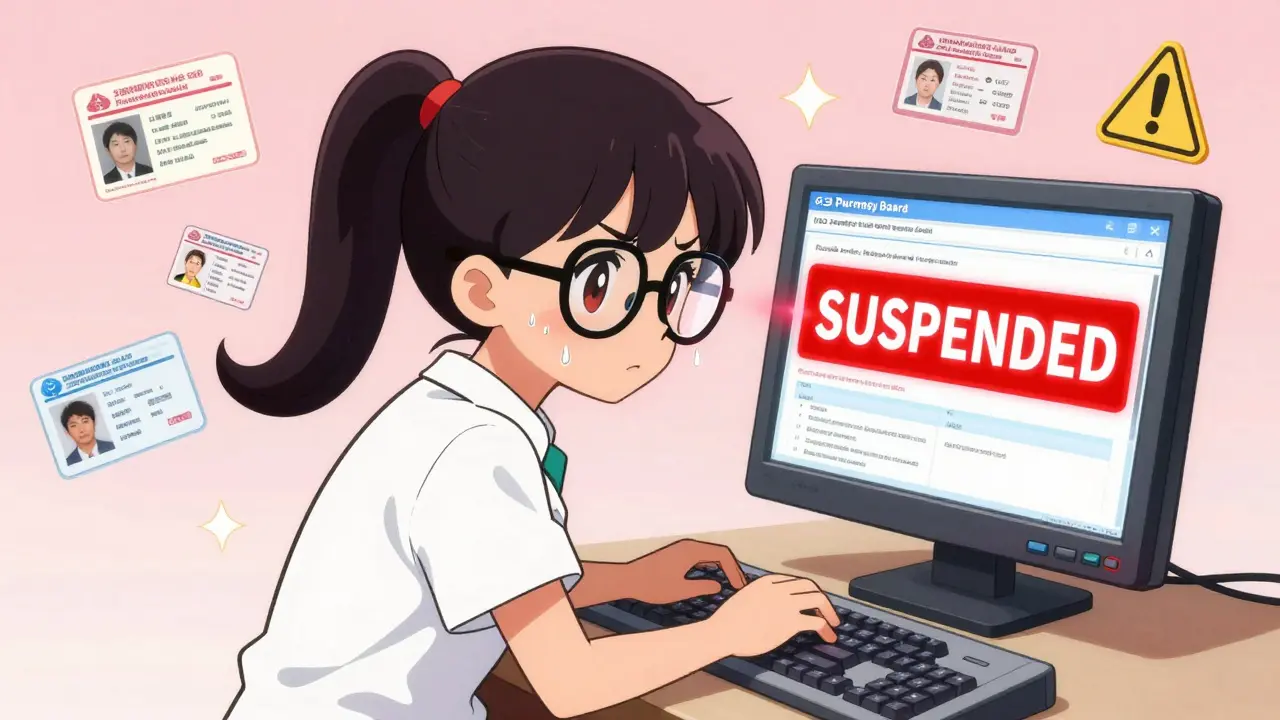
- Check the status. Valid statuses include “Active,” “Renewal Pending,” or “In Good Standing.” Red flags: “Suspended,” “Revoked,” “Expired,” or “Probation.”
Some states make this easier than others. Maryland’s system lets you search by 11 different criteria, including city and license type. D.C. requires exact matches - enter a partial name and you’ll get nothing. Always use the full legal name. Middle initials matter. Misspellings? Try variations.
Why You Can’t Rely on Third-Party Services
You might see job postings asking for “proof of license” via LinkedIn, Indeed, or even a scanned copy of a card. Don’t accept that. Those aren’t official. A 2023 survey by the American Society of Health-System Pharmacists found that 78% of hospitals now require primary source verification - meaning they check directly with the state board. Why? Because third-party sources are outdated, inaccurate, or forged.Even services like NABP Verify - while useful - aren’t replacements. NABP offers a centralized portal that tracks licenses across multiple states. It’s great for pharmacists moving between states or employers hiring across state lines. But it’s not the official record. State boards are. NABP updates once a week. State boards update daily. If someone’s license was revoked yesterday, NABP might not know yet. Your state board will.
What License Statuses Mean - And What to Watch For
License status tells you everything. Here’s what to look for:- Active - The pharmacist is legally practicing.
- Renewal Pending - Their license is still valid while they wait for renewal. Common after exam results or paperwork delays.
- Expired - They can’t legally practice. No grace period in most states.
- Suspended - Temporarily barred due to an investigation or violation.
- Revoked - Permanent loss of license. Usually for fraud, theft, or endangering patients.
- Probation - They’re still working, but under strict supervision. Red flag for employers.
- Retired - They’re done practicing. Can’t dispense meds.
- Deceased - The license is closed.
Here’s the scary part: 47% of disciplinary actions against pharmacists involve practicing with an invalid or expired license, according to NABP’s 2023 white paper. That means nearly half of the cases where someone got hurt or got the wrong drug started because no one checked the license.
Real Problems with the System
The system works - but it’s not perfect. Delays happen. Maryland’s board admitted in 2023 that it can take up to three weeks for a new license to appear online after someone passes their exam. That’s dangerous. A pharmacist might be working legally but appear “unlicensed” to employers or patients.Worse, disciplinary actions aren’t always updated in real time. A 2022 study in the Journal of the American Pharmacists Association found pharmacy boards update disciplinary records 15% slower than medical boards - averaging 14.3 days. That’s more than two weeks where a suspended pharmacist might still be working, and no one knows.
And then there’s the interface nightmare. Every state has a different website. One looks like a 2008-era HTML page. Another requires a login. Some don’t even have mobile support. Pharmacists spend an average of 22 minutes per verification attempt when juggling multiple states, according to the National Community Pharmacists Association. That’s time lost - and risk increased.
How This Connects to Counterfeit Drugs
Counterfeit drugs don’t just come from overseas. Sometimes, they come from a pharmacy with an expired license, a technician working without supervision, or a pharmacist who got suspended but kept working. The FDA estimates that 1% of all medications sold in the U.S. are counterfeit - and that’s just what’s caught. The real number is higher.When a pharmacy board fails to update a license status quickly, it creates a blind spot. A patient might get fake insulin, contaminated antibiotics, or pills with no active ingredient - all from a pharmacy that should’ve been shut down. Verifying the license isn’t just paperwork. It’s a life-saving step.
What Employers and Patients Should Do
If you’re hiring a pharmacist - don’t accept a resume, a photo of a license, or a LinkedIn profile. Go to the state board website. Do it yourself. Print the verification page. Keep it in their file.If you’re a patient - ask. Don’t be shy. “Can I see your license?” is a reasonable question. Most pharmacists will gladly show you. If they hesitate? Walk out. You have the right to know who’s handling your medication.
And if you suspect someone is practicing without a license? Report it. Every state board has a hotline or online complaint form. One report could stop a dangerous practice before someone gets hurt.
The Future: Faster, Smarter, Safer
Change is coming. Maryland’s updated system, launched in January 2023, now handles over 150,000 verifications in six months. NABP is rolling out technician verification in Q2 2024. The Interstate Pharmacy Licensure Compact (IPLC) now includes 23 states, letting pharmacists practice across borders with one license.By 2025, NABP predicts 90% of state boards will have real-time updates - meaning license changes appear within hours, not days. That’s huge. But until then, you can’t wait. You have to check. Every time.
Can I verify a pharmacy license for free?
Yes. All 56 state pharmacy boards offer free online license verification. You don’t need to pay or create an account. Some states charge a small fee (usually under $10) if you request an official letter sent by mail or fax, but the online search is always free.
What if I can’t find the license online?
Try different search terms - use the full legal name, include middle initials, or try the license number if you have it. If you still can’t find it, call the board directly. Most have a customer service line. For example, Maryland’s Board of Pharmacy can be reached at (410) 764-4755 during business hours. Don’t assume the person isn’t licensed - the system might just be delayed.
Do pharmacy technicians need to be licensed too?
Yes. Every state requires pharmacy technicians to be licensed or registered. Their credentials are listed on the same verification system as pharmacists. You can search for them by name or license number. Employers must verify tech licenses just like pharmacist licenses.
Can a pharmacist practice in multiple states?
Yes, but they need a separate license in each state - unless they’re in a state that participates in the Interstate Pharmacy Licensure Compact (IPLC). As of 2023, 23 states are part of the IPLC, which allows pharmacists to hold one license and practice in all member states. Even then, each state’s board still maintains its own records, so verification should still be done through the state where the pharmacist is practicing.
How often do state boards update license statuses?
It varies. Most boards update weekly, but some take up to 14 days. Renewals, new licenses, and disciplinary actions often have delays. If someone just passed an exam or had their license reinstated, wait a few days before assuming the system is wrong. If a license shows “Revoked” or “Suspended,” assume it’s accurate - those updates are usually immediate.
lela izzani
February 26, 2026 AT 04:17Just verified my pharmacist’s license last week after a weird experience at the pharmacy. Turned out their renewal was pending - no red flags, but I had no idea how easy it was to check. Seriously, everyone should do this. It’s free, takes 90 seconds, and could save your life. I’m telling my whole family now.
Vanessa Drummond
February 26, 2026 AT 11:08Ugh I hate when pharmacies act like they’re doing you a favor by being licensed. Like, no - you’re supposed to be. My cousin got fake blood pressure meds from a place that didn’t even have a tech on file. This post is spot on. Stop being passive. Check. It. Now.
Nick Hamby
February 27, 2026 AT 20:33There’s a deeper philosophical layer here that deserves attention: the erosion of trust in institutional authority, and the corresponding rise of individual responsibility as a safeguard. We are no longer merely patients - we are active participants in our own safety, compelled by systemic gaps. The state pharmacy board, though imperfect, remains the last legitimate arbiter of professional legitimacy. To delegate verification to third parties is to outsource moral agency. The act of checking is not bureaucratic diligence - it is an ethical ritual. One that, paradoxically, restores dignity to both provider and recipient. We must not let convenience eclipse conviction.
kirti juneja
February 28, 2026 AT 10:55As an Indian pharmacist working in the US, I can tell you - this is HUGE. Back home, licenses are a joke. Here? It’s actually enforced. I’ve seen colleagues get suspended for missing a renewal by 3 days. No mercy. But honestly? I love that. It’s not about fear - it’s about pride in the profession. If you’re doing it right, you’ve got nothing to hide. And if you’re not? The system’s got your back - by kicking you out.
Natanya Green
February 28, 2026 AT 16:31OMG I just found out my pharmacist’s license was SUSPENDED last month???!?!?!?!?!? I’ve been getting my insulin from him for THREE YEARS!!! I’m literally shaking right now. I called the board and they said it was because he sold a controlled substance to a friend. I’m filing a complaint. I need a therapist. I need a new pharmacy. I need a new life.
Steven Pam
March 1, 2026 AT 15:19Love this. Seriously. I used to think this stuff was overkill - until my mom got a batch of fake antibiotics that made her sicker than the infection. Now I check every single time. Even if I’ve been going to the same place for 10 years. You don’t get to assume. You get to verify. And honestly? It feels good to be in control. Like a superhero with a tiny, boring, spreadsheet-powered cape.
Timothy Haroutunian
March 2, 2026 AT 03:54Let’s be real - this whole system is a farce. State boards are understaffed, outdated, and slow. The fact that you have to manually search 56 different websites with inconsistent interfaces is absurd. And don’t get me started on the NABP loophole. If the system were actually functional, we wouldn’t need this guide. We’d just have one federal database. But no - bureaucracy prefers chaos. So here we are. Checking licenses like it’s 1999.
Erin Pinheiro
March 3, 2026 AT 08:45Yall are overreacting. I’ve been going to the same pharmacy for 15 years and my pharmacist is fine. You don’t need to check every time. It’s like checking if your barber has a license before you get a trim. I mean, come on. And also - I swear I saw someone say ‘renewal pending’ was okay but I think they meant expired? Idk. I’m tired. I just want my meds.
Michael FItzpatrick
March 3, 2026 AT 20:12Man, I’ve been a pharmacy tech for 12 years. I’ve seen licenses get revoked for stealing Sudafed. I’ve seen people get suspended because they didn’t update their address. I’ve seen techs working without registration because the state website was down for a week. This system? It’s broken. But it’s also the only thing standing between you and a vial of chalk powder labeled ‘insulin.’ So yeah - check it. Even if it’s annoying. Even if it’s slow. Even if the site looks like it was built in Windows 95. It matters.
Brandice Valentino
March 4, 2026 AT 02:24Look, I’m sorry, but if you’re relying on state boards, you’re already behind. Real professionals use the NABP portal. It’s centralized. It’s modern. It’s… actually kind of nice. And if you’re still going to some .gov site that uses Comic Sans? Honey, you’re doing it wrong. Also, why are you even reading this? You should be verifying your own credentials. I mean, really.
Larry Zerpa
March 5, 2026 AT 06:08Let me dismantle this. First, you claim state boards are the frontline defense - but 14.3-day delays in disciplinary updates render them irrelevant. Second, you cite a 1% counterfeit rate - but that’s FDA’s *caught* rate. The real number? Likely 5-10%. Third, you imply verification prevents counterfeit drugs - but counterfeit drugs are mostly imported, not from unlicensed local pharmacists. You’re conflating two distinct problems. This post is emotional manipulation disguised as public service. The real solution? Federal oversight. Not more checking. More control.
Gwen Vincent
March 5, 2026 AT 21:22I appreciate this. I really do. I work in a hospital and we verify every single license, every single time. It’s tedious, but it’s non-negotiable. I wish more patients knew this existed. Maybe if we normalized asking - ‘Can I see your license?’ - it wouldn’t feel so confrontational. It’s just part of the job. Like asking if your surgeon washed their hands. Simple. Necessary. Human.
Nandini Wagh
March 5, 2026 AT 23:52Wow. So we’re supposed to trust a website that might be 14 days behind? And you think that’s the answer? I’ve got news for you - the guy who gave me my flu shot last week had a revoked license. I didn’t find out until I Googled him. Turns out he was banned for stealing oxycodone. The board? Still listed him as ‘active.’ So yeah. Thanks for the checklist. It’s cute. Like bringing a flashlight to a nuclear meltdown.