
Drug Rash Assessment Tool
Drug Rash Assessment Tool
This tool helps identify potential drug-induced rashes and determines the appropriate next steps. Important: This tool is not a substitute for medical advice. Always consult a healthcare professional for proper diagnosis and treatment.
When you start a new medication, you expect it to help - not hurt. But for some people, a simple pill or injection triggers a reaction that shows up on the skin. A rash. Blisters. Itchy red patches. Swelling. These aren’t just annoyances. They can be warning signs of something serious. And many people don’t realize their skin is sending an alarm.
Medication-induced dermatitis, or drug rash, is one of the most common side effects of prescription and over-the-counter drugs. About 2-5% of all adverse drug reactions involve the skin. That means if you’re taking even a few medications, your chances of developing a skin reaction are higher than you might think. The good news? Most rashes are mild and go away within 1-2 weeks after stopping the drug. The bad news? Some can be life-threatening if ignored.
What Does a Drug Rash Look Like?
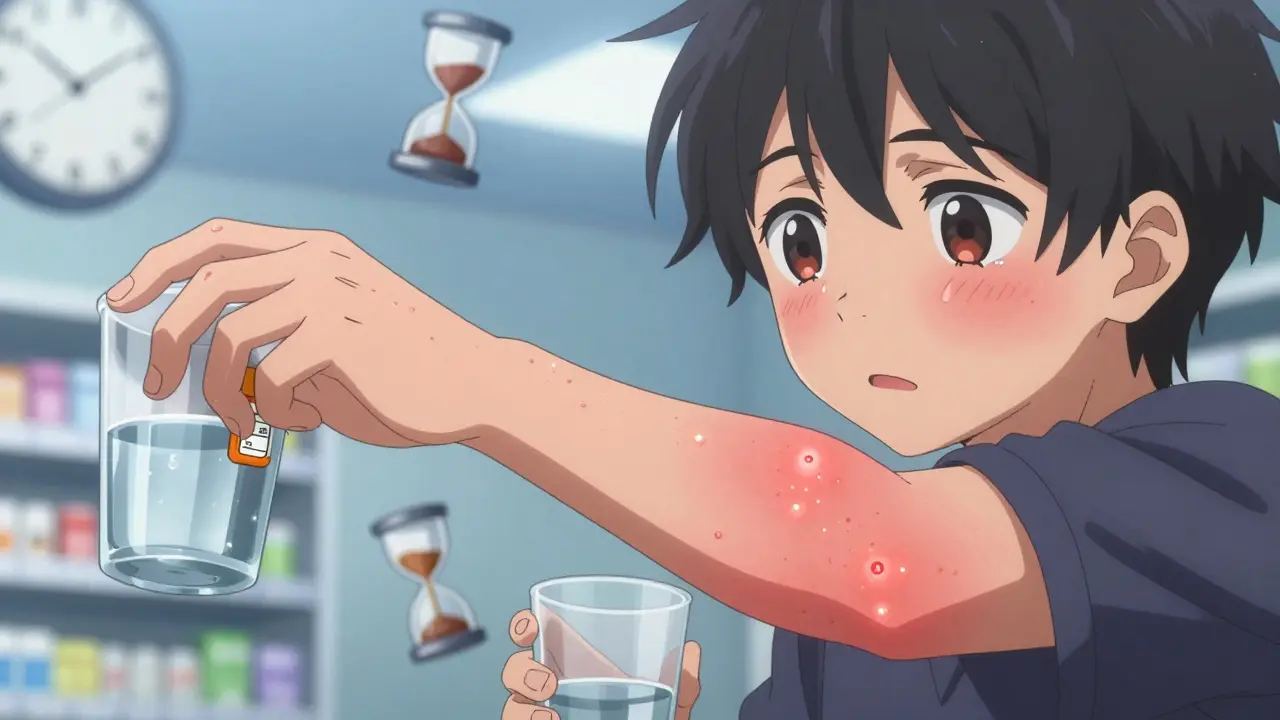
Not all drug rashes are the same. They come in different shapes, sizes, and severity levels. The most common type is a morbilliform rash - also called a measles-like rash. It shows up as small, flat, red spots or slightly raised bumps. They usually start on the chest, back, or upper arms and spread symmetrically. Itches, but rarely hurts. This type accounts for 90-95% of all drug rashes and is often caused by antibiotics like penicillin or sulfa drugs.
Another common pattern is urticaria - hives. These are raised, red, itchy welts that can appear anywhere on the body. They come and go within hours, sometimes moving from one area to another. Hives often show up within minutes to hours after taking the drug. If you get hives after taking ibuprofen or naproxen, it might not be an allergy - it could be a non-allergic reaction. About 25% of NSAID skin reactions work this way.
Then there’s nummular dermatitis. This one looks like coins - round, red, scaly patches that can be dry or weepy. It’s often mistaken for eczema. But if you’ve recently started a new medication like minocycline or vancomycin, it could be drug-induced. Unlike regular eczema, which can last years, nummular rashes from drugs usually clear up in 4-8 weeks after stopping the trigger.
The Dangerous Ones: When to Go to the ER
Most rashes are harmless. But some are medical emergencies. You need to act fast if you notice any of these:
- Widespread blistering or peeling skin - like a bad sunburn that’s falling off
- Blisters in your mouth, eyes, or genitals
- Fever over 38.5°C (101.3°F) with the rash
- Swelling of the face, lips, or tongue
- Difficulty breathing or swallowing
These are signs of severe cutaneous adverse reactions (SCARs). The most dangerous include:
- Stevens-Johnson Syndrome (SJS) - affects less than 1 in 100,000 people per year, but has a 5-15% death rate
- Toxic Epidermal Necrolysis (TEN) - more severe than SJS, with a 25-35% death rate
- DRESS syndrome - Drug Reaction with Eosinophilia and Systemic Symptoms. It doesn’t just hit the skin. It can wreck your liver, kidneys, or lungs. Onset is delayed - often 2-6 weeks after starting the drug. Common culprits: carbamazepine, phenytoin, lamotrigine, allopurinol, and sulfonamides.
- AGEP - acute generalized exanthematous pustulosis. Think tiny, non-infectious pustules covering large areas of skin. Usually linked to antibiotics like minocycline or macrolides.
These severe reactions are rare - less than 2% of all drug rashes - but they cause 90% of drug-related skin deaths. If you have any of these symptoms, go to the emergency room. Don’t wait. Don’t call your doctor tomorrow. Go now.
Why Do Some People Get Rashes and Others Don’t?
It’s not random. Genetics play a huge role. For example:
- If you’re from Southeast Asia and take carbamazepine (for epilepsy or nerve pain), you have a 1,000-fold higher risk of SJS if you carry the HLA-B*1502 gene.
- If you’re of Han Chinese descent and take allopurinol (for gout), your risk of DRESS or SJS jumps 580-fold if you have HLA-B*5801.
Doctors in places like Thailand and Taiwan now screen patients for these genes before prescribing these drugs. In New Zealand and other Western countries, testing isn’t routine - but if you’ve had a rash from one of these drugs before, your doctor should consider genetic testing.
Other risk factors:
- Multiple medications - Taking 5 or more drugs a day raises your lifetime risk of a drug rash to 35%. For someone on just one or two, it’s around 5%.
- Viral infections - If you have Epstein-Barr virus (mononucleosis) or HIV and take amoxicillin or ampicillin, your chance of a rash jumps 5-10 times.
- Immune system problems - Cancer patients on chemotherapy or those on immunosuppressants have 3-5 times higher risk.
- Age - Older adults are more likely to develop drug rashes because they take more meds and their skin and immune systems change with age.
What Medications Cause the Most Rashes?
Some drugs are far more likely to trigger skin reactions than others. Here’s the shortlist:
| Medication Class | Common Examples | Approximate Risk |
|---|---|---|
| Antibiotics | Penicillin, amoxicillin, sulfonamides | Penicillin causes 10% of all drug rashes |
| Anti-seizure drugs | Carbamazepine, phenytoin, lamotrigine | Up to 7% of drug rashes; high risk for DRESS |
| NSAIDs | Ibuprofen, naproxen, aspirin | 25% of non-allergic skin reactions |
| Allopurinol | For gout | 5% of drug rashes; high risk for DRESS/SJS |
| Diuretics | Hydrochlorothiazide | Linked to 2% of photosensitivity rashes |
| Antibiotics (topical/systemic) | Doxycycline, ciprofloxacin | Common cause of sun-related rashes |
Penicillin is the biggest offender. But here’s something surprising: 15% of people who think they’re allergic to penicillin aren’t. Years ago, they had a rash - maybe from a virus - and were told to avoid it. Now they’re stuck with broader-spectrum antibiotics that are more expensive and carry higher risks. Skin testing for penicillin allergy is now 95% accurate. If you’ve been told you’re allergic, ask your doctor about testing.
What Should You Do If You Get a Rash?
Don’t panic. But don’t ignore it either.
- Don’t stop your meds on your own - Especially if it’s something critical like an anti-seizure drug, blood pressure medicine, or insulin. Stopping suddenly can be dangerous.
- Take a photo - Skin rashes change fast. A picture helps your doctor track progress.
- Call your doctor - Describe the rash, when it started, what meds you’re on, and if you have other symptoms like fever or swelling.
- Keep a list - Write down every medication, supplement, and even over-the-counter product you’ve taken in the last 4 weeks. Sometimes the culprit isn’t the new drug - it’s something you’ve been taking for months.
- Use gentle skin care - If it’s mild, take lukewarm baths with fragrance-free cleansers. Pat dry. Apply unscented moisturizer within 3 minutes. Over-the-counter hydrocortisone 1% cream can help with itching - use it twice daily for no more than 7 days.
If it’s severe - blisters, peeling, trouble breathing - go to the ER. No hesitation.
Can You Prevent Drug Rashes?
You can’t always prevent them - but you can reduce your risk.
- Know your triggers - If you’ve had a rash from a drug before, tell every doctor you see. Keep a list. Put it in your phone.
- Minimize polypharmacy - Ask your doctor every time a new drug is added: “Is this absolutely necessary?” Sometimes, one drug can replace two.
- Watch for photosensitivity - If you’re on doxycycline, ciprofloxacin, or hydrochlorothiazide, wear sunscreen, a hat, and long sleeves. Even on cloudy days. These drugs make your skin burn easier.
- Be cautious with antibiotics during infections - If you have mono, HIV, or even a bad cold, avoid amoxicillin or ampicillin unless your doctor confirms it’s safe.
- Ask about genetic testing - If you’re of Southeast Asian or Han Chinese descent and your doctor wants to prescribe carbamazepine or allopurinol, ask if HLA screening is an option.
Most importantly - don’t assume a rash is just "allergy." It might be. But it might be something else. Only a doctor can tell.
What Happens After the Rash?
If you had a mild rash and it went away after stopping the drug, you’ll likely be fine. But you should still:
- Get your medications reviewed
- Update your medical records with the name of the drug and reaction
- Consider wearing a medical alert bracelet if you had a severe reaction
For those who had DRESS, SJS, or TEN - recovery can take months. Skin regrows slowly. Scarring is common. Some people develop chronic dry skin, sensitivity to heat, or eye problems. Follow-up with a dermatologist is essential.
And here’s the thing: if you had one severe drug reaction, you’re at higher risk for another. Avoiding future triggers is critical. Your doctor may recommend avoiding entire drug classes - not just one medication.
Can I get a drug rash from a medication I’ve taken before without problems?
Yes. Your immune system can change over time. A drug you took safely last year might trigger a rash now. This is especially true with antibiotics, anti-seizure meds, and NSAIDs. You don’t need to have had a reaction before to develop one.
Is a drug rash always an allergy?
No. Only about 10-15% of drug rashes are true allergies. Most are non-allergic reactions - either direct irritation, photosensitivity, or immune system confusion without IgE involvement. That’s why skin testing for penicillin allergy is so important - many people think they’re allergic when they’re not.
How long does it take for a drug rash to go away?
Mild rashes usually clear in 1-2 weeks after stopping the drug. Hives fade in 24-48 hours. DRESS syndrome can take 3-6 weeks to resolve and often needs steroids. Severe reactions like SJS/TEN may take months, and skin regrowth can be uneven or scarred.
Can I take the same drug again if the rash went away?
Never. Once you’ve had a drug rash, you should avoid that medication and related drugs in the same class. Re-exposure can trigger a worse reaction - even fatal. Always inform every healthcare provider about past drug rashes.
Are natural supplements safe? Can they cause rashes too?
Yes. Herbal supplements, vitamins, and even probiotics can cause skin reactions. St. John’s Wort, green tea extract, and high-dose niacin are common culprits. Many people don’t realize supplements are drugs too - and they can interact with prescriptions. Always tell your doctor what you’re taking, even if it’s "natural."
If you’ve ever been told you’re allergic to penicillin - or you’ve had a rash after any medication - your story matters. Talk to your doctor. Get tested if needed. Keep track. And remember: your skin is one of your body’s best warning systems. Listen to it.
phyllis bourassa
March 7, 2026 AT 00:23Ugh, I had a rash from amoxicillin in college and they told me I was "allergic." Turned out it was mono. Now I avoid all penicillins like the plague. But guess what? My doctor just prescribed me cephalexin for a UTI last month. I had to remind him twice. Why is this stuff not in medical records? My skin remembers. My doctors forget.
Also, can we talk about how weird it is that we’re supposed to trust pills we don’t understand but ignore our own bodies? My rash wasn’t "just an allergy." It was my skin screaming. And nobody listens until it’s too late.
Ian Kiplagat
March 8, 2026 AT 15:48Been there. Hives after ibuprofen. Thought it was stress. Took 3 days to realize it was the painkillers. Went to A&E. Wasn’t allergic. Just a weird immune glitch. Now I only take paracetamol. Simple. Safe. No drama.
PS: Always check expiry dates. Old meds = higher risk.
Amina Aminkhuslen
March 9, 2026 AT 06:18Y’all are downplaying the real villain here: polypharmacy. I’m 68, on 7 meds, and my dermatologist said last week: "Your skin is basically a war zone."
One of them? A supplement. "Natural" my ass. St. John’s Wort + blood pressure med = red, itchy, angry mess. My doctor didn’t even ask about supplements. Said he "assumed" I was too old for that nonsense.
So now I keep a spreadsheet. Medication. Date started. Rash? Yes/No. Temperature? Yes/No. Mood? 😠/😌. It’s ridiculous. But it saved me. My skin is my only body part that can’t speak. So I speak for it.
amber carrillo
March 10, 2026 AT 03:23My mother had DRESS from allopurinol. Took six months to recover. Skin peeled off her arms. She’s still sensitive to heat. Never takes new meds without a dermatology consult. We’re lucky she survived.
Don’t ignore rashes. They’re not just inconvenient. They’re data.
Tim Hnatko
March 10, 2026 AT 22:21I’m a nurse. I’ve seen too many patients wait too long. One guy ignored a rash for 10 days because he thought "it was just dry skin." He ended up in ICU with TEN. Survived. But lost 30% of his skin. And his job. And his confidence.
If you’re unsure, go to urgent care. Don’t wait for a doctor’s appointment. The clock starts ticking the second the rash appears.
Aaron Pace
March 11, 2026 AT 13:01OMG YES. I had a rash from minocycline. Thought it was acne flare-up. Then I got fever. Then my tongue turned purple. 🤢 Went to ER. They said "you’re lucky you came in." DRESS. Took 8 weeks. Steroids. Hospital. Now I avoid tetracyclines like they’re cursed.
Also - why do doctors not warn us? I read this article and I cried. I wish someone had told me this before I almost died.
😭😭😭
Joey Pearson
March 11, 2026 AT 15:15You’re not alone. I got a rash from lamotrigine after 3 weeks. No fever. No blisters. Just red dots. I stopped it myself. My psychiatrist freaked out. Said I could’ve had a seizure.
But I trusted my body. And I’m alive. So here’s my rule: if it looks weird, feels wrong, or makes you uneasy - pause. Call your doctor. Take a pic. Don’t wait for permission to protect yourself.
You’ve got this. 💪
Roland Silber
March 12, 2026 AT 16:48One thing missing from this article: the role of gut health. Emerging research shows a strong link between gut microbiome disruption and drug-induced rashes. Antibiotics wipe out good bacteria. That imbalance can trigger immune misfires.
Probiotics won’t prevent all rashes, but they might reduce severity. I’ve seen patients on long-term antibiotics who took high-dose probiotics develop far fewer skin reactions.
Also - if you’re on immunosuppressants, consider a dermatologist check-up every 6 months. Prevention > reaction.
Patrick Jackson
March 14, 2026 AT 14:22My skin is a mirror. Every drug I take? It writes a letter. Sometimes it’s a love note. Sometimes it’s a screaming manifesto.
When I got that rash from carbamazepine? I felt like my body was handing me a note: "You’re not safe here. You’re not safe here." I stopped it. I cried. I called my neurologist.
Turns out I have HLA-B*1502. I’m Thai-American. My doctor didn’t know. I had to Google it. And then I had to teach him.
Why is genetic screening not automatic? Why do we wait for someone to nearly die before we listen?
My skin didn’t fail me. The system did.
Adebayo Muhammad
March 15, 2026 AT 15:55Let’s be real: this whole "drug rash" narrative is a pharmaceutical distraction. The real issue? Overprescribing. The system is built on profit, not prevention. They don’t want you to know that 15% of "penicillin allergies" are false - because then they’d have to stop pushing expensive broad-spectrum antibiotics.
And don’t get me started on HLA testing - it’s expensive. Insurance won’t cover it. So only rich people get to live safely. That’s not medicine. That’s eugenics with a stethoscope.
Meanwhile, your skin is screaming. And they’re billing you for the scream.
Pranay Roy
March 16, 2026 AT 07:19Did you know the CDC admits that 70% of drug rash reports are never followed up? That’s not negligence - it’s intentional. The FDA and pharma lobby have quietly suppressed data on long-term skin damage from statins, antivirals, and antidepressants. I’ve seen the redacted studies. The rashes aren’t "mild." They’re chronic. They cause autoimmunity. They’re linked to lupus and scleroderma. But you won’t hear that from your doctor.
And yes - supplements? They’re worse. Because they’re unregulated. Green tea extract? It’s a liver toxin in disguise. And they call it "natural."
Wake up. Your skin is the canary. And the mine is collapsing.
phyllis bourassa
March 17, 2026 AT 20:36Wait - you all are talking about your rashes like they’re personal tragedies. But here’s the thing: I’ve been the one who *told* my doctor about the rash. And they said, "It’s probably just eczema. Use this cream."
So I did. And it got worse.
Then I Googled. Found this article. And realized I had DRESS. I went to the ER. They admitted me. I spent 12 days on IV steroids.
My doctor never apologized. Never asked me to bring in my supplement list. Never mentioned HLA testing.
So now I don’t trust doctors. I trust my skin. And this article. And you guys. Because if we don’t talk about this - who will?