
Itching that won’t quit. Red bumps that spread. Tiny bugs you can’t see but feel crawling on your skin. If you’ve ever dealt with scabies or lice, you know how frustrating and embarrassing these infestations can be. They don’t care if you’re clean, rich, or live in a fancy neighborhood-they just want to survive, and they’re better at hiding than most people realize.
Scabies and lice are two of the most common parasitic skin conditions worldwide. They’re not signs of poor hygiene. They’re not something you catch only in dirty places. They’re simple, ancient, and incredibly efficient parasites that have adapted to live on humans for thousands of years. And today, with rising resistance to old treatments and new cases popping up in schools, nursing homes, and even high-end daycares, knowing how to spot them-and how to kill them for good-is more important than ever.
What’s Actually Living on Your Skin?
Scabies isn’t caused by lice. It’s caused by a microscopic mite called Sarcoptes scabiei var. hominis. These mites burrow under your skin to lay eggs. The itching? That’s your body’s allergic reaction to their poop, eggs, and dead bodies. You won’t see the mites, but you might notice thin, wavy lines on your skin-especially between fingers, on wrists, around the waist, or on the soles of your feet. Babies and young children often get rashes on their palms and soles. Nighttime itching is the classic sign-worse because your body’s temperature rises and the mites become more active.
Lice are different. They’re visible to the naked eye if you look closely. There are three types:
- Head lice (Pediculus humanus capitis)-live on the scalp, especially behind ears and near the neck. Common in kids 3-11.
- Body lice (Pediculus humanus corporis)-live in clothing and only crawl onto skin to feed. Linked to poor access to clean laundry.
- Pubic lice (Pthirus pubis)-also called crabs. Found in coarse body hair: pubic area, armpits, beard, eyebrows.
Unlike scabies mites, lice don’t burrow. They cling to hair shafts and bite the skin to feed on blood. You’ll notice nits-tiny white or yellow eggs glued to hair strands-usually within ¼ inch of the scalp. Nits aren’t dandruff. They don’t brush off easily.
Why Standard Treatments Often Fail
Most people reach for permethrin cream or shampoo first. It’s over-the-counter, cheap, and widely available. But here’s the problem: permethrin resistance is real. In the U.S., 15-30% of head lice populations no longer respond to permethrin, according to the National Pediculosis Association’s 2022 report. Even for scabies, studies show that single applications of permethrin cure only about 70-80% of cases. Why? Because permethrin doesn’t kill the eggs.
Scabies mites lay eggs that hatch in 3-4 days. The new mites take another 10-14 days to mature and start laying eggs themselves. If you only treat once, you’re leaving behind a new generation. That’s why the CDC recommends a second application of permethrin 7 days after the first. Same goes for lice-repeat treatment after 7-10 days to catch newly hatched nymphs.
And here’s another hidden issue: improper application. In a 2022 audit from a California dermatology clinic, 12.3% of treatment failures were due to people missing key areas-finger webs, under nails, genitals, or the soles of feet. One woman treated her arms but forgot her wrists. Her husband treated his torso but skipped his groin. They both stayed infected. They kept passing it back and forth.
When Permethrin Isn’t Enough: Ivermectin to the Rescue
Oral ivermectin is a game-changer. It’s not FDA-approved for scabies in the U.S.-but doctors prescribe it off-label all the time. Why? Because it works where topical treatments fall short.
Studies show a single dose of ivermectin (200 micrograms per kilogram of body weight, taken with food) cures about 86% of scabies cases after two weeks. Add a second dose 7-14 days later? Cure rate jumps to 100%. For lice, a single dose of ivermectin (same dosage) clears 95% of head lice infestations, even in permethrin-resistant cases.
It’s especially useful for:
- People who can’t apply cream all over their body-elderly, disabled, or those with severe skin conditions
- Outbreaks in nursing homes or schools where treating everyone with cream is impractical
- Crusted (Norwegian) scabies, where thousands of mites infest the skin. Here, doctors combine ivermectin with permethrin for maximum effect.
Side effects? Mild. Some people report nausea, dizziness, or headache. But in a 2021 Medscape survey, only 8.3% of users had gastrointestinal issues. The real risk? Ivermectin hasn’t been studied in children under 15 kg or pregnant women. So, use with caution and only under medical supervision.
What About Newer Options Like Spinosad?
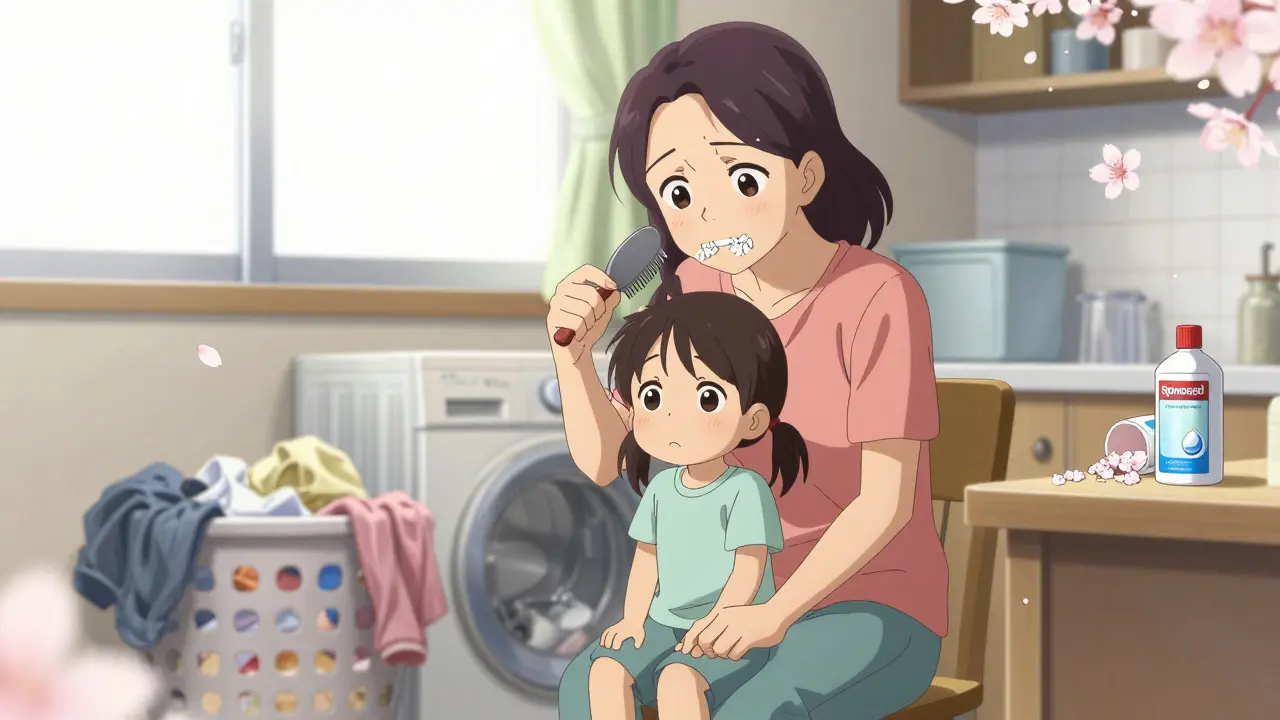
Spinosad (0.9% liquid) was approved by the FDA in 2019 specifically for scabies in kids as young as 4. It’s also approved for head lice. Unlike permethrin, spinosad kills both adult lice and eggs in a single application. That’s huge. No need to repeat treatment in most cases.
It’s pricier than permethrin-about $70-$100 per bottle-but for parents tired of combing through hair for days or applying messy cream to their kids’ entire bodies, it’s worth considering. One 2023 study found spinosad cured 95% of head lice cases after one use, compared to 75% for permethrin.
It’s also less irritating than permethrin. In a RealSelf survey, 18% of users reported burning or stinging with permethrin. Spinosad users rarely reported discomfort.
How to Actually Eradicate the Infestation
Treating the person isn’t enough. You have to break the cycle. Here’s what works:
- Treat everyone at the same time. All household members, close contacts, and sexual partners-even if they have no symptoms. Scabies can spread before itching starts.
- Wash everything in hot water. Bedding, towels, clothes worn in the last 3 days. Use water at least 50°C (122°F) and dry on high heat. Items you can’t wash? Seal them in plastic bags for 72 hours. Mites die without human contact after 2-3 days.
- Don’t share combs, hats, or pillows. Lice can’t swim, but they can crawl from one head to another on shared items.
- For body lice, focus on clothing. Wash and change clothes daily until the infestation is gone. Body lice live in seams and folds.
- For pubic lice, shave or trim affected areas. This helps, but isn’t required. Treatment with permethrin or spinosad is still essential.
And here’s a tip most people miss: vacuum furniture, car seats, and mattresses. It won’t kill mites, but it removes skin flakes and hair that might carry eggs. Don’t bother with fumigants or sprays-they’re ineffective and toxic.

When to See a Doctor
You don’t need to run to the doctor for every case of lice. But you should if:
- After two rounds of OTC treatment, the itching or nits are still there
- You have crusted scabies-thick, scaly patches covering large areas of skin
- You’re pregnant, breastfeeding, or treating a child under 2
- Signs of infection appear: pus, swelling, red streaks
Doctors can prescribe stronger treatments like topical ivermectin (1%), which matches permethrin’s effectiveness. Or they can guide you on the right dose of oral ivermectin. Don’t self-prescribe. Dosing matters. Too little won’t work. Too much can be dangerous.
Global Efforts and What’s Next
Scabies affects 204 million people worldwide each year, according to the WHO. In places like the Solomon Islands, health workers give out ivermectin and azithromycin together-treating scabies and trachoma at the same time. In one program, they treated over 26,000 people. Scabies cases dropped by 95%.
Researchers are now testing new drugs that actually kill mite eggs. Three compounds are in Phase II trials as of late 2023. The goal? One-dose cures. No repeat applications. No messy creams. Just a pill or a single application that ends it.
For now, though, the best tools we have are permethrin, ivermectin, and spinosad. The key isn’t finding the magic bullet-it’s using the right one, the right way, with the right timing.
Common Mistakes and How to Avoid Them
- Mistake: Treating only the person with symptoms. Solution: Treat everyone in the household at once.
- Mistake: Washing clothes but not drying them on high heat. Solution: Heat kills mites and lice. Dry for at least 20 minutes on high.
- Mistake: Using lice shampoo once and calling it done. Solution: Repeat after 7-10 days. Eggs hatch later.
- Mistake: Believing scabies is a hygiene issue. Solution: It’s contagious. Cleanliness doesn’t prevent it. Speed and accuracy do.
- Mistake: Ignoring the itching after treatment. Solution: Itching can last weeks after the mites are dead. That doesn’t mean it’s still active.
If you’ve tried everything and it’s still not gone, you might be dealing with re-infestation-not treatment failure. Go back to the start. Check your contacts. Re-clean your environment. Be ruthless. These parasites are stubborn. But they’re not unbeatable.
Can you get scabies from a toilet seat?
It’s extremely unlikely. Scabies mites can’t survive long away from human skin-usually less than 48 hours. They need direct skin-to-skin contact to spread. Sitting on a toilet seat won’t give you scabies unless someone with crusted scabies just sat there and left behind thick layers of infected skin. Even then, the risk is low.
How long does it take for lice to go away after treatment?
If you use a treatment that kills both adults and eggs-like spinosad-you’ll see results in 1-2 days. For permethrin or ivermectin, adult lice die within 24 hours. But you need to wait 7-10 days to make sure no new lice hatch from eggs. You may still see nits (empty egg shells) for weeks. That’s normal. They’re not alive. Just stick to the timeline.
Is ivermectin safe for kids?
Oral ivermectin is not approved for children under 15 kg (about 33 pounds) or under 5 years old in the U.S. Topical permethrin or spinosad are safer first choices for young kids. But in cases of severe or resistant scabies, doctors may prescribe it off-label for older children based on weight. Always follow medical advice.
Can you get lice from pets?
No. Human lice can’t live on dogs, cats, or other animals. They’re species-specific. If your pet has fleas or ticks, that’s a different problem. But you can’t catch head lice from your dog. Same goes for scabies-animal mites might cause temporary itching if they bite you, but they won’t burrow or reproduce on human skin.
Why does the itching last so long after treatment?
The mites and lice are dead, but your immune system is still reacting to their remains-eggs, feces, body parts. That allergic response can last weeks. Use soothing creams like calamine or hydrocortisone (after confirming the infestation is gone) to ease itching. Antihistamines like cetirizine can help too. Don’t assume the treatment failed just because you’re still itchy.
Scabies and lice aren’t going away anytime soon. But with better tools, smarter treatment plans, and awareness, they’re no longer the nightmare they used to be. The key isn’t panic-it’s precision. Treat everyone. Treat correctly. Treat twice. And don’t let shame stop you from asking for help.
Erwin Kodiat
January 17, 2026 AT 20:47Man, I thought I was the only one who thought permethrin was a joke after the third time it didn’t work. I used spinosad on my kid last year-single application, no combing, no drama. Game changer. My wife still makes fun of me for buying the $80 bottle, but now I just shrug and say, 'Worth every penny.'
Jacob Hill
January 19, 2026 AT 07:52Just to clarify: permethrin resistance is real, yes-but it’s not universal. In rural Maine, we still see 90%+ efficacy with proper application. The real issue? People apply it like they’re putting on sunscreen-thin and uneven. You need to cover every inch. Every. Inch.
Lewis Yeaple
January 21, 2026 AT 06:52While the article provides a reasonably comprehensive overview of scabies and lice management, it fails to adequately address the epidemiological implications of off-label ivermectin use in pediatric populations. The FDA’s lack of formal approval is not merely bureaucratic-it reflects insufficient longitudinal safety data in children under 15 kg. The cited 2021 Medscape survey, while suggestive, lacks control groups and is subject to recall bias. One must exercise caution.
Jake Rudin
January 22, 2026 AT 06:22It’s funny how we treat parasites like villains in a movie-like if we just apply enough chemicals, we can ‘win’-but they’ve been here longer than us. They don’t hate us. They don’t even know we exist. We’re just… warm meat with a pulse. And we’re the ones who feel guilty? The real parasite is our arrogance. We think we can outsmart evolution with a cream. But maybe the real cure is humility. And maybe, just maybe, we should stop treating our skin like a battlefield and start treating it like a home.
Lydia H.
January 24, 2026 AT 04:38I used to be so ashamed when my daughter got lice. Like I’d failed as a mom. Then I found out half her class had it-and half the parents didn’t even know what nits were. Now I just hand out spinosad bottles at PTA meetings. No judgment. Just help. We’re all just trying not to scratch our eyes out.
Astha Jain
January 26, 2026 AT 04:17OMG I just read this and my mind is blown. I thought lice was like… dirt? Like if you don’t wash your hair? Turns out I was a total noob. Also ivermectin? Is that the horse dewormer? I thought that was for cows?? 😅
Josh Kenna
January 27, 2026 AT 15:55My cousin’s kid got scabies from a daycare that didn’t even tell the parents. I’m not mad-I’m just disappointed. Why are we still letting these places get away with this? Someone’s gotta get sued. And why isn’t this on the news? It’s not just some ‘gross thing’-it’s a public health failure. Wake up, America.
Valerie DeLoach
January 29, 2026 AT 10:28For anyone reading this and feeling guilty: you are not responsible for a parasite choosing to live on you. It’s not a moral failing. It’s biology. And if you’ve been through this, you’re already stronger than you think. Treat yourself kindly. Wash the sheets. Use the right medicine. And don’t let anyone make you feel dirty for something that’s been around since the pyramids.
Christi Steinbeck
January 31, 2026 AT 02:11STOP WAITING. If someone in your house has it-treat everyone the same day. No excuses. No ‘I’ll do it tomorrow.’ Do it now. I waited three days because I was ‘too tired.’ Guess what? I gave it to my whole family. Don’t be me. Be smart. Be fast. Be ruthless. You’ll thank yourself.
Jackson Doughart
January 31, 2026 AT 21:18It’s worth noting that the 72-hour isolation method for unwashable items is based on mite survival data under controlled laboratory conditions. Real-world environments-especially humid ones-may extend viability. In coastal regions, I recommend extending the quarantine period to 96 hours. Also, vacuuming is not useless; it removes keratin debris that may harbor viable eggs. The key is consistency, not perfection.
Malikah Rajap
February 1, 2026 AT 23:37Okay but… what if it’s not lice or scabies? What if it’s… I don’t know… a curse? My aunt said her neighbor got it after touching a mirror that someone died in front of. And she swears it didn’t go away until they burned the mirror. I mean… what if we’re missing something? Like… the spiritual angle? 😶
sujit paul
February 2, 2026 AT 16:15Let me tell you something. The government doesn’t want you to know this-but ivermectin was banned because Big Pharma doesn’t make money from it. It’s cheap. It’s old. It’s from a fungus. They want you buying permethrin every month. Look at the WHO reports-they’re pushing ivermectin in Africa. Why? Because they know the truth. Wake up.
Tracy Howard
February 4, 2026 AT 01:19Canada has been using spinosad in public schools since 2020. We don’t have this chaos. Why? Because we have leadership. You Americans treat health like a TikTok trend. ‘Oh, I’ll just scrub with tea tree oil.’ No. We have protocols. We have science. We have dignity. Stop treating your kids like lab rats.
Aman Kumar
February 4, 2026 AT 15:48As a clinical microbiologist with 17 years in parasitology, I must emphasize that the rise in treatment failure is not merely due to resistance-it’s a systemic collapse of public health infrastructure. The commodification of healthcare has led to OTC self-diagnosis, misapplication, and the erosion of physician-guided protocols. The proliferation of misinformation on social media has exacerbated this. This is not a medical issue-it is a sociopolitical one. The mites are merely the symptom.
Phil Hillson
February 4, 2026 AT 22:57So basically… we spent 2000 words telling us to use medicine and wash clothes? Bro. I thought this was gonna be wild. Where’s the drama? Where’s the scandal? Where’s the ‘lice are a government mind control tool’ angle? I’m disappointed. This is just… boring.