
When you think of psoriasis, you probably picture red, flaky patches on your elbows, knees, or scalp. But for about 1 in 3 people with psoriasis, the problem doesn’t stop at the skin. Their joints start hurting-stiff, swollen, sometimes so badly they can’t hold a coffee cup or walk up stairs. This isn’t just bad luck. It’s psoriatic arthritis, a hidden consequence of an immune system gone rogue.
It Starts With the Skin, But It Doesn’t Stay There
Psoriatic arthritis doesn’t appear out of nowhere. It’s tied to psoriasis, a condition where the immune system attacks skin cells, causing them to multiply too fast. That’s what creates those thick, scaly plaques. But in some people, the same immune fire spreads to the joints. The body starts attacking the lining of the joints, tendons, and even where tendons attach to bone. That’s when pain, swelling, and stiffness show up-not as a side effect, but as a direct result of the same disease process. Most people with psoriatic arthritis have had skin psoriasis for 5 to 10 years before joint symptoms show up. But here’s the twist: in about 15% of cases, the joints hurt first. That’s when things get tricky. Doctors might treat the joint pain as rheumatoid arthritis or osteoarthritis-and miss the real cause. If you’ve got unexplained joint pain and later notice pitted nails or flaky skin, that’s a red flag.It’s Not Just One Type of Joint Pain
Psoriatic arthritis doesn’t look the same in everyone. It comes in five main patterns, and knowing which one you have helps guide treatment. The most common is asymmetric oligoarthritis. That means just a few joints on one side of the body hurt-say, your right knee and left wrist. It’s not symmetrical like rheumatoid arthritis, which usually hits both sides equally. This asymmetry is a key clue doctors use to tell them apart. Then there’s symmetric polyarthritis. It looks a lot like rheumatoid arthritis-same joints on both sides, swelling in hands and feet. But here’s the difference: rheumatoid arthritis often shows up with a positive rheumatoid factor blood test. Psoriatic arthritis? That test is almost always negative. And while RA can destroy cartilage, PsA often causes new bone growth around tendons, a sign called ‘whiskering’ visible on X-rays. Distal interphalangeal predominant (DIP) arthritis targets the joints closest to your fingernails. If you’ve got pitting in your nails and pain right at the tips of your fingers, this could be it. This pattern is rare in other types of arthritis, making it a strong indicator of psoriatic arthritis. Spondylarthritis affects the spine and lower back. It causes stiffness that’s worse in the morning or after sitting still. Unlike regular back pain from lifting heavy stuff, this gets better with movement. It’s often mistaken for a herniated disc or general aging. And then there’s arthritis mutilans-the rarest and most severe form. Less than 5% of people with PsA get this. It eats away at bone in the hands and feet, causing fingers to shorten and look like an opera glass. It’s devastating, but early treatment can stop it from happening.Signs You Might Not Notice-Until It’s Too Late
Joint pain is the obvious symptom. But there are quieter signals that often get ignored. Dactylitis-also called ‘sausage digits’-is when an entire finger or toe swells up like a sausage. It’s not just the joint. It’s the whole digit, because both the joint and the tendons around it are inflamed. About half of people with PsA get this. It’s unmistakable once you’ve seen it. Enthesitis is another hidden sign. That’s inflammation where tendons or ligaments attach to bone. Common spots? The back of your heel (Achilles tendon) or the bottom of your foot (plantar fascia). People think it’s plantar fasciitis or a sports injury. But if you’ve got psoriasis and your heel hurts without any recent trauma, it could be PsA. Nail changes are huge. Eight out of 10 people with PsA have nail problems: pitting, lifting (onycholysis), thickening, or discoloration. In fact, if you have nail psoriasis and joint pain, the chance you have psoriatic arthritis jumps to 89%. That’s why dermatologists and rheumatologists need to talk to each other.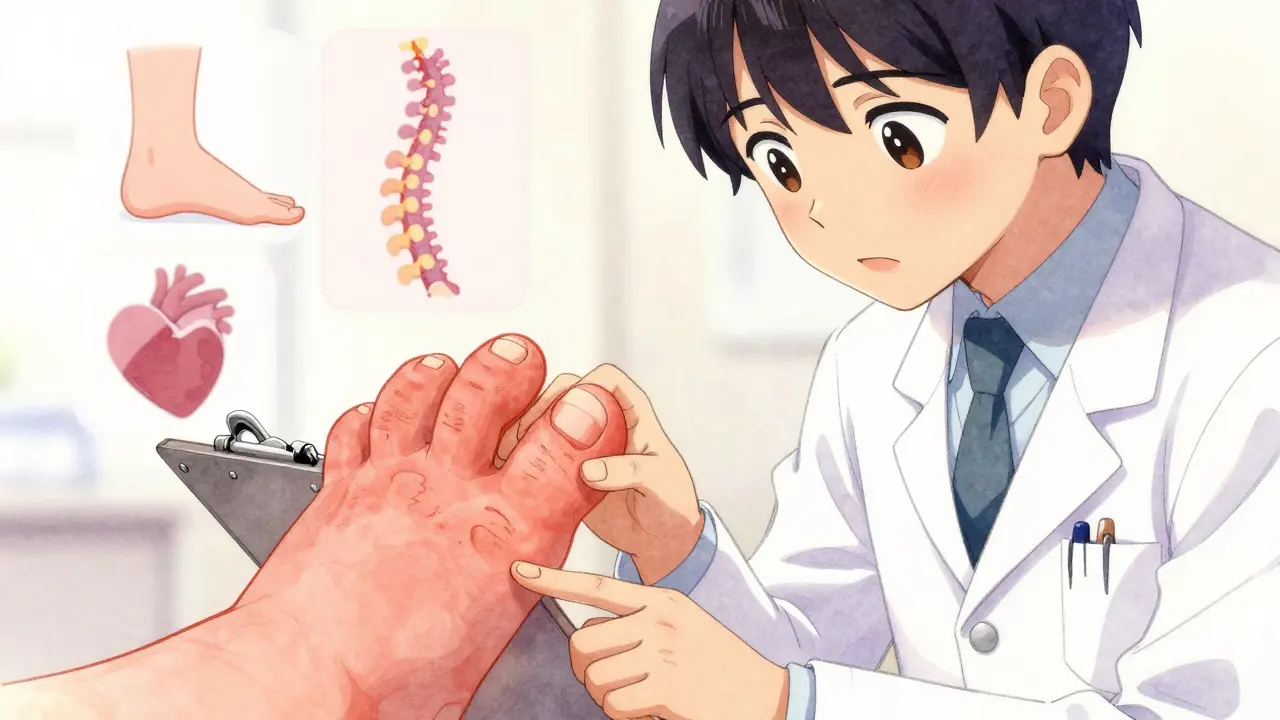
Why Diagnosis Takes So Long-and Why That’s Dangerous
The average person with psoriatic arthritis waits 2 to 5 years for a correct diagnosis. Nearly half visit three or more doctors before getting it right. Why? Because the symptoms don’t fit neatly into one box. Your GP sees joint pain and refers you to an orthopedist. Your orthopedist sees swelling and thinks osteoarthritis. Your rheumatologist sees skin patches but doesn’t connect them to your joints. The problem? Every month you wait increases your risk of permanent joint damage. A 2022 study found that people diagnosed after 12 months had over three times more joint destruction five years later than those diagnosed within six months. Once bone erosion happens, you can’t undo it. That’s why early detection isn’t just helpful-it’s critical.What Triggers Flares-and How to Spot Them Early
Psoriatic arthritis doesn’t stay quiet. It flares up. And most people know what sets them off. Stress? Cited by 85% of patients. Infections? 63%. Cold weather? 57%. Even minor things like a sore throat or a bad night’s sleep can trigger a flare. That’s because your immune system is already on edge. Add a trigger, and it goes into overdrive. Obesity is another major player. If your BMI is over 30, your risk of developing PsA more than doubles. Fat tissue isn’t just storage-it’s active. It releases inflammatory chemicals that fuel joint damage. Losing weight doesn’t cure PsA, but it makes treatments work better and reduces flare frequency. Prior joint injuries also matter. If you twisted your ankle badly and later developed PsA in that same ankle, you’re not alone. Trauma can activate the disease in a specific joint. That’s why doctors check for past injuries when evaluating joint pain in people with psoriasis.Treatment Has Changed-And It’s Better Than Ever
Ten years ago, treatment for psoriatic arthritis was limited. You’d take methotrexate, maybe a steroid shot, and hope for the best. Today, we have targeted therapies that stop the immune system’s attack at its source. TNF inhibitors (like adalimumab or etanercept) were the first big breakthrough. They reduce inflammation and slow joint damage. About 65% of patients reach minimal disease activity within six months on these drugs. Now, newer options like IL-17 and IL-23 inhibitors (secukinumab, guselkumab) are changing the game. A 2023 trial showed guselkumab helped 64% of patients achieve a 50% improvement in symptoms in just 24 weeks. These drugs also clear skin psoriasis faster and more completely than older options. But here’s the catch: about 30% of people don’t respond to their first biologic. That’s why treatment is personal. It’s not one-size-fits-all. Doctors now use a ‘treat-to-target’ approach: set a goal (like no swelling, no pain, normal blood markers), check progress every 3-6 months, and switch if you’re not hitting it.
It’s Not Just Your Joints-Your Whole Body Is at Risk
Psoriatic arthritis isn’t just a joint disease. It’s a systemic condition. That means inflammation doesn’t stop at your knees or spine. About 1 in 10 people with PsA get uveitis-an eye inflammation that can cause redness, pain, and blurred vision. Left untreated, it can lead to permanent vision loss. Inflammatory bowel disease (IBD) is also more common. About 5-10% of PsA patients have Crohn’s or ulcerative colitis. If you’ve got joint pain and persistent diarrhea or abdominal cramps, don’t brush it off. And here’s something most people don’t know: people with PsA have a 2.1 times higher risk of heart attack or stroke. Why? Chronic inflammation damages blood vessels over time. That’s why managing PsA isn’t just about stopping joint pain-it’s about protecting your heart, too.What You Can Do Right Now
If you have psoriasis and notice any of these: stiff joints in the morning, swollen fingers, heel pain without injury, or nail changes-don’t wait. See a rheumatologist. Bring photos of your skin and a list of your symptoms. Mention any family history of psoriasis or arthritis. If you’ve already been diagnosed, track your flares. Note what triggers them. Keep a journal of pain levels, fatigue, and sleep. This helps your doctor adjust your treatment faster. Exercise matters-not just for weight loss, but to keep joints mobile. Swimming, cycling, yoga-low-impact activities reduce stiffness without stressing your joints. Strength training helps support damaged joints. And don’t underestimate sleep. Poor sleep fuels inflammation. Finally, work with both a dermatologist and a rheumatologist. Studies show that when these two specialists coordinate care, outcomes improve by 50%. One doctor can’t see the whole picture. You need both.There’s Hope-But Only If You Act
Psoriatic arthritis isn’t a death sentence. It’s a chronic condition, yes. But with the right treatment, most people live full, active lives. The key is catching it early and staying on top of it. The science is moving fast. By 2027, doctors may use genetic and protein markers to predict which drug will work best for you-before you even start treatment. That’s the future. But you don’t have to wait for it. The tools to stop joint damage are here now. Don’t ignore your body. If your skin is sending a signal, your joints might be listening. Listen back.Can psoriatic arthritis be cured?
No, there is no cure for psoriatic arthritis yet. But with early diagnosis and the right treatment, most people can achieve remission-meaning no active inflammation, no joint damage progression, and minimal symptoms. The goal isn’t to eliminate the disease, but to control it so it doesn’t control your life.
Is psoriatic arthritis the same as rheumatoid arthritis?
No. While both cause joint swelling and pain, they’re different diseases. Rheumatoid arthritis is symmetrical (affects both sides equally), often positive for rheumatoid factor, and rarely involves the spine or nails. Psoriatic arthritis is often asymmetric, has negative rheumatoid factor, commonly affects the spine and nails, and can cause unique bone changes like new bone growth around tendons. The treatments overlap, but the underlying causes are different.
Do I need an X-ray or MRI to diagnose psoriatic arthritis?
Yes, imaging is essential. Blood tests alone can’t confirm it. X-rays can show bone erosion or new bone growth-key signs of PsA. MRIs are even more sensitive and can detect inflammation in tendons and joints before damage appears on X-rays. Ultrasound is also used to spot early enthesitis or dactylitis. These tools help rule out other conditions and confirm the diagnosis.
Can stress cause psoriatic arthritis?
Stress doesn’t cause psoriatic arthritis, but it’s one of the most common triggers for flares. When you’re under stress, your body releases chemicals that can activate your immune system. If you already have the genetic risk for PsA, that activation can push the disease into motion. Managing stress through sleep, exercise, or therapy doesn’t cure PsA, but it helps keep it quiet.
Will I end up in a wheelchair?
Not if you get treated early. Severe joint damage, like the rare ‘opera glass hand’ deformity, happens only in a small percentage of people who go years without treatment. Modern medications can stop joint destruction before it starts. Most people with PsA who start treatment within six months of symptoms maintain full mobility and function. The key is not waiting.
Can I still exercise with psoriatic arthritis?
Yes-and you should. Movement keeps joints flexible and muscles strong, which supports damaged joints. Low-impact activities like swimming, walking, cycling, and yoga are ideal. Avoid high-impact sports during flares. During remission, strength training helps prevent muscle loss and reduces joint stress. Always warm up first, and stop if you feel sharp pain. Gentle movement is medicine.
Michael Marchio
January 10, 2026 AT 09:43Look, I’ve seen this play out in my own family-my uncle had psoriasis for 12 years, then one day his knuckles swelled up like overinflated grapes. Doctor thought it was gout. Then a rheumatologist looked at his nails and said, ‘That’s PsA.’ The nail pitting was the giveaway. Most docs don’t even ask about skin when joints hurt. They’re trained to compartmentalize. But the body doesn’t work that way. It’s one system, one fire. If you’re ignoring the skin, you’re ignoring the root.
And don’t get me started on the ‘it’s just aging’ excuse. My uncle was 52. He wasn’t old. He was misdiagnosed. By the time they caught it, he’d lost cartilage in two fingers. Now he’s on guselkumab and can hold a wrench again. Early detection isn’t optional. It’s the difference between living and surviving.
Also, obesity isn’t just a risk factor-it’s a silent accomplice. Fat tissue isn’t inert. It’s a factory of cytokines. If you’re carrying extra weight and have psoriasis, you’re basically lighting a match next to a gas tank. Lose the weight, and you’re not just helping your knees-you’re lowering the entire inflammatory burden. Simple math.
And yes, stress triggers flares. But calling it ‘stress’ is lazy. It’s immune dysregulation triggered by cortisol spikes. You can’t just ‘relax your way out of it.’ You need structure: sleep hygiene, movement, maybe even therapy. This isn’t a lifestyle blog. It’s immunology.
Bottom line: if you’ve got psoriasis and one joint that doesn’t feel right, see a rheumatologist. Not your PCP. Not your ortho. A rheum. And bring pictures. Don’t assume they’ll connect the dots. They won’t.
Mario Bros
January 11, 2026 AT 13:03Bro, I had this for 3 years before I got diagnosed. My knuckles looked like sausages. Thought it was carpal tunnel. Went to the gym, lifted heavier, thought ‘I just need to get stronger.’
Turns out I was wrecking my joints. Now I do yoga, swim, and take my biologic like clockwork. No more ‘I’ll just tough it out.’ Your body talks. Listen.
Also, my dermatologist and rheum talk to each other now. Magic.
💪❤️
McCarthy Halverson
January 12, 2026 AT 15:34Got it. Skin first. Joints second. Nail pitting = red flag. Weight matters. Biologics work. See rheum. Early is key.
Done.
Lisa Cozad
January 13, 2026 AT 11:22I’m a nurse and I’ve seen so many patients dismissed because their joint pain ‘doesn’t fit’ the textbook. One woman came in with heel pain and pitted nails-her PCP told her to stretch more. She waited two years. By then, she had dactylitis in three fingers. She’s on secukinumab now and says she feels like herself again. But she almost lost her job because she couldn’t hold a pen.
Doctors need to stop thinking in silos. PsA isn’t just ‘arthritis with a skin rash.’ It’s a systemic fire. And we need to treat it like one.
Also, I tell my patients: take photos of your skin every month. You won’t believe how much changes in 60 days.
Saumya Roy Chaudhuri
January 15, 2026 AT 11:18Oh please. You think this is new? I’ve been living with this since 2011. My dermatologist didn’t even mention PsA until I brought it up. And now? Every time I go to a conference, some ‘expert’ acts like they just discovered enthesitis. It’s been documented since the 1940s. Why do we still act like it’s a mystery?
Also, ‘treat-to-target’ sounds fancy but in practice? Insurance denies biologics for 9 months. So you sit there, in pain, while bureaucrats decide if your joints are ‘bad enough.’
And yes, I’ve lost two fingers to arthritis mutilans. You think I’m here to ‘inspire’ you? No. I’m here to say: don’t wait for a miracle. Fight. Now.
Jay Amparo
January 16, 2026 AT 22:06I’m from India and I’ve seen this too-people ignore skin because ‘it’s just psoriasis,’ then come to the hospital with crippled hands. One patient, a schoolteacher, couldn’t write her students’ names. Her nails were pitted, her heels burned. She thought it was ‘dust allergy.’
We got her on a biologic within 3 months. Now she’s back in class. The key? Connecting the dots. Dermatologists and rheumatologists need to talk-no matter the country.
And yes, stress and weight matter. But so does access. Not everyone can afford guselkumab. We need global awareness, not just American protocols.
Let’s not make this a luxury disease.
Christine Milne
January 17, 2026 AT 00:40Let me be perfectly clear: this entire narrative is dangerously oversimplified. The notion that psoriatic arthritis is a ‘direct result’ of the same immune process as cutaneous psoriasis is not universally accepted in the literature. There are distinct immunological pathways, and the notion of a ‘single fire’ is a reductive metaphor popularized by pharmaceutical marketing.
Furthermore, the claim that 89% of patients with nail psoriasis and joint pain have PsA is statistically misleading. The specificity of nail changes is high, but the sensitivity is not. Many patients with psoriasis develop nail dystrophy without systemic involvement. To conflate correlation with causation is irresponsible.
And the assertion that ‘early diagnosis prevents joint damage’-while intuitively appealing-is not supported by longitudinal data across all subtypes. Arthritis mutilans, for instance, is exceedingly rare and often progresses rapidly regardless of intervention. The 2022 study cited? Retrospective. Confounded. Underpowered.
It is not the duty of the patient to ‘connect the dots’-it is the duty of the physician to be trained in the differential diagnosis of inflammatory arthropathies. To place the burden on the layperson is a failure of medical education, not a call to action.
And as for ‘treat-to-target’-this is a construct born of managed care, not clinical science. The goal is not ‘no swelling.’ The goal is functional preservation. And that requires individualized, not protocolized, care.
Do not mistake advocacy for evidence.
Dwayne Dickson
January 17, 2026 AT 16:16Christine, your comment is a textbook example of why medicine has become so detached from humanity. You’ve dissected every sentence with academic precision, but you’ve missed the entire point.
This isn’t a journal club. This is a person’s life. A mother who can’t hug her child because her fingers lock. A mechanic who can’t turn a wrench. A teacher who can’t hold a pen.
You’re right-the science is complex. But the suffering is not. The patient doesn’t need a lecture on immunological heterogeneity. They need a doctor who listens. Who asks, ‘Do you have skin lesions?’ Who checks their nails.
And yes, biologics are expensive. But so is disability. So is lost wages. So is depression. So is a 2.1x higher risk of heart attack. The cost of inaction is far greater than the cost of treatment.
It’s not about ‘pharma marketing.’ It’s about recognizing that the body doesn’t care about your citations. It only cares if you’re in pain.
And if you’re still arguing semantics while someone’s joints are crumbling? Then you’re part of the problem.
Faith Edwards
January 18, 2026 AT 07:22How profoundly tragic that we’ve reduced a complex, systemic autoimmune disorder to a checklist of symptoms and a pharmaceutical sales pitch. The very language used here-‘fire,’ ‘trigger,’ ‘silent accomplice’-is alarmist, almost evangelical. It’s not medicine. It’s fearmongering dressed in scientific jargon.
And yet, the most damning detail? No one mentions the gut. The microbiome. The role of dietary emulsifiers, glyphosate, or even the overuse of antibiotics in childhood. These are not fringe theories. They are peer-reviewed. But you’d never know it from this piece.
Meanwhile, the ‘treat-to-target’ mantra ignores the fact that biologics suppress immunity. And immunity isn’t a switch. It’s a symphony. Suppress one cytokine, and another rises. That’s why 30% don’t respond. That’s why some develop lupus-like syndromes. That’s why we’re seeing more cases of tuberculosis and fungal infections in patients on these drugs.
And yet, we’re told to ‘take it like clockwork.’ No nuance. No caution. No acknowledgment that the body is not a machine to be fixed, but a living system to be understood.
This isn’t hope. It’s pharmaceutical hegemony wrapped in a bow of ‘early detection.’
Bradford Beardall
January 19, 2026 AT 12:57My brother’s a rheumatologist in Boston. He told me something I’ll never forget: ‘The most dangerous word in medicine is ‘probably.’ If a patient has psoriasis and joint pain, it’s not ‘probably’ PsA. It’s ‘until proven otherwise.’
And if your doctor says ‘wait and see’? That’s not cautious. That’s negligent.
Bring photos. Track symptoms. Ask for an MRI if it’s not clear. Don’t let anyone tell you it’s ‘just aging’ or ‘overuse.’
And if you’re reading this and you’ve got psoriasis? Look at your nails. Right now.
They might be whispering something your joints already screamed.