
GI Bleeding Risk Calculator
This tool helps determine if you should take a proton pump inhibitor (PPI) to reduce gastrointestinal bleeding risk when on antiplatelet therapy. Based on guidelines from the European Society of Cardiology and other evidence-based sources.
Your risk assessment will appear here based on your inputs.
When you're on dual antiplatelet therapy - usually aspirin plus clopidogrel, prasugrel, or ticagrelor - your blood doesn't clot as easily. That’s good for preventing heart attacks and strokes. But it also means your stomach lining is more vulnerable. Every year, thousands of people on these medications suffer serious gastrointestinal (GI) bleeding. The good news? Adding a proton pump inhibitor (PPI) can cut that risk by nearly a third. The bad news? Many doctors still don’t prescribe them the right way - or prescribe them when they’re not needed.
Why Antiplatelets Put Your Stomach at Risk
Aspirin and other antiplatelet drugs work by stopping platelets from sticking together. That’s how they prevent clots in arteries. But platelets also help repair tiny tears in your stomach lining. When you block them, your stomach becomes more sensitive to acid. Even normal stomach acid can start eating away at the tissue. The result? Ulcers, bleeding, and sometimes life-threatening complications. Studies show that people on dual antiplatelet therapy (DAPT) have a 30% to 50% higher chance of GI bleeding in the first 30 days. Aspirin alone doubles the risk. And if you’re over 65, have had a previous ulcer, or take NSAIDs like ibuprofen or steroids? Your risk jumps even higher.How PPIs Protect Your Stomach
Proton pump inhibitors - like omeprazole, esomeprazole, and pantoprazole - shut down the acid-producing pumps in your stomach cells. This reduces acid output by 70% to 98%. Less acid means less damage to your stomach lining, even when your platelets aren’t doing their repair job. The data is clear: when PPIs are added to DAPT, the risk of major GI bleeding drops by 34% to 37%. In one study of nearly 97,000 stroke patients, those on PPIs had a 37% lower chance of serious bleeding over a year. That’s not a small benefit. It’s the difference between going home and ending up in the ICU.Not All PPIs Are Created Equal
Here’s where things get tricky. Not every PPI works the same with every antiplatelet drug. The problem is a liver enzyme called CYP2C19. It’s needed to activate clopidogrel. But omeprazole blocks it. That means if you’re taking clopidogrel and omeprazole together, your heart protection might weaken. Studies show omeprazole can reduce clopidogrel’s effectiveness by up to 30%. That’s not worth the risk if you’re already at high risk for another heart attack. So if your doctor prescribes clopidogrel, avoid omeprazole. Instead, use pantoprazole or esomeprazole. These two barely touch CYP2C19. They protect your stomach without messing with your heart meds. Ticagrelor and prasugrel? No problem. They don’t rely on CYP2C19. So you can use any PPI with them - omeprazole included. But if you’re on clopidogrel, stick to pantoprazole or esomeprazole.PPIs vs. Other Stomach Protectors
You might hear about H2 blockers like famotidine (Pepcid) as an alternative. They reduce acid too, but not as well. A major 2017 analysis found PPIs cut GI bleeding risk by 60%, while H2 blockers only did 30%. The absolute difference? PPIs prevented 1.8% more bleeding events than H2 blockers. That’s one fewer GI bleed for every 55 patients treated. And here’s the kicker: H2 blockers need to be taken twice a day. PPIs are once daily. Simpler. More reliable. That’s why guidelines don’t recommend H2 blockers for high-risk patients on DAPT.
Who Really Needs a PPI?
You don’t need a PPI just because you’re on aspirin. The 2023 European Society of Cardiology guidelines say you need one if you have two or more of these risk factors:- Age 65 or older
- History of stomach ulcer or GI bleeding
- Taking anticoagulants like warfarin or apixaban
- Using NSAIDs (even occasional ibuprofen)
- Taking steroids (like prednisone)
When to Start - and When to Stop
Start the PPI on day one of your antiplatelet therapy. Most GI bleeds happen in the first 30 days. Waiting until you feel pain? Too late. How long should you stay on it? For most people, 6 to 12 months is enough. That’s the typical length of DAPT after a stent. After that, if your risk factors are gone - you’re under 65, no prior bleeding, off NSAIDs - talk to your doctor about stopping. Don’t just keep taking it because “it’s safe.” It’s not meant to be lifelong unless you’re still at high risk.The Big Problem: Overprescribing
Here’s the ugly truth: 35% to 45% of PPI prescriptions for DAPT patients are unnecessary. A 2022 study found that most cardiologists don’t use risk scores. They just prescribe PPIs to everyone. That’s not care - it’s habit. Meanwhile, in Korea, only 16.6% of low-risk patients got PPIs - even though the data says they’d benefit. So we’ve got both overuse and underuse happening at the same time. That’s a system failure. The fix? Doctors need to use tools like the AIMS65 score or Glasgow-Blatchford score. These are quick, free, and accurate. They tell you exactly who needs a PPI and who doesn’t.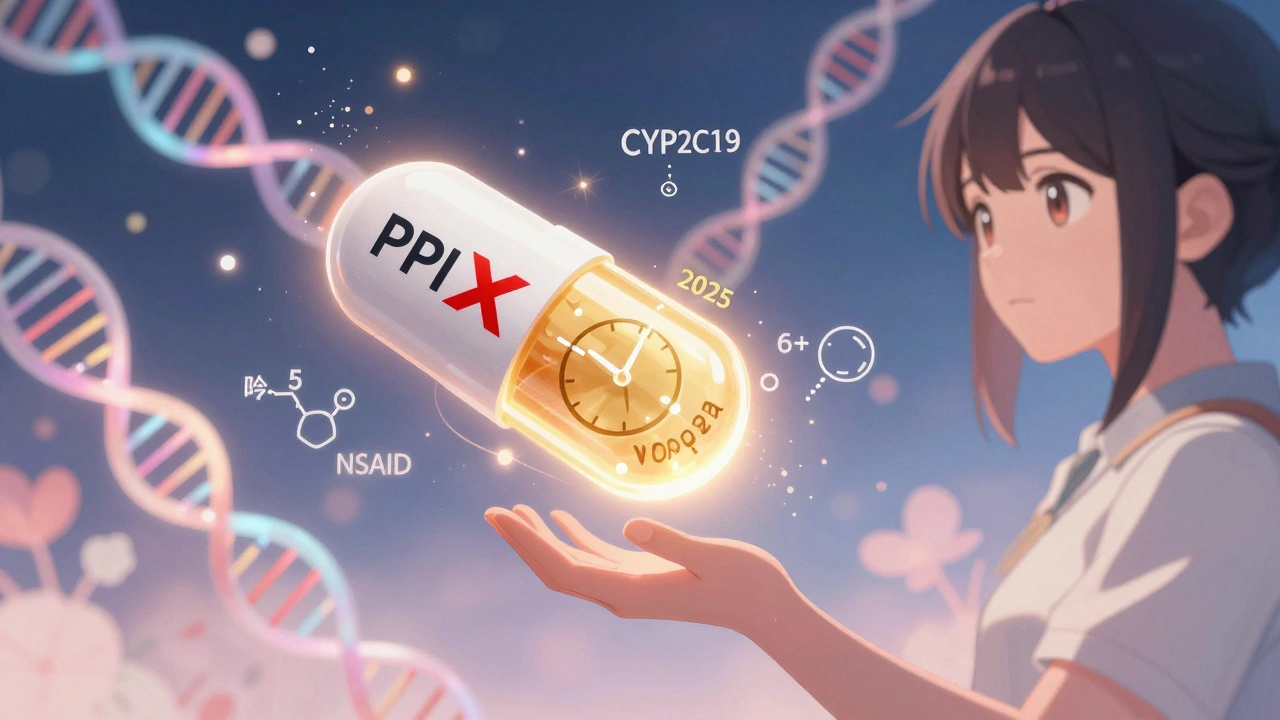
What’s Next? New Drugs and Better Science
A new drug called vonoprazan is coming. It’s not a PPI - it’s a potassium-competitive acid blocker. It works faster, lasts longer, and doesn’t interfere with clopidogrel. The FDA is reviewing it now, and it could be available by late 2025. If approved, it could replace PPIs for many patients. Genetic testing is also on the horizon. Some people have a CYP2C19 gene variant that makes clopidogrel less effective. If you’re one of them, you might need prasugrel or ticagrelor anyway. And if you are, you can safely use any PPI. Personalized medicine is coming - but it’s not here yet.What You Should Do
If you’re on aspirin plus another antiplatelet:- Ask your doctor: “Do I have any of the GI bleeding risk factors?”
- If yes, ask: “Which PPI should I take? And why?”
- If you’re on clopidogrel, make sure it’s pantoprazole or esomeprazole - not omeprazole.
- Ask when to stop. Don’t assume you need it forever.
- Never take NSAIDs without talking to your doctor first.
Alicia Marks
December 1, 2025 AT 23:26Just started my DAPT last week and my cardiologist prescribed pantoprazole-glad I didn’t skip asking why. So many people just take what’s handed to them. You’re right to emphasize timing. Started the PPI Day 1, no waiting. 🙌
Ella van Rij
December 3, 2025 AT 09:15Oh wow so omeprazole is basically a heart attack waiting to happen if you’re on clopidogrel? Who knew? Maybe doctors should, like, read a textbook once in a while? 🙄
Steve Enck
December 4, 2025 AT 22:31The entire paradigm of PPI prophylaxis is a statistical illusion masked as clinical wisdom. The absolute risk reduction is negligible when contextualized against the confounding variables of NSAID co-use, H. pylori status, and gastric mucosal resilience. You’re reducing a surrogate endpoint while amplifying microbiome dysbiosis and nutrient malabsorption. The data cherry-picks outcomes that validate institutional inertia.
Moreover, the assumption that PPIs are ‘safe’ is a dangerous myth propagated by pharmaceutical marketing departments. The 2021 JAMA meta-analysis on chronic PPI use and CKD progression showed a dose-dependent hazard ratio of 1.28-yet no one talks about that. Why? Because it doesn’t fit the narrative.
And let’s not forget the CYP2C19 pharmacogenomic elephant in the room. We’re prescribing PPIs like they’re aspirin while ignoring that 30% of Caucasians are poor metabolizers. We’re treating populations, not patients. This isn’t medicine-it’s algorithmic compliance.
Until we move to genotype-guided therapy and abandon the one-size-fits-all approach, we’re just rearranging deck chairs on the Titanic.
dave nevogt
December 5, 2025 AT 11:07I’ve been on clopidogrel and pantoprazole for 3 years now after my stent. I used to think PPIs were just for heartburn, but this post really opened my eyes. It’s not just about acid-it’s about platelets doing their job in the stomach lining. I never connected those dots. And now I know why I can’t touch ibuprofen anymore. Even a couple of pills can trigger something serious.
What struck me most was how many people just keep taking PPIs forever because it’s ‘easy’ or ‘safe.’ But the body doesn’t work like that. Long-term suppression of stomach acid? That’s not harmless. It changes how you absorb magnesium, B12, calcium. I read a study last year that linked it to bone density loss in older adults. I’m 71, and I don’t want to be falling because my bones are brittle from a pill I took ‘just in case.’
So I asked my GI doc last month if I still needed it. He checked my history-no prior ulcers, off NSAIDs, no steroids, no anticoagulants. He said, ‘You’re low risk now.’ We tapered me off over 6 weeks. No rebound, no issues. It felt like taking off a heavy coat I didn’t realize I was still wearing.
I wish more doctors did this. Not just prescribe, but reassess. The guidelines are clear: if your risk factors are gone, stop. But most just keep you on it because it’s easier than having the conversation. I’m lucky I had a doctor who actually listens. Not everyone is.
Lynn Steiner
December 5, 2025 AT 22:32OMG I’m 68 and on clopidogrel and I’ve been taking omeprazole for 2 years 😭 I just thought it was ‘for my stomach’ and never questioned it… I’m so mad at my cardiologist right now. I’m gonna call them first thing tomorrow. I’m literally shaking. 💔
Shannara Jenkins
December 6, 2025 AT 21:30Thank you for writing this. So clear, so needed. I’m a nurse and I’ve seen too many patients on PPIs long-term with zero indication. One lady was on it since 2018 after a minor gastritis-never had a bleed, never on NSAIDs, no risk factors. She was scared to stop. We walked through the guidelines together. She cried when she realized she didn’t need it anymore. You’re not just saving stomachs-you’re saving people from unnecessary lifelong medication.
Roger Leiton
December 8, 2025 AT 03:50Just read this after my doc prescribed me esomeprazole. I’m on ticagrelor and was worried about the PPI interaction. Now I’m relieved! Also-vonoprazan? That sounds like a sci-fi drug. When’s it coming? I’ll be first in line. 🤖💊
Elizabeth Grace
December 8, 2025 AT 13:14My grandma died from a GI bleed on aspirin. She never got a PPI because ‘she didn’t have symptoms.’ This post is heartbreaking and beautiful. Thank you.
Joel Deang
December 10, 2025 AT 09:20yo i just found out i’ve been takin omeprazole with clopidogrel for 8 months 😳 my doc said it was ‘fine’… i’m gonna print this out and hand it to him next week. also i miss ibuprofen so bad 😭
मनोज कुमार
December 11, 2025 AT 04:10Paul Keller
December 12, 2025 AT 15:47This is an exceptionally well-researched and clinically nuanced piece. The distinction between clopidogrel and newer antiplatelets regarding CYP2C19 interactions is critical and underappreciated in primary care. I’ve reviewed the 2023 ESC guidelines and concur with the risk stratification criteria-two or more risk factors is the correct threshold. The overprescribing epidemic is not just a medical issue, it’s a cultural one: the expectation that every pharmacological intervention must be accompanied by a protective agent, even when evidence doesn’t support it.
Furthermore, the emphasis on duration-6 to 12 months-is vital. Many patients assume PPIs are lifelong, when in fact they are time-limited prophylactics. The shift toward vonoprazan represents a promising frontier, particularly for CYP2C19 poor metabolizers. I would only add that patient education must be standardized: not every patient needs a PPI, but every patient on DAPT deserves to know whether they do.
Thank you for this. It’s the kind of content that elevates public discourse on cardiovascular care.