
Imagine handing a patient the wrong dose of a high-alert medication. It’s not just a mistake; it’s a potential catastrophe. In 1999, the Institute of Medicine’s landmark report To Err is Human shocked the healthcare world by estimating that between 44,000 and 98,000 preventable deaths occurred annually in U.S. hospitals due to medical errors, with medication mistakes playing a huge role. Fast forward to today, and while technology has advanced, the pressure on pharmacists hasn’t let up. This is where modern pharmacy workflow systems and error prevention technologies step in. They aren't just fancy gadgets; they are critical safeguards designed to catch human slips before they reach the patient.
The Anatomy of a Modern Pharmacy Workflow
At its core, a pharmacy workflow system is a digital backbone that connects every step of the medication journey, from the moment a doctor clicks "prescribe" to the second the pill hits the patient's hand. You might think this is just about organizing shelves, but it’s actually a complex orchestration of data and physical actions. These systems integrate directly with Electronic Health Records (EHRs), allowing for real-time access to patient history. When a prescription comes in, the software doesn't just print a label; it screens for allergies, checks for drug interactions, and verifies dosage against current guidelines.
This process relies heavily on interoperability. Most robust systems use HL7 standards for bi-directional communication with EHR platforms. This means if a pharmacist flags an issue, the information can bounce back to the prescriber instantly. Without this seamless data exchange, you’re left with silos of information where errors thrive. The goal is a closed-loop system where every action is logged, verified, and traceable.
How Technology Catches What Humans Miss
Let’s be honest: pharmacists are human. They work long shifts, deal with interruptions, and manage massive volumes of prescriptions. Studies show that technology-assisted workflows can detect up to 14 times more errors than manual processes alone. How? By automating the boring, repetitive, and high-risk parts of the job.
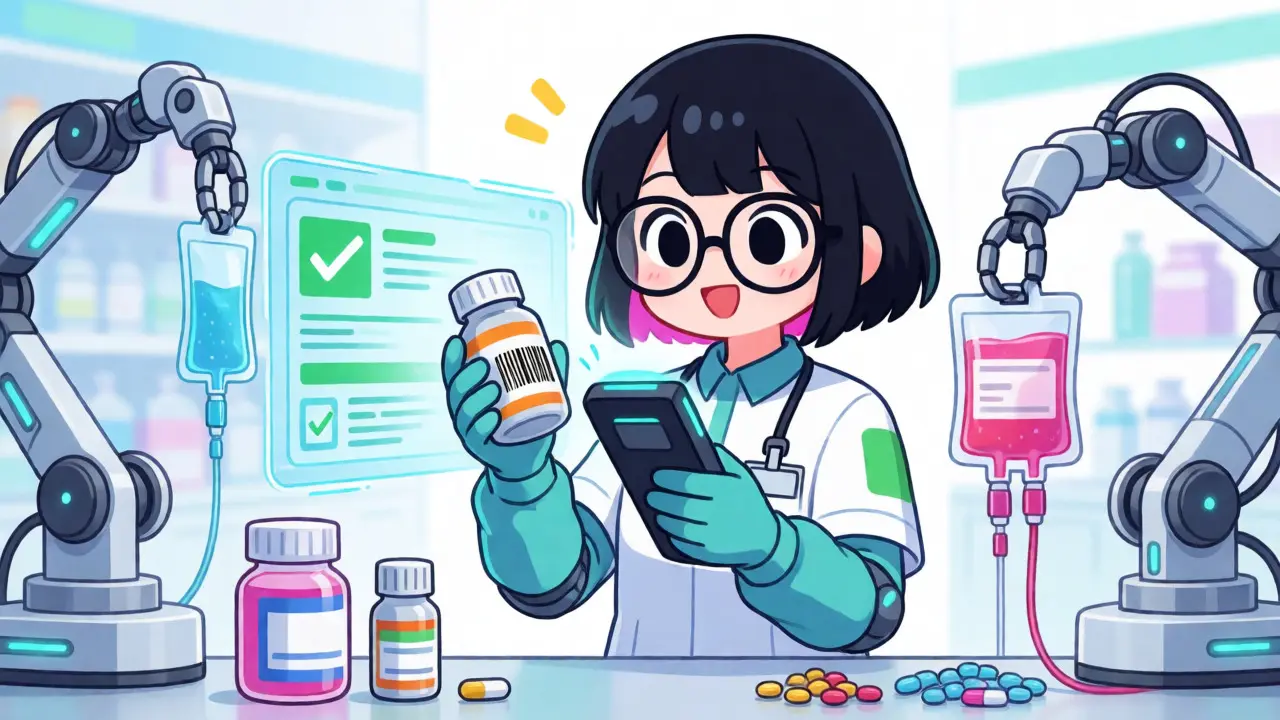
Barcode scanning is one of the most visible tools. Before a bottle leaves the counter, a technician scans the National Drug Code (NDC) on the stock bottle and compares it to the NDC in the system. If they don’t match, the system stops the transaction. No scan, no sale. It sounds simple, but it eliminates the classic "look-alike, sound-alike" drug mix-ups that have plagued pharmacies for decades.
Beyond barcodes, robotics are changing the game, especially in hospital settings. Automated dispensing cabinets, like BD Pyxis™, lock medications away until a nurse or pharmacist authenticates their identity and selects the specific drug. The machine then dispenses exactly what was requested. For IV compounding, specialized robots measure and mix sterile compounds with precision that humans simply can’t match consistently. This isn't about replacing pharmacists; it's about removing the variables that lead to fatigue-induced errors.
Key Components of Error Prevention Systems
If you are looking at implementing or upgrading these systems, you need to understand the key modules that drive safety. Here is a breakdown of the essential components:
- Computerized Physician Order Entry (CPOE): This allows doctors to enter orders electronically, reducing transcription errors from illegible handwriting.
- Clinical Decision Support (CDS): Software alerts that pop up when a prescribed drug conflicts with a patient’s allergy list or another medication they are taking.
- Automated Dispensing Cabinets (ADCs): Secure storage units that track inventory and require user authentication for access.
- Robotic Compounding: Machines that prepare sterile IV bags and oral liquids with exact measurements.
- Inventory Management Modules: Real-time tracking that alerts staff to shortages, expirations, or recall notices.
Each of these components plays a specific role in the semantic web of pharmacy safety. For instance, the CDS module relates directly to the EHR entity, pulling patient data to make logical judgments. Meanwhile, the ADC interacts with the inventory database to ensure that what is physically present matches what is recorded digitally.
Comparing System Types: Hospital vs. Retail
Not all pharmacy environments are created equal, and neither are their workflow needs. A large hospital dealing with complex IV drips has different requirements than a retail chain filling maintenance prescriptions. Let’s look at how these systems differ across major categories.
| Feature | Hospital/Health System | Retail/Community Pharmacy | Specialized Compounding |
|---|---|---|---|
| Primary Focus | Complex IVs, unit-dose distribution, ICU support | Volume processing, patient counseling, insurance claims | Sterile preparation, USP <797>/<800> compliance |
| Key Tech | Pyxis/Omnicell cabinets, robotic IV compounders | High-speed pick-and-place robots, barcode scanners | Laminar flow hoods, automated mixers, strict logging |
| Error Risk Area | Dosing errors, wrong patient administration | Selection errors, refill confusion | Contamination, measurement inaccuracies |
| Integration Needs | Deep EHR integration (Epic/Cerner) | PBM interfaces, POS systems | Lab result integration, batch record management |
| Cost Range (Annual) | $50,000 - $250,000+ | $10,000 - $50,000 | $30,000 - $100,000 |
Hospitals lean heavily on enterprise solutions from vendors like Epic or Cerner because they need deep integration with clinical notes and lab results. Retail pharmacies, on the other hand, often prioritize speed and throughput. Tools like Kissflow or KanBo help independent pharmacies automate non-dispensing tasks like scheduling and inventory counts, freeing up staff time for actual patient care.
The Human Element: Training and Culture
Here is the hard truth: buying the software doesn’t fix the problem. Installing a new system without retraining staff is a recipe for disaster. Implementation typically takes three to six months, and during that transition, productivity often dips before it soars. Staff need to understand not just how to click the buttons, but why the system is stopping them.
Consider the scenario where a pharmacist overrides a drug interaction alert. If they do it out of habit rather than clinical judgment, the safety net fails. Successful adoption requires a culture shift where technology is seen as a partner, not a nagging boss. The American Society of Health-System Pharmacists (ASHP) emphasizes this in their implementation checklists, noting that workflow redesign must happen alongside technology installation. You can’t just layer new tech over broken old habits.
Feedback from pharmacy technicians using systems like Wolters Kluwer’s Simplifi+ highlights that real-time visibility into workflow bottlenecks helps teams collaborate better. When everyone sees the same dashboard, finger-pointing decreases, and problem-solving increases. But this only works if leadership supports the change and provides adequate training resources.

Regulatory Compliance and Future Trends
Compliance is non-negotiable. Systems must adhere to HIPAA privacy laws and, for compounding pharmacies, USP standards <797> and <800>. These regulations dictate everything from how clean your air is to how you document your mixing process. Modern software automates much of this documentation, creating audit trails that save hours during inspections.
Looking ahead, artificial intelligence is poised to take error prevention further. Imagine AI that predicts inventory shortages based on seasonal flu trends or analyzes past dispensing patterns to flag unusual prescriptions before they are filled. We are also seeing greater consolidation in the market, with larger healthcare IT companies acquiring niche workflow tools to create end-to-end platforms. The future isn't just about preventing errors; it's about predicting them.
Frequently Asked Questions
Do pharmacy workflow systems eliminate all medication errors?
No system can eliminate 100% of errors. While technology significantly reduces mechanical and selection errors, clinical judgment errors still rely on the pharmacist's expertise. The goal is to reduce preventable errors to near zero, not to remove the human element entirely.
How long does it take to implement a pharmacy workflow system?
Implementation timelines vary by complexity. Small retail pharmacies might go live in 1-3 months, while large hospital systems with robotic integrations can take 6-12 months. This includes hardware installation, software configuration, staff training, and parallel testing phases.
What is the biggest challenge when adopting these systems?
Staff resistance and workflow disruption are common hurdles. Employees may feel overwhelmed by new interfaces or frustrated by initial slowdowns. Successful adoption requires strong change management, comprehensive training, and clear communication about the benefits for both patients and staff.
Can these systems integrate with any Electronic Health Record (EHR)?
Most modern systems use standard protocols like HL7 or FHIR for integration. However, compatibility depends on the specific versions of the EHR and the pharmacy system. It is crucial to verify interoperability with your vendor before purchase to avoid costly custom interface development.
Are barcode scanning systems mandatory in all pharmacies?
While not universally mandated by federal law for all dispensing steps, many states and health systems require barcode verification for controlled substances and high-risk medications. Even where optional, it is considered a best practice for patient safety and liability protection.
Vivek Chaturvedi
September 1, 2026 AT 18:11Its not about the tech its about the moral failure of a system that relies on humans who are overworked and underpaid to catch every single slip The IOM report from 1999 was a wake up call that we largely ignored because it was cheaper to sue than to fix
fred eden
September 3, 2026 AT 10:14This is so important 🙌 It’s comforting to know there are layers of protection like barcode scanning and AI alerts helping our pharmacists out ❤️ We need to support them more 💪🏼 They do such hard work keeping us safe 🥺💕
Sarah Kinch
September 4, 2026 AT 16:02typical corporate fluff
they talk about 'closed-loop systems' but ignore that the loop breaks the second a human gets interrupted by a phone call or a rude customer
the stats are cherry picked to sell software subscriptions to hospital boards who care more about liability shields than actual patient outcomes
its all just performative safety theater really
larry williams
September 5, 2026 AT 09:47I appreciate the nuance here regarding the transition period because in my experience leading teams through these digital transformations the dip in productivity is real and often misunderstood by upper management who expect immediate ROI without investing in the emotional labor required for staff adaptation and if you don't address the culture shift first the technology becomes another source of stress rather than relief which ultimately defeats the purpose of error prevention in the first place
Tobi Oyewole
September 5, 2026 AT 17:39We must acknowledge that while interoperability standards like HL7 provide a technical framework they do not guarantee semantic understanding between disparate systems. A pharmacist may see an alert that lacks clinical context leading to alert fatigue where critical warnings are dismissed as noise. Therefore the solution lies not merely in better hardware but in fostering a collaborative ecosystem where prescribers and dispensers share a unified language of care.
Stuart Lorne
September 5, 2026 AT 20:54Look at the cost table again retail pharmacies paying $10k-$50k annually just to keep their heads above water while hospitals spend hundreds of thousands This disparity means community pharmacies are stuck with outdated tech while big health systems get the shiny new toys Its creating a two-tier safety net where your location determines your risk of getting the wrong pill and honestly its insulting to the average consumer
Pearl Richardson
September 7, 2026 AT 17:44They tell us it's for safety but look at who profits 🤔
The consolidation mentioned at the end? That's not innovation that's monopoly power creeping in.
When one company owns the EHR and the pharmacy workflow and the inventory system they control the data flow completely.
Are we sure the algorithms aren't prioritizing drug shortages based on vendor contracts rather than pure clinical need? 🧐
We need transparency in how these AI predictions are weighted.
Kimberly Thomas
September 9, 2026 AT 12:50You're missing the point entirely. The issue isn't the tech it's the liability structure. Hospitals buy these systems to cover their own backs when things go wrong not necessarily to save lives. Until the legal incentives change the 'human element' will always be the scapegoat for systemic failures designed by people who never worked a single shift behind a counter.
Anderson Miller
September 10, 2026 AT 10:13Well, technically, the liability structure is exactly what drives the adoption; if you didn't have the threat of litigation, would anyone actually pay for the expensive integration modules? Probably not. So, in a way, the fear of being sued is the only thing forcing the industry to prioritize patient safety over profit margins. It’s ironic, but perhaps necessary?