When you pick up your prescription at the pharmacy, you might expect to get exactly what your doctor wrote on the script. But in Medicare Part D, that’s not always what happens. Medicare Part D substitution is a common practice - and it can save you money, or cost you more, depending on your plan. Understanding how it works isn’t just helpful; it’s necessary to avoid surprise bills or gaps in your treatment.
What Is Medicare Part D Substitution?
Medicare Part D substitution means a pharmacist or your doctor swaps one drug for another that’s considered similar in effect - usually to cut costs. This isn’t random. It’s guided by your plan’s formulary, which is a list of approved drugs sorted into tiers based on price and effectiveness. Generic drugs are typically on the lowest tier, meaning you pay the least. Brand-name drugs? They’re higher up - and cost more.
Substitution can happen in two ways:
- Generic substitution: Your doctor prescribes a brand-name drug, but the pharmacist gives you the generic version - which is chemically identical and approved by the FDA. This is routine and usually allowed without extra approval.
- Therapeutic substitution: Your plan swaps one brand-name drug for another brand-name drug in the same class - say, switching from one statin to another. This often requires prior authorization or step therapy, meaning you have to try a cheaper option first.
Not all substitutions are automatic. Your pharmacist can’t just swap any drug. They must follow your plan’s rules - and your doctor can block a substitution if they write "Do Not Substitute" on the prescription.
How Formularies Control What You Get
Your Medicare Part D plan uses a five-tier formulary to decide what drugs it covers and how much you pay. Here’s how it breaks down in 2025:
- Preferred generics: Lowest cost. Often $0-$5 copay.
- Non-preferred generics: Slightly higher, maybe $10-$15.
- Preferred brand-name drugs: $40-$60 copay.
- Non-preferred brand-name drugs: $80-$120+ - or even coinsurance (you pay a percentage).
- Specialty drugs: High-cost meds like injectables or cancer treatments. Coinsurance can be 33% or more.
Plans use these tiers to push you toward cheaper options. If your drug is on a higher tier, your plan may require you to try a lower-tier alternative first - this is called step therapy. Or they might say, "We’ll cover this drug, but only if you pay more." That’s when substitution becomes a financial decision, not just a medical one.
And here’s the catch: every Part D plan has a different formulary. Two plans might cover the same drug, but one puts it on tier 2 and the other on tier 4. That means your out-of-pocket cost could be tripled - just by switching plans.
The $2,000 Out-of-Pocket Cap Changes Everything
As of January 1, 2025, the Medicare Part D "donut hole" is gone. You no longer hit a coverage gap where you pay full price. Instead, there’s a hard cap: once you’ve spent $2,000 out of pocket on covered drugs in a calendar year, you enter catastrophic coverage - and you pay nothing for the rest of the year.
This changes substitution behavior dramatically. Before, people avoided higher-cost drugs to stay out of the donut hole. Now, the incentive is flipped: if you’re close to the $2,000 limit, your plan might push you toward cheaper drugs to help you reach catastrophic coverage faster. But if you’re already past it? Then cost doesn’t matter - you’re covered. That means your pharmacist might suggest a more expensive drug if it’s more effective, because you won’t pay extra.
For people taking insulin, the rules are even clearer. Most plans now cap insulin at $35 for a 30-day supply - regardless of tier. That’s a fixed price, no substitution needed. But for other high-cost drugs, like those for rheumatoid arthritis or multiple sclerosis, substitution is still a big deal.
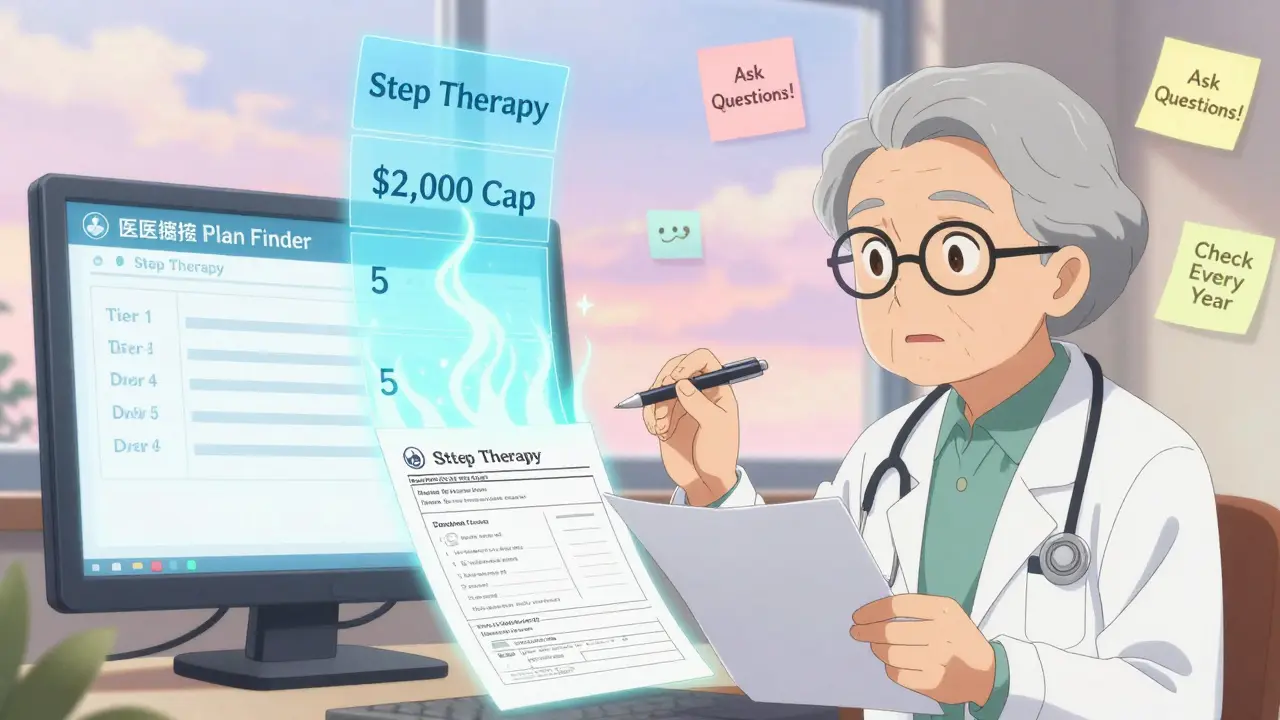
What Happens When Your Drug Gets Removed From the Formulary?
Every year, plans update their formularies. A drug you’ve been taking for years might suddenly be moved to a higher tier - or dropped entirely. This happens because drug manufacturers raise prices, or new generics enter the market. It’s legal, but it’s also disruptive.
If your drug is removed or restricted, your plan must notify you at least 60 days in advance. You have options:
- Ask your doctor for a medical exception - they can argue why you need the original drug.
- Switch to a similar drug on a lower tier.
- Change plans during Open Enrollment (October 15 to December 7).
Many people don’t realize they can switch plans mid-year if they qualify for a Special Enrollment Period - like moving to a new state or losing other drug coverage. But if you wait until you’re out of meds to act, you’re already behind.
How to Avoid Surprises With Substitution
You don’t have to guess what your plan will cover. Here’s how to stay in control:
- Check your formulary every year. Go to your plan’s website or call customer service. Ask: "Is my drug still covered? What tier is it on?" Don’t assume it’s the same as last year.
- Use the Medicare Plan Finder tool. Enter your drugs, zip code, and pharmacy. It shows you exactly what each plan charges for your prescriptions.
- Ask your pharmacist. When you pick up a prescription, ask: "Was this substituted? Why?" They can tell you if a generic was swapped in, or if a brand was replaced.
- Keep a list of your meds. Include the name, dose, and why you take it. Bring it to every doctor visit. That way, if a substitution is suggested, your doctor can say yes or no based on your needs - not just cost.
One woman in Ohio switched plans in 2024 and didn’t check her formulary. Her blood pressure med was covered - but moved to the highest tier. She paid $180 a month instead of $25. By the time she realized, she’d already paid $1,000 out of pocket. She switched back during Open Enrollment, but it cost her months of stress.
Medicare Advantage vs. Stand-Alone Part D: Different Rules
More than half of Medicare beneficiaries now get their drug coverage through Medicare Advantage (MA-PD) plans - not stand-alone Part D plans. And here’s the key difference: MA plans bundle medical and drug coverage. That means your doctor and pharmacist might be in the same network, and your plan might coordinate substitutions across both your doctor visits and prescriptions.
Stand-alone Part D plans are just for drugs. They don’t know what other meds you’re taking unless you tell them. So if you’re on an MA plan, substitution might be more streamlined - but also more tightly controlled. If your MA plan says you need to try a cheaper drug first, your doctor might have to jump through more hoops to get approval.
By 2025, there are only 14 stand-alone Part D plans on average per region - down 52% from 10 years ago. Meanwhile, MA-PD options have grown by 143%. That means your chances of being in a bundled plan are higher than ever.
What You Can Do Right Now
You don’t have to wait for Open Enrollment to protect yourself. Here’s what to do today:
- Call your pharmacy and ask for a copy of your current plan’s formulary.
- Look up your top three prescriptions on Medicare.gov’s Plan Finder.
- If you’re spending more than $1,000 a year on meds, consider switching to a plan with a lower deductible or better tier placement.
- If you take insulin, confirm your plan’s $35 cap is active - and that you’re not being charged more.
The goal isn’t to always get the cheapest drug. It’s to get the right drug - at a price you can afford. Substitution is a tool. Used well, it saves money. Used poorly, it risks your health.
Can my pharmacist substitute my drug without telling me?
No. Pharmacists must inform you if they substitute a drug - unless your doctor specifically wrote "Do Not Substitute" on the prescription. Even if it’s a generic, they should tell you what was dispensed. Always check the label and ask if you’re unsure.
What if my doctor says I need a specific brand, but my plan won’t cover it?
Your doctor can file a medical exception request with your plan. They’ll need to explain why the generic or preferred drug won’t work for you - maybe due to side effects, allergies, or past failures. If approved, your plan must cover the drug. This process can take a few days, so don’t wait until your prescription runs out.
Are all generic drugs the same?
Yes, legally. Generic drugs must meet FDA standards for the same active ingredient, strength, dosage, and effectiveness as the brand. But some people report differences in how they feel - possibly due to inactive ingredients or manufacturing variations. If you notice a change after switching to a generic, talk to your doctor. You can still request a brand if medically necessary.
Does Medicare Part D cover over-the-counter drugs?
No. Medicare Part D only covers prescription drugs. Even if your doctor recommends an OTC medication - like daily aspirin or a pain reliever - it won’t be covered. Some Medicare Advantage plans may offer limited OTC benefits as a supplemental perk, but that’s not part of standard Part D.
Can I switch plans if I’m unhappy with my drug coverage?
Yes - during Open Enrollment (October 15 to December 7). You can also switch mid-year if you qualify for a Special Enrollment Period, like moving, losing other coverage, or entering a nursing home. Don’t wait until you’re out of meds. Use the Medicare Plan Finder to compare options before making a change.
Final Thought: Know Your Plan, Know Your Drugs
Medicare Part D substitution isn’t a mystery - it’s a system. And like any system, it works best when you understand the rules. Your plan’s formulary isn’t just a list. It’s a roadmap to your costs. Your pharmacist isn’t just filling a script - they’re following a financial script written by your insurer. And your doctor? They’re your advocate when the system doesn’t fit your needs.
Don’t assume. Don’t guess. Check your formulary every year. Ask questions. Speak up if something doesn’t feel right. Your health - and your wallet - depend on it.
gerard najera
December 31, 2025 AT 16:36Substitution isn’t magic-it’s math.
Austin Mac-Anabraba
January 1, 2026 AT 03:35Let’s be clear: this isn’t healthcare-it’s actuarial theater. The system doesn’t care if you’re stable on a brand-name drug for 12 years. If a generic exists, you’re being moved like a pawn. The FDA says generics are equivalent, but bioequivalence ≠ clinical equivalence. I’ve seen patients crash after switching-tremors, mood swings, even seizures. The formulary isn’t designed for you. It’s designed for shareholders. And the $2,000 cap? Just a shiny distraction while premiums keep rising. You think you’re protected? You’re just being herded into a cheaper herd.
Stephen Gikuma
January 1, 2026 AT 05:00They’re not just swapping drugs-they’re swapping your autonomy. Did you know the big pharma lobbyists wrote the formulary tiers? And the ‘Do Not Substitute’ clause? It’s a trap. Pharmacies get fined if they honor it without prior auth. Meanwhile, the government says ‘you’re in control’ while the algorithm picks your meds. This is digital eugenics wrapped in a copay sticker. They want you docile, compliant, and on the cheapest version of everything-even if it makes you sicker. Wake up. This isn’t insurance. It’s surveillance with a pill bottle.
Bobby Collins
January 2, 2026 AT 09:00my grandma got switched to a generic for her heart med and she started forgetting her own name 😭 i cried for 3 days. i had to fight the plan for 6 weeks just to get her old one back. they said ‘it’s the same!’ but it’s not the same when your grandma doesn’t know you anymore. i hate this system. 🤕💔
Layla Anna
January 2, 2026 AT 20:28so i just called my pharmacist and asked if my lisinopril was switched and they said yes but it was fine 😊 i didn't even notice but now i'm gonna check every time i pick it up because i read this and it made me think maybe i should care more 🤔 i'm gonna start keeping a little med log like they said 💪
Heather Josey
January 3, 2026 AT 13:25It is imperative that beneficiaries proactively engage with their plan documentation. The assumption that formulary status remains static is not only erroneous but potentially hazardous. Annual review of formulary updates, utilization of the Medicare Plan Finder tool, and direct communication with both prescribers and pharmacists are not optional-they are non-negotiable components of responsible health management. Proactive behavior mitigates financial and clinical risk. Do not wait for a crisis to initiate action.
Donna Peplinskie
January 4, 2026 AT 17:02Thank you for writing this so clearly-it’s like someone finally translated the insurance jargon into human language. I’m from Canada, and we don’t have this mess, but I’ve watched my sister struggle with Part D for years. She’s 72, works part-time, and pays $140/month for a drug that should cost $30. It’s not just about money-it’s about dignity. Please, everyone: check your formulary. Talk to your pharmacist. Don’t let them treat your health like a spreadsheet. You deserve better.
Olukayode Oguntulu
January 4, 2026 AT 22:42The entire Medicare Part D architecture is a neocolonial capitalist apparatus, predicated on the commodification of corporeal vulnerability. The formulary, as a hegemonic instrument of pharmacoeconomic control, enforces a biopolitical regime wherein the subject’s physiological integrity is subordinated to actuarial calculus. One must interrogate the epistemic violence inherent in therapeutic substitution protocols-wherein clinical subjectivity is erased under the rubric of ‘cost-efficiency.’ The $2,000 cap? Merely a neoliberal sop, a performative gesture designed to pacify the aggrieved while the structural rot persists. The real solution? Single-payer. Or, at minimum, abolish tiered formularies. Otherwise, we are merely rearranging deck chairs on the Titanic of American healthcare.
jaspreet sandhu
January 5, 2026 AT 03:09I don't know why people make such a big deal. I've been on Medicare since 2010 and I've had 12 different drugs switched out and I'm still alive. The generics work fine. You think you're special because you're on a brand name? Everyone else is on generic and they're fine. The system works. You just don't want to take responsibility for your own health. You want everything handed to you. If you don't like your plan, switch it. It's not hard. Go on the website. Type in your drugs. Pick a plan. Done. Stop complaining. The problem is not the system. The problem is you.
LIZETH DE PACHECO
January 6, 2026 AT 20:27I’m so glad this was written. I’ve been helping my neighbor navigate her Part D plan this year and it’s been a nightmare. She’s on three meds for diabetes and heart issues, and one got switched without her knowing-she ended up in the ER because her blood sugar spiked. We had to call the plan, get a letter from her doctor, and wait 10 days. She’s 81. She shouldn’t have to fight like this. Please, if you’re reading this: ask questions. Write things down. Bring someone with you to the pharmacy. You’re not being difficult-you’re being smart.
Lee M
January 7, 2026 AT 11:58Let’s cut through the noise: substitution is not the enemy. The enemy is the lack of transparency. The system doesn’t just allow substitution-it incentivizes it at every level, from the pharmacy’s rebate structure to the insurer’s formulary design. The $2,000 cap doesn’t fix that. It just moves the goalposts. The real issue? No one is accountable. No one gets fined for switching a drug that causes adverse effects. No one audits whether the ‘therapeutic equivalent’ actually works for real patients with real comorbidities. Until there’s liability for bad substitutions, this is just corporate welfare dressed up as patient care.
Alex Warden
January 8, 2026 AT 17:05They’re lying to you. The ‘generic’ isn’t the same. The FDA lets them use different fillers and binders-some are made in China, some in India. You think they care if you get a rash or feel dizzy? No. They care about profit margins. And now they’re pushing specialty drugs because they get kickbacks from the manufacturers. This isn’t healthcare. It’s a rigged casino and you’re the sucker. Wake up. Call your rep. Demand transparency. Stop letting them treat you like a number.