
Most parents have been told that if a child can't swallow a pill, they need the liquid version. It feels like common sense. You buy the syrup, you measure it out with the little cup, and hope your kid doesn't spit it back into your face. But what if that advice is outdated? Recent data suggests that liquid medications might not always be the best choice for your child-and in many cases, they could even be less safe or effective than solid forms.
The debate isn't just about convenience; it's about accuracy, cost, and whether your child actually takes the right dose every time. While liquids have been the default for decades, new research from major health organizations is flipping the script. Let’s break down why tablets-specifically modern mini-tablets-are becoming the smarter choice for many families, and when you should still stick with the bottle.
The Hidden Risks of Liquid Medications
We often assume liquids are easier because you don't have to worry about choking. That part is true. But there’s a bigger problem: measurement error. According to data from the American Academy of Pediatrics (AAP), between 15% and 20% of parents mismeasure liquid doses. That means one in five times you give medicine, your child gets too much or too little. For antibiotics, this can mean treatment failure. For other drugs, it could lead to side effects.
Liquids also come with storage headaches. Many require refrigeration at 2-8°C and lose stability quickly after opening-often within 14 to 30 days. If you forget a dose for a day, then go on vacation, that bottle might expire before you return. Plus, taste is a massive hurdle. A study by Garvie (2007) found that 68% of pediatric patients experience taste aversion. Even "strawberry" flavors often taste like chemicals, leading to refusal and wasted medicine.
Then there’s the cost. Liquid formulations are significantly more expensive to produce and purchase. In the UK, the NHS found that switching appropriate prescriptions from liquid to solid forms could save thousands per institution annually. Why? Because liquids degrade faster, require special packaging, and often result in waste when partially used bottles are thrown away.
Why Tablets Are Making a Comeback
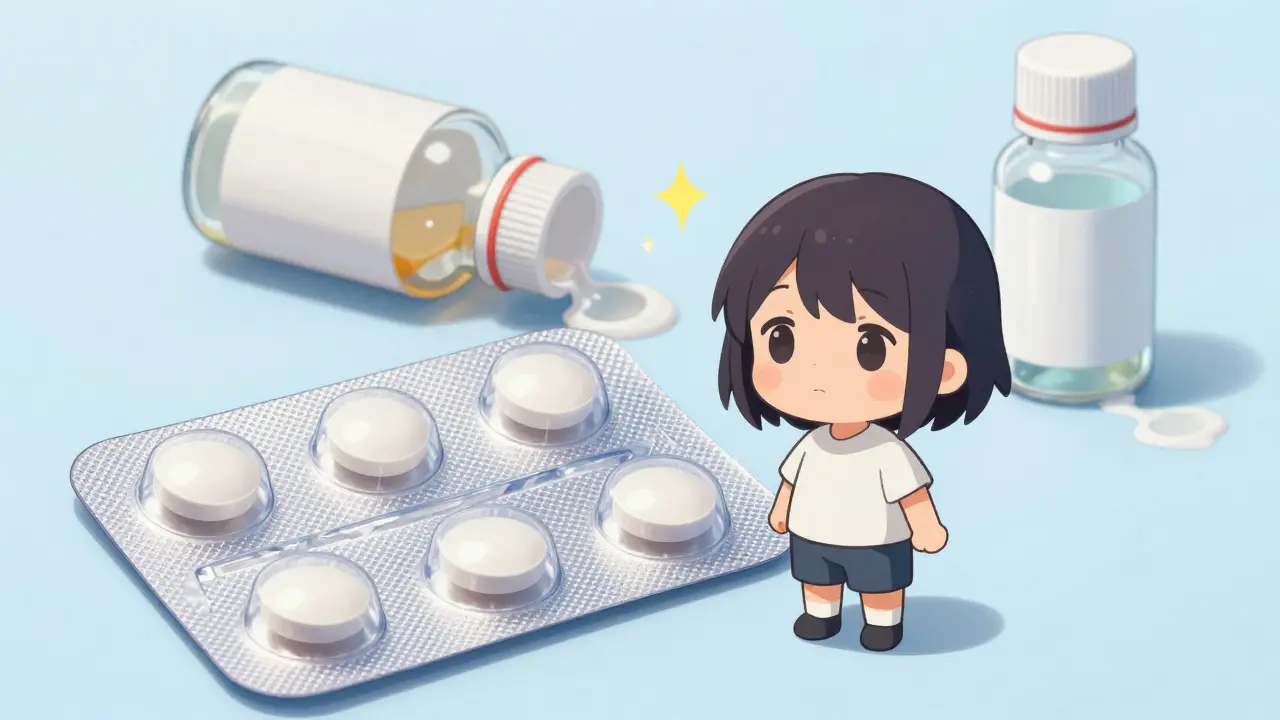
If liquids have so many downsides, why do we still prescribe them? Habit. But the landscape has changed. Modern mini-tablets are tiny solid dosage forms designed specifically for children, often as small as 2mm in diameter. These aren’t the giant white pills adults take. They’re engineered for small throats.
A pivotal 2012 study by Spomer et al. tested these mini-tablets on 60 children aged 6 months to 6 years. The results were surprising: acceptance rates for mini-tablets were equal to or better than liquids, especially in the 6-month-to-1-year group where liquid refusal hit 40%. Solid forms had only a 15% refusal rate. Why? Because they bypass the tongue’s taste buds entirely if swallowed correctly, avoiding the bitter aftertaste that plagues syrups.
Tablets also offer superior stability. They typically last 24 to 36 months at room temperature (15-30°C). No refrigeration needed. No guesswork about expiration dates after opening. And dosing is precise. One tablet equals one exact dose. No measuring cups, no shaking the bottle, no meniscus errors.
| Feature | Liquid Formulations | Solid Forms (Tablets) |
|---|---|---|
| Dosing Accuracy | Low (15-20% error rate) | High (Fixed dose) |
| Shelf Life | Short (14-30 days after opening) | Long (24-36 months) |
| Storage | Often requires refrigeration | Room temperature stable |
| Cost Per Dose | Higher | 25-40% lower |
| Taste Issues | Common (68% aversion) | Rare (if swallowed whole) |
| Portability | Poor (spills, leaks) | Excellent |
When Liquids Are Still Necessary
This isn’t to say tablets are perfect for every situation. There are specific scenarios where liquids remain the gold standard. First, infants under 6 months old generally cannot swallow solids safely. Their swallowing reflexes aren’t fully developed, making any solid form a choking risk.
Second, some medications require precise titration based on weight changes. Drugs like levothyroxine (for thyroid conditions) or warfarin (a blood thinner) need doses adjusted in tiny increments-sometimes down to 0.1mL. A fixed-dose tablet can’t accommodate these micro-adjustments easily. In these cases, a liquid allows for fine-tuning that ensures therapeutic efficacy without toxicity.
Third, if a child has a physical disability that prevents them from closing their lips around a bottle or using a straw, or if they have severe esophageal issues, liquids may be the only viable option. Always consult your pediatrician or pharmacist if your child has complex medical needs.

How to Train Your Child to Swallow Pills
The biggest barrier to using tablets is fear. Parents fear choking; children fear the unknown. But evidence shows that children as young as 3 can learn to swallow pills with proper training. The European Medicines Agency (EMA) recommends starting this training early for chronic conditions.
Here’s a step-by-step approach that works:
- Start with Practice Objects: Begin with mini-marshmallows or small pieces of bread. Have your child practice placing the object on their tongue and swallowing it with water. This builds muscle memory without the pressure of actual medication.
- Use the Pop-Bottle Method: This technique is highly effective. Place the tablet on the tongue, then have the child sip rapidly from a plastic bottle (not a glass). The suction helps pull the pill down smoothly. Avoid tilting the head back excessively, which increases choking risk.
- Progress Gradually: Once they master marshmallows, move to sugar-free gum drops, then finally to actual mini-tablets. Supervise closely during the transition.
- Keep It Positive: Praise success. Never force the issue. If they gag, stop and try again later. Anxiety makes swallowing harder.
Studies show that when healthcare providers demonstrate these techniques, acceptance rates jump by 65%. It’s less about the pill and more about the confidence of both parent and child.
What About Crushing Tablets?
You might hear advice to crush a tablet and mix it with applesauce. Be very careful here. Crushing tablets can destroy their chemical structure. Extended-release formulations, for example, are designed to release medication slowly over hours. Crushing them dumps the entire dose at once, which can cause dangerous spikes in drug levels.
Additionally, crushing leads to preparation errors in 30-40% of cases. Some of the powder sticks to the spoon or food, meaning your child gets an incomplete dose. Unless your pharmacist explicitly says a tablet is safe to crush, do not do it. Instead, ask for a mini-tablet or an orodispersible tablet (which dissolves on the tongue in 30 seconds without water).
Cost and Accessibility Considerations
Beyond safety and efficacy, there’s the wallet factor. Liquid medications are consistently more expensive. A 2018 study documented that solid forms cost 25-40% less per dose. Over a year of daily medication for a chronic condition, this adds up to significant savings.
Insurance coverage also plays a role. Sometimes, insurers prefer generic solids over branded liquids. Check with your pharmacy to see if a solid alternative is available and covered. Don’t assume the liquid is the only option-ask your doctor about switching to a solid form if appropriate.
Furthermore, consider travel. Taking a bottle of liquid medicine through airport security can be a hassle. Tablets fit in a pocket. They don’t leak in the car seat. They don’t spoil if the AC breaks. For active families, the logistical ease of solids is a major plus.
Expert Consensus and Future Trends
The medical community is shifting. Dr. Jane Standing, a specialist at Great Ormond Street Hospital, noted that the automatic preference for liquids is "not evidence-based." The FDA’s 2023 draft guidance encourages development of age-appropriate solid formulations. The WHO updated its essential medicines list in 2024 to include solid forms for children as young as 2.
Market trends reflect this change. Mini-tablet products increased by 220% between 2015 and 2022. By 2030, experts predict solids will make up 55-60% of pediatric prescriptions, up from 35% today. This shift is driven by better adherence-solid forms show 22% higher adherence rates in chronic conditions-and reduced costs.
However, education remains a gap. Only 18% of pediatricians feel adequately trained to counsel families on swallowing techniques. This is why resources like this matter. Knowledge empowers you to make informed choices rather than relying on outdated habits.
Can a 2-year-old swallow a tablet?
Yes, with proper training. The American Academy of Pediatrics acknowledges that children as young as 2 can successfully swallow appropriately sized tablets using techniques like the pop-bottle method. Start with practice objects like mini-marshmallows before moving to actual medication.
Are mini-tablets safe from choking?
Yes. FDA adverse event reporting from 2010-2020 shows choking incidents with appropriately sized pediatric tablets occur at a rate of less than 0.002%. Mini-tablets are designed to be small enough (2mm-4mm) to pass safely while being large enough to avoid aspiration risks associated with powders.
Why are liquid medications more expensive?
Liquids require more complex manufacturing, preservatives, flavorings, and specialized packaging to prevent leakage and maintain stability. They also have shorter shelf lives, leading to more waste. Solid forms are cheaper to produce, store, and transport, resulting in 25-40% lower costs per dose.
Should I crush my child's tablet if they won't swallow it?
Only if your pharmacist confirms it is safe. Crushing extended-release or enteric-coated tablets can alter how the drug works, causing dangerous side effects or reduced efficacy. Additionally, crushing leads to dosing errors as powder sticks to surfaces. Ask for a mini-tablet or orodispersible alternative instead.
When should I definitely choose liquid medication?
Choose liquids for infants under 6 months, for medications requiring precise weight-based titration (like thyroid meds), or if your child has physical disabilities preventing safe swallowing. Also use liquids if the specific medication is only available in that form.
Do mini-tablets taste better than liquids?
If swallowed whole, yes. Mini-tablets bypass the taste buds on the tongue, eliminating the bitter aftertaste common in syrups. Studies show higher acceptance rates for solids because children avoid the unpleasant chemical flavors often found in "fruit-flavored" liquids.