
Switching to generic medications saves money - a lot of it. In New Zealand and across the world, most prescriptions are filled with generics now. But for some people, that switch isn’t as simple as paying less at the pharmacy. You might feel different after the switch. Maybe your headaches came back. Or your mood dipped. Or you got a strange nausea you didn’t have before. These aren’t just "in your head." They’re real, and they happen more often than most doctors admit.
Why Your Body Might React Differently to Generics
Generic drugs are required to be "bioequivalent" to their brand-name cousins. That means they must deliver 80% to 125% of the same active ingredient into your bloodstream. Sounds precise, right? But here’s the catch: that’s a 45% window of variation. One generic might put 90% of the drug in your blood. Another from a different manufacturer might put 115%. For most people, that’s fine. For others - especially those on drugs with a narrow therapeutic index - it’s enough to cause problems.
Think of drugs like warfarin (blood thinner), levothyroxine (thyroid hormone), or seizure medications. These have very little room for error. A small change in how much drug your body absorbs can mean the difference between being stable and ending up in the hospital. In 2013, heart transplant patients in the U.S. had emergency visits after switching to a new generic version of tacrolimus. Their bodies weren’t rejecting the organ - they were getting too little of the drug. That’s not rare. It’s underreported.
What to Track in Your Medication Journal
Just writing down "took my pill" isn’t enough. You need to track how you feel, when you feel it, and which version of the pill you took. Here’s what actually matters:
- Medication name - both brand (e.g., Synthroid) and generic (e.g., levothyroxine), plus the manufacturer (e.g., Teva, Mylan, Dr. Reddy’s). You’ll need this later.
- Lot number - printed on the bottle. If you switch manufacturers, write it down. It’s your evidence if something goes wrong.
- Physical appearance - color, shape, imprint code. One generic might be a white oval with "50" on it. The next might be a blue circle with "LTX." Even if the dose is the same, your body might respond differently.
- Date of switch - mark the day you got a new bottle. This helps you connect symptoms to the change.
- Symptoms - use a simple 1-10 scale. Rate pain, fatigue, mood, dizziness, nausea. Don’t say "I felt weird." Say "Fatigue went from 3 to 8 on day 4 after switching to Mylan brand."
- Objective data - if you’re on blood thinners, record your INR. If you’re diabetic, log your glucose. If you have high blood pressure, write down your readings. Numbers don’t lie.
- Adherence - did you miss a dose? Why? Stress? Cost? Forgetting? Track it. Sometimes the problem isn’t the drug - it’s the routine.
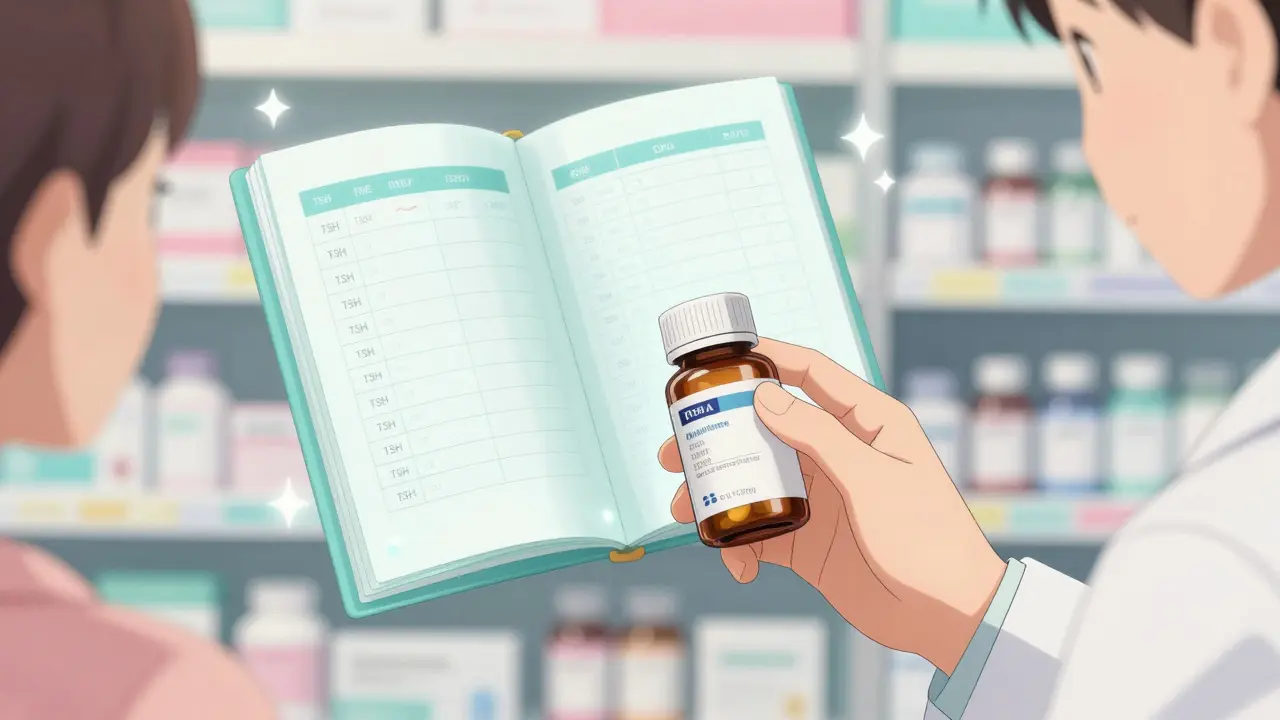
Most people skip the lot number and manufacturer. Big mistake. One patient on Reddit tracked her levothyroxine for six months. Her TSH levels jumped from 1.2 to 8.7 after switching manufacturers - three times. She showed her journal to her endocrinologist. They switched her back to brand-name. Her levels stabilized in weeks.
Paper vs. Digital: Which Works Better?
You don’t need fancy tech. But you do need consistency.
Over 60% of people over 65 still use paper journals. Why? Because they’re simple. You can stick them in your wallet. You can hand them to your pharmacist. The CDC offers free printable templates with tear-off sheets and carbon copies. A pack of 100 pages costs under $5. That’s cheaper than one extra doctor visit.
For younger users, apps like Medisafe or MyTherapy work well. They send reminders, let you log symptoms with a tap, and even generate reports to share with your doctor. Medisafe has over 150,000 reviews on the Apple App Store - 4.7 stars. MyTherapy is used by 8 million people globally. But apps fail when you forget to open them. Paper doesn’t need a battery.
Best approach? Start with paper. Use a notebook you keep with your meds. After a month, see if you’re still writing in it. If yes, great. If not, try an app. Don’t overcomplicate it.
When Journaling Makes the Biggest Difference
Not all drugs need this level of tracking. But if you’re taking one of these, your journal could prevent a crisis:
- Antiepileptics - 7.3% of patients had breakthrough seizures after switching generic manufacturers, according to a 2020 study. That’s 6 times higher than those who stayed on the same brand.
- Thyroid meds - small changes in absorption can throw your whole metabolism off. TSH levels can swing wildly.
- Warfarin - a 10% change in blood levels can mean clotting or bleeding. INR must be tight.
- Immunosuppressants - after organ transplants, even tiny drops in drug levels can trigger rejection.
- Antidepressants - while most people don’t notice differences, some do. Mood changes are subtle. A journal helps spot them.
For drugs like statins or antibiotics? Probably not worth the effort. But for these? Your journal is your early warning system.
Common Mistakes (and How to Avoid Them)
Most people stop journaling after a few weeks. Here’s why - and how to fix it:
- "I forgot to write it down." - Set a phone alarm for 10 minutes after you take your pill. Use the same time every day. Link it to a habit - like brushing your teeth.
- "I didn’t know what to write." - Use a template. The Cleveland Clinic’s NTI tracking form is free online. It has clear boxes for manufacturer, lot number, symptoms, and measurements. Users say it’s 63% more useful than free-form notes.
- "I thought my symptoms were normal." - Many people blame aging, stress, or diet. But if your symptoms started after switching generics, it’s worth tracking. Don’t assume.
- "I switched back and forth too much." - If your insurance keeps changing which generic you get, your journal becomes your bargaining chip. Bring it to your pharmacist. Ask: "Can we stick with one manufacturer?" Many pharmacies can special-order a specific brand.
One study found patients who brought journals to appointments had 27% higher adherence and 32% fewer unnecessary medication changes. That’s power.
What to Do With Your Journal
Don’t just collect data - use it.
- Bring it to every doctor visit. Not just your GP - your pharmacist, specialist, even your endocrinologist.
- Ask: "Could this be the generic?" Don’t be shy. Pharmacists are trained to spot these issues.
- If you notice a pattern - say, every time you get the Mylan version, you feel dizzy - ask for a specific manufacturer. Most insurers will cover it if you prove it’s medically necessary.
- If your doctor dismisses you, ask for a serum drug level test. For thyroid meds, that’s TSH and free T4. For seizure drugs, it’s blood level monitoring. Numbers speak louder than feelings.
The FDA itself now recognizes patient journals as a source of real-world data. Between 2020 and 2023, 142 cases of adverse reactions were flagged through patient reports - leading to changes in labeling or manufacturing. Your journal isn’t just personal. It’s public health data.
The Bottom Line
Generics are safe. For most people, they’re perfect. But for some, the small differences matter. If you’re on a critical medication, your body is the best detector you have. A simple journal - even on paper - gives you control. It turns confusion into clarity. It turns fear into evidence.
You don’t need to track everything. Just the drugs that keep you alive. Or stable. Or functional. If you’re taking one of those, start today. Write down the name. The lot number. How you feel. And don’t stop until you know what’s really going on.
Do all generic drugs have the same effect?
No. While generics must meet FDA bioequivalence standards, they can vary by up to 45% in how much drug enters your bloodstream. This is usually fine, but for drugs with a narrow therapeutic index - like thyroid meds, blood thinners, or seizure drugs - even small differences can affect how you feel or your health outcomes.
Should I switch back to brand-name if I feel worse on generics?
Not necessarily. First, track your symptoms for at least 4-6 weeks after each switch. Use a journal to record how you feel, your dosage, and the manufacturer. Then, bring it to your doctor. Sometimes, the issue isn’t the generic - it’s a different fill or inactive ingredient. Your doctor may be able to request a specific generic manufacturer your insurance covers, avoiding the need to go back to the more expensive brand-name drug.
Can my pharmacist help me with my medication journal?
Yes. Pharmacists are trained to recognize when a patient’s symptoms might be linked to a generic switch. Many pharmacies now offer medication therapy management (MTM) services - free for Medicare Part D patients - where a pharmacist reviews your journal, checks for interactions, and helps you identify patterns. In one Kaiser Permanente program, pharmacist-led journal reviews cut unnecessary generic switches by 44%.
What if my insurance keeps changing which generic I get?
This is common, especially with mail-order pharmacies. If you notice symptoms changing each time you refill, document the manufacturer and lot number. Ask your pharmacist if they can order a specific brand - many can. If they can’t, ask your doctor to write a letter of medical necessity. Some insurers will cover one manufacturer if you prove it’s the only one that works for you.
Is there a template I can use for my medication journal?
Yes. The Cleveland Clinic offers a free NTI (Narrow Therapeutic Index) medication tracking form that includes columns for manufacturer, lot number, physical appearance, symptom severity, and lab values. The Epilepsy Foundation and American Thyroid Association also have disease-specific templates. These are more useful than blank notebooks because they guide you to record the right data.
peter vencken
March 25, 2026 AT 13:58Just switched my levothyroxine to a new generic last month and my TSH went from 1.8 to 7.4. I thought I was just stressed or eating too much sugar. Turns out it was the manufacturer switch - Mylan to Teva. Wrote down the lot number, showed my endo, and now I’m back on the one that works. Paper journal, baby. No app needed.
Natasha Rodríguez Lara
March 27, 2026 AT 07:22This is so real. I’m a nurse in Texas and I’ve seen patients crash because their generic tacrolimus changed. One guy almost lost his kidney transplant because his new batch had 15% less bioavailability. He didn’t even know to track the lot number. This post should be mandatory reading for anyone on critical meds. Thanks for writing it.
Linda Foster
March 27, 2026 AT 11:00While I appreciate the intent behind this article, I must emphasize the importance of relying on regulatory oversight. The FDA’s bioequivalence standards are rigorously tested and validated through clinical trials. Anecdotal patient reports, while emotionally compelling, should not override evidence-based pharmacological guidelines. Consistency in medication adherence remains paramount, regardless of brand or manufacturer.
Rama Rish
March 29, 2026 AT 08:19From India, I’ve seen this too. My mom switched to a local generic for blood pressure and started dizzy. We noted the color and lot - turned out it was a bad batch. We asked for the old one. Pharmacist helped. Simple. Free. Real.
Kevin Siewe
March 29, 2026 AT 15:06For anyone starting this journal - don’t overthink it. Grab a cheap notebook. Write the name, the color, the number on the pill. Rate your energy on a scale of 1–5. Do it for two weeks. If nothing changes? Cool. If something does? You’ve got proof. No drama. Just facts. You’re not crazy. Your body’s just telling you something.
Chris Farley
March 31, 2026 AT 07:10Why are we letting patients play doctor? The FDA doesn’t approve generics based on some guy’s mood diary. This is just fearmongering wrapped in a pretty spreadsheet. If your body can’t handle a generic, maybe you’re just weak. Big Pharma doesn’t want you to know generics work just fine.
Darlene Gomez
March 31, 2026 AT 17:46My sister had breakthrough seizures after switching from one generic to another - same dose, different maker. She didn’t track it. She thought it was stress. By the time she went to the neurologist, she’d had three hospital visits. We started the journal the next day. Within two weeks, her seizures stopped. I’m not saying all generics are dangerous. I’m saying: if you’re on a narrow-therapeutic-index drug, your body is the most accurate sensor you’ve got. Listen to it. Write it down. Don’t let anyone tell you it’s "just in your head."
Katie Putbrese
March 31, 2026 AT 22:10People who don’t take responsibility for their own health shouldn’t be allowed to use public healthcare. If you’re too lazy to track your meds, don’t blame the system. You’re not special. Your symptoms aren’t unique. Just take the damn pill and stop whining about "manufacturers." This is why we can’t have nice things.
Jacob Hessler
April 2, 2026 AT 00:53ugh i just got my meds switched again and i dont even know who made them. i think it was teva? or was it mylan? i dont care. i just want my brain to stop feeling foggy. why is this so hard??