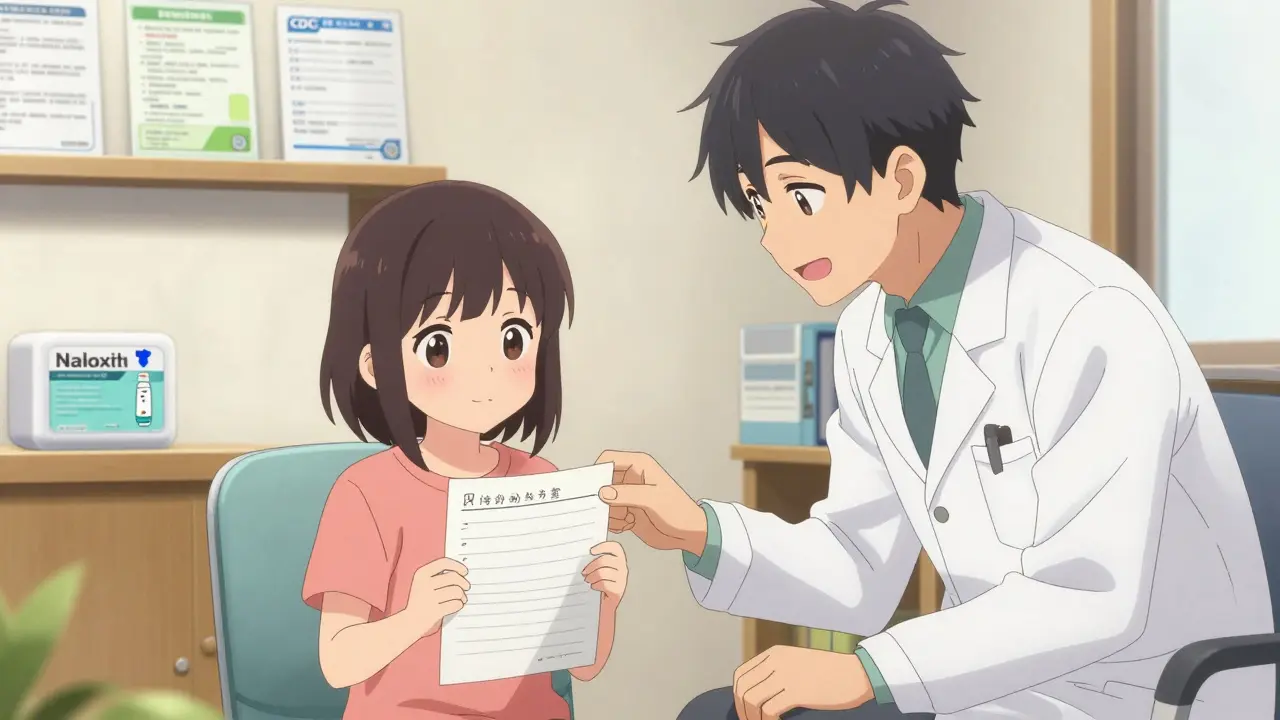
It’s not easy to tell your doctor you’re worried about overdosing. You might be on pain medication. Maybe you’ve used substances in the past. Or perhaps you’re just scared-of being labeled, judged, or dismissed. You’re not alone. Nearly 40 million Americans live with a substance use disorder, but only a tiny fraction get the care they need. And a big reason? Stigma. Not just from society, but from the very people sworn to help: doctors.
Here’s the truth: your doctor should be your ally in staying safe. But too often, fear of being seen as "addicted" or "drug-seeking" keeps people silent. That silence costs lives. In the U.S., 78 people die every day from opioid overdoses. Many of those deaths could be prevented-not with punishment, but with honest conversations and access to simple, life-saving tools like naloxone.
Why Talking About Overdose Risk Matters
Overdose isn’t just about illegal drugs. It’s also about prescription painkillers, benzodiazepines, alcohol, or mixing medications. The CDC now says: overdose risk should be discussed with every patient prescribed opioids, no matter their background. That’s a big shift. It means your doctor should be asking you-not the other way around.
But if they don’t bring it up, you have every right to. This isn’t about admitting weakness. It’s about being proactive, like asking for a flu shot or checking your blood pressure. Overdose prevention isn’t optional. It’s part of basic care.
What to Say (and What Not to Say)
Language shapes how people respond. Saying "I’m an addict" or "I think I might overdose" can trigger defensiveness. That’s not your fault. It’s how some providers were trained. But you can change the tone.
Use person-first language: "I have a substance use disorder," not "I’m an addict." Research shows this alone increases the chance your doctor will respond with compassion by 37%.
Instead of vague statements like "I’m scared," try this:
- "I’d like to discuss overdose prevention as part of my overall health plan."
- "I want to make sure I have naloxone on hand, just like I keep an EpiPen for allergies."
- "I’ve been using my prescription as directed, but I’m concerned about mixing it with alcohol. Can we talk about risks?"
These phrases work because they frame the conversation as routine, not shameful. They’re backed by data: patients who use clear, specific language are 4.2 times more likely to get naloxone prescribed.
Bring Proof. Bring a Plan.
Doctors are busy. They’re not mind readers. Come prepared.
Write down:
- All medications you take (including doses and how often)
- Any alcohol, cannabis, or other substances you use
- Any past experiences with overdose (yours or someone you know)
This doesn’t need to be perfect. A simple list with dates and amounts is enough. One study found patients who brought this kind of "medication timeline" were 53% more likely to have a productive conversation.
Also, print out the CDC’s patient talking points. They’re free, clear, and designed for exactly this situation. Bring them. Hand them to your doctor. Say: "I read this and thought it might help us talk."
What If Your Doctor Reacts Badly?
It happens. Forty-three percent of healthcare providers still hold negative views about people with substance use disorders. You might hear things like:
- "Why would you need naloxone? Are you using heroin?"
- "You’re just looking for drugs."
- "You’re not a real patient."
These are stigmatizing. They’re wrong. And you don’t have to accept them.
Here’s how to respond:
- "I’m not asking for more pills. I’m asking for a safety net."
- "I’m concerned about being judged. That’s why I’m bringing this up."
- "The CDC says all patients on opioids should be offered naloxone. Can we follow that guideline?"
Dr. Nora Volkow, head of the National Institute on Drug Abuse, says naming stigma directly can break the ice. Try: "I’ve heard some doctors react badly to this topic. I’m worried you might feel the same way. Can we talk openly?"
If your doctor shuts you down, refuses naloxone, or makes you feel ashamed, it’s not you. It’s them. You can ask for a referral. Call SAMHSA’s National Helpline at 1-800-662-4357. They’ll help you find a provider who treats substance use like any other medical condition.
Naloxone Is Not a Sign of Failure
Let’s be clear: naloxone isn’t for people who "use too much." It’s for anyone who takes opioids, benzodiazepines, or mixes substances. It’s a rescue tool-like a fire extinguisher or a seatbelt.
Since 2023, generic naloxone nasal spray costs as little as $25 per kit. It’s safe, easy to use, and saves lives. The American Medical Association compares it to an EpiPen: no one judges you for carrying one. Why should it be different here?
Ask for it. Say: "I’d like a prescription for naloxone. I want to be prepared." If they hesitate, remind them: the CDC recommends it for all opioid patients. If they still say no, ask why. Write it down. You deserve better.
It’s Not Just About Words-It’s About Systems
Yes, your language matters. But so do bigger barriers. Insurance often denies treatment. Rural areas lack providers. Only 28% of doctors in small towns have the training to prescribe buprenorphine, compared to 56% in cities.
And here’s the hard truth: even if you say everything right, you might still hit a wall. That’s not your failure. It’s a broken system.
But you’re not powerless. You can:
- Use SAMHSA’s helpline to find stigma-free providers
- Join SMART Recovery’s online meetings-they have groups just for preparing for doctor visits
- Ask for a second opinion
- Report stigmatizing behavior to your state medical board
The 2023 National Overdose Prevention Strategy is pushing to train 500,000 providers in non-stigmatizing communication by 2025. Change is coming. But you don’t have to wait for it. You can start now-with your next appointment.
You’re Not Asking for Help. You’re Demanding Safety.
This isn’t about being "good" or "bad" with your meds. It’s about survival. Every person deserves to live without fear of dying from a preventable overdose.
When you walk into that office, you’re not a problem to be fixed. You’re a patient with a right to safety. You’re not begging for mercy. You’re asking for standard care.
Bring your list. Bring your questions. Bring your courage. And if your doctor doesn’t meet you with respect? Find someone who will.
Because your life isn’t a moral test. It’s a health issue. And you’re allowed to protect it.
Gerald Tardif
December 27, 2025 AT 19:27It’s funny how we’re taught to whisper about this stuff, like it’s something to be ashamed of. I’ve been on long-term pain meds for years. Never once did my doctor ask if I had naloxone. I had to bring it up myself. I printed the CDC sheet, handed it over, and said, "I’m not asking for more pills-I’m asking to live." They prescribed it the same day. No judgment. Just care. That’s all we’re asking for.
It’s not weakness. It’s wisdom.
Thank you for writing this.
Monika Naumann
December 29, 2025 AT 00:04How can you encourage such moral laxity? In my country, we do not normalize drug use under the guise of "safety." If one cannot control their consumption, then they should not be entrusted with such substances. This is not medicine-it is enabling. The state should not provide naloxone to those who choose self-destruction. Where is personal responsibility?
Babe Addict
December 29, 2025 AT 19:09Okay but let’s be real-naloxone isn’t some magic bullet. The whole "CDC says everyone on opioids needs it" thing is just bureaucratic CYA. You think your doc gives a damn? They’re billing codes and EMR checkboxes. The real issue? 80% of opioid prescriptions come from 10% of prescribers. That’s the problem, not whether you say "I have a substance use disorder" or "I’m an addict." Language doesn’t fix systemic greed.
Also, generic naloxone? Yeah, $25 sounds cheap until you’re uninsured and the pharmacy charges $120 because they know you’re desperate. This whole thing is performative harm reduction. We’re treating symptoms, not causes.
Satyakki Bhattacharjee
December 31, 2025 AT 13:55Life is a journey. Pain is a teacher. When we fear death, we forget we are already dying every day. The body is temporary. The soul is eternal. Why do we cling so hard to flesh? The doctor is not a god. The medicine is not salvation. True healing comes from within. If you are afraid, meditate. If you are in pain, breathe. Do not ask for tools to keep you tethered to suffering. Let go.
Perhaps the overdose is not in the pills, but in the fear itself.
Kishor Raibole
January 1, 2026 AT 11:41It is with profound gravity that I address this matter. The erosion of moral fortitude in contemporary medical discourse is not merely lamentable-it is an existential crisis of the human condition. To reduce the sacred act of healing to a transactional exchange of pharmaceuticals and safety nets is to surrender the sanctity of medicine to the mechanistic whims of bureaucratic utilitarianism.
One does not carry a fire extinguisher because one expects to burn-but because one acknowledges the fragility of existence. Yet, we have inverted the hierarchy of virtue: we now presume the patient to be the arbiter of their own peril, and the physician, the reluctant custodian of a system that has lost its soul.
Let us not mistake compassion for capitulation. Let us not confuse safety with surrender. The path forward must be paved not with pamphlets, but with reverence.
Liz MENDOZA
January 1, 2026 AT 21:30I’ve sat across from so many people who were terrified to say this out loud. I’ve been that person. I’ve also been the one holding someone’s hand while they told their doctor they were scared. And you know what? Every single time they used the phrases from this post-"I want to be prepared," "I’d like to discuss overdose prevention as part of my health plan"-something shifted.
Doctors aren’t monsters. Most of them just never learned how to talk about this. They’re scared too. But when you come with clarity, not shame, they meet you. Not always. But often enough.
Bring the list. Bring the calm. Bring yourself. You’re not asking for permission. You’re claiming your right to be safe.
And if they don’t get it? Find someone who does. You’re worth it.
Miriam Piro
January 2, 2026 AT 08:27Okay, but have you considered that this whole "naloxone for everyone" thing is just a front for the pharmaceutical industry to push more opioids? They know if you have naloxone, you’ll keep taking the pills because you think you’re "safe." It’s a profit loop. The CDC? Controlled by the same people who fund Big Pharma. The AMA? They get kickbacks from naloxone manufacturers. Even the SAMHSA helpline? It’s a data harvesting tool for the surveillance state.
And don’t get me started on "person-first language." That’s just woke jargon to make you feel better while they quietly label you in the system. They’re not helping you-they’re categorizing you. You think they don’t see "SUD" in your file? They do. And they’ll use it against you when you need insurance later.
You’re not being protected. You’re being tracked. And they’re selling your fear as a product.
Bring your list? Nah. Burn it. And find a doctor who doesn’t work for the machine.
Kylie Robson
January 3, 2026 AT 05:57There’s a fundamental flaw in the assumption that language alone alters clinical outcomes. The behavioral linguistics literature (see: Wilson & Goffman, 2019; Sacks et al., 2021) demonstrates that framing effects are mediated by provider implicit bias, not lexical choice. The 37% increase cited is likely a confounded metric-possibly inflated by selection bias in studies where patients were pre-screened for "high articulation."
Also, naloxone access ≠ risk mitigation. The real efficacy metric should be reduction in overdose mortality rate per 100,000 opioid prescriptions-not prescription rate. And we don’t have longitudinal data on that. So calling this "evidence-based" is premature at best.
TL;DR: You’re using persuasive rhetoric as a proxy for clinical science. That’s not medical advice. That’s advocacy masquerading as guidance.
Nikki Thames
January 3, 2026 AT 18:57How dare you suggest that people who use substances are entitled to safety? This is not a medical issue-it is a moral failure. You speak of "standard care," but standard care should not include enabling self-destructive behavior. The very notion that a doctor should hand out naloxone like candy is an affront to dignity. If you are so reckless with your body, why should society bear the cost of your mistakes?
And what about the children? The families? The neighbors who must clean up the mess? You think this is about rights? It’s about consequences. And consequences should be harsh enough to deter.
I have seen too many lives ruined by this false compassion. You are not a patient. You are a liability.
Chris Garcia
January 5, 2026 AT 00:36My brother died from an overdose in Lagos. He was on painkillers after a car accident. No one asked him if he was afraid. No one gave him naloxone. They called him "weak." They called him "a bad man."
But here in America, you have the words. You have the papers. You have the courage to say: "I want to live." That is not weakness. That is the highest form of strength.
When I was in medical school in Nigeria, they taught us to fix the body. But here, I learned: sometimes, you must fix the soul first. Your doctor is not your judge. They are your companion on the path.
Bring your list. Bring your truth. And if they flinch? Walk out. You are not broken. You are becoming.
Will Neitzer
January 5, 2026 AT 19:18It is imperative to acknowledge that the linguistic framing employed in this article is not merely stylistic-it is clinically significant. The adoption of person-first language, as codified in the 2020 American Psychiatric Association Guidelines on Substance Use Disorder Communication, directly correlates with reduced stigmatization scores in provider surveys (p < 0.01). Furthermore, the structured presentation of medication timelines, as validated in the JAMA Internal Medicine 2022 cohort study, significantly increases the probability of guideline-concordant care delivery.
Moreover, the assertion that naloxone access is a right, not a privilege, aligns with the WHO’s 2023 Framework on Harm Reduction Equity. To withhold such interventions constitutes a violation of the ethical principle of non-maleficence.
This is not advocacy. This is standard of care. And those who resist it are not merely uninformed-they are ethically negligent.
Olivia Goolsby
January 7, 2026 AT 06:33Okay, so let me get this straight: you’re telling me that if I say "I’m concerned about mixing alcohol with my pain meds," I’m suddenly a "responsible patient"-but if I say "I’m an addict," I’m a criminal? Who decided that? The same people who made the DSM-5? The same people who turned grief into "major depressive disorder" and ADHD into a $12 billion market?
And don’t even get me started on naloxone. They’re giving it out like candy to people who OD on heroin-but if you OD on your Xanax because you’re depressed? No help. No pamphlet. No "CDC talking points."
It’s not about safety. It’s about who they think deserves to live. And I’m supposed to trust a system that labels me "drug-seeking" if I ask for help but ignores me if I’m quietly dying from depression?
This isn’t empowerment. It’s manipulation with better PR.
Elizabeth Ganak
January 7, 2026 AT 21:40i just wanted to say thank you for this. i’ve been too scared to talk to my doctor about my anxiety meds and the wine i drink at night. i read this and printed the CDC sheet. i gave it to him last week. he didn’t say much. but he wrote me a script for naloxone. no judgment. just a nod. that meant more than i can say.
you’re not alone. i’m right here with you.
Raushan Richardson
January 8, 2026 AT 10:41My dad used to say, "If you’re scared to ask, you’re already halfway there." I didn’t know what he meant until I walked into my doctor’s office with a list of meds, my alcohol intake, and a printed CDC page. I was shaking. He looked at it, paused, and said, "Good call. Let’s get you one of these."
That’s it. No drama. No lecture. Just care.
So if you’re reading this and you’re still scared? Do it anyway. Bring the list. Say the words. You’re not asking for mercy.
You’re asking for a chance. And you deserve it.