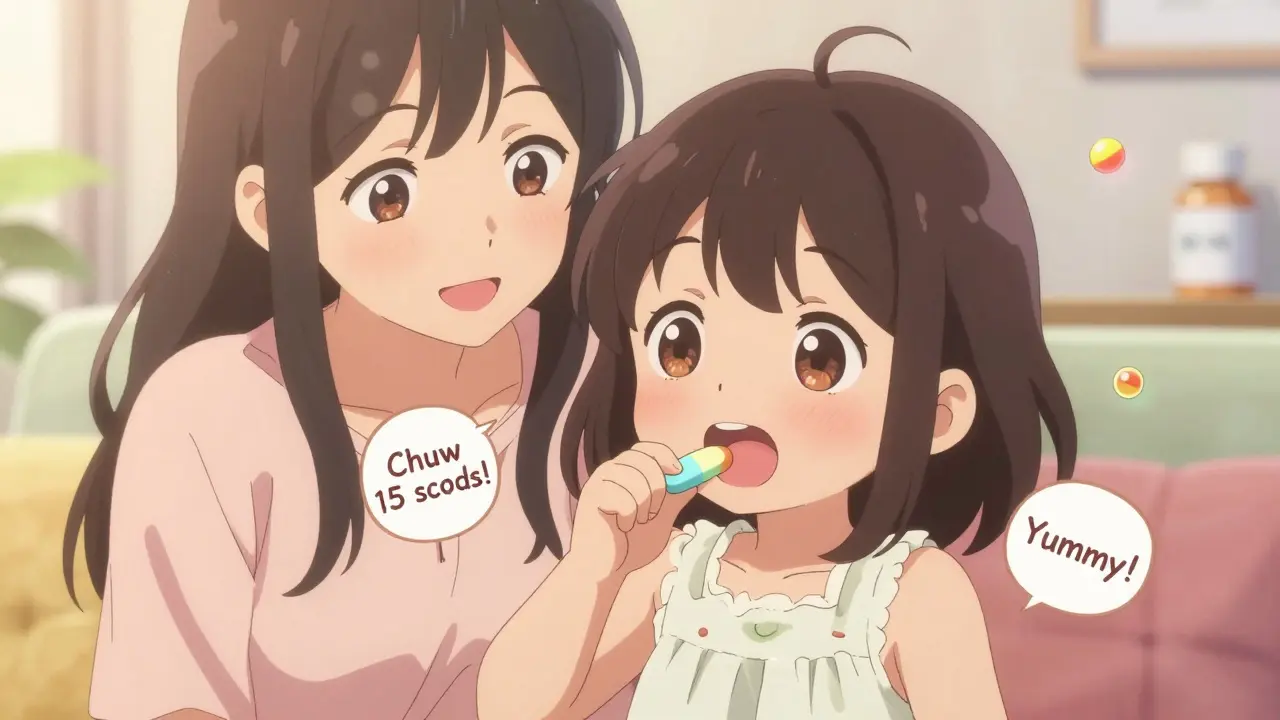
Switching your child from liquid medicine to a chewable or tablet can feel like a win-no more messy spills, no more fighting over a spoonful of bitter syrup, and no more worrying about measuring the right amount. But if you skip the right steps, it can also lead to underdosing, missed doses, or even serious side effects. This isn’t just about changing the form of the medicine-it’s about making sure your child gets the full benefit of the drug, safely and consistently.
Why Switch from Liquid to Chewable or Tablet?
Liquid medications are common for kids because they’re easy to adjust by dose and swallow. But they come with real downsides. Studies show that up to 60% of parents struggle with accurate dosing using measuring cups or syringes. A single misread line can mean your child gets too little-or too much-medicine. And let’s not forget the refrigeration needs: 68% of pediatric liquids must be kept cold, making travel, school, or even a quick trip to the store a hassle. Chewable tablets solve many of these problems. They’re stable at room temperature, come in pre-measured doses (with less than 2% variation in accuracy), and last 24 to 36 months-almost double the shelf life of liquids. For kids who are old enough to chew (usually age 2 and up), they’re often easier to take. A 2023 study found that switching a 4-year-old from liquid antibiotics to chewables improved adherence from 65% to 92% over six months. Parents reported fewer meltdowns and no more sticky bottles collecting dust in the cabinet.When Is It Safe to Switch?
Not all kids are ready for chewables. Age matters, but so does ability. Most children can safely chew and swallow tablets between ages 2 and 3, but it depends on their development. If your child has trouble chewing food like apples or crackers, they may not be ready for medicine tablets yet. If they’ve ever choked on food or have a history of swallowing pills whole without chewing, talk to your doctor first. The American Association of Pharmaceutical Scientists recommends a swallowing assessment before switching. Tools like the Gugging Swallowing Screen help doctors check if your child can handle solids safely. Even if your child seems fine, some medications-like potassium chloride or certain antibiotics-can cause serious harm if swallowed whole. One hospital reported three pediatric asthma flare-ups in six months because parents switched to chewable albuterol tablets but didn’t teach their kids to chew them properly.How to Match the Dose Correctly
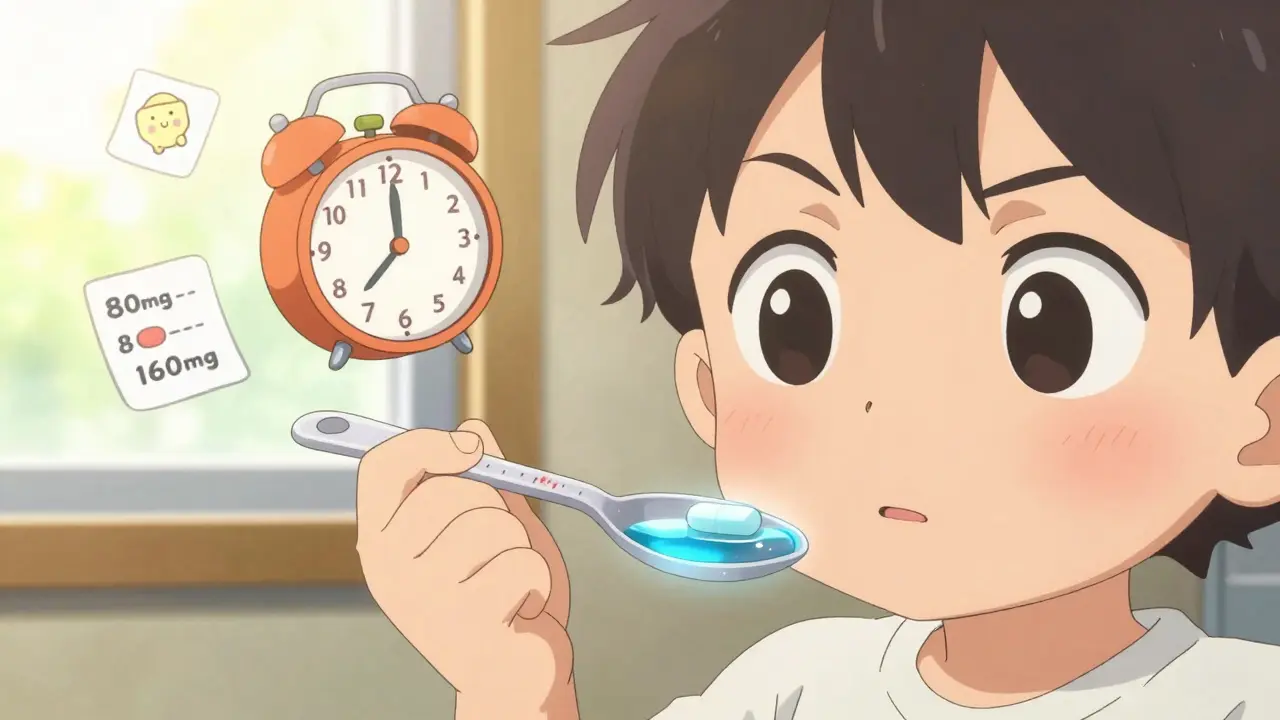
This is where most mistakes happen. Liquid and chewable doses aren’t always one-to-one. For example, Tylenol Children’s Suspension is 160 mg per 5 mL. The chewable tablet is also 160 mg. So if your child needs 80 mg, you give them half a tablet-not half a teaspoon. Mixing up volume (mL) and weight (mg) is the most common error, accounting for 87% of dosing mistakes reported by pharmacists. Always check the label. The exact dose for your child’s weight is listed on the packaging. For instance:- 12-17 lbs: 80 mg → ½ tsp liquid OR 1 chewable tablet
- 18-23 lbs: 120 mg → ¾ tsp liquid OR 1.5 chewable tablets
- 24-35 lbs: 160 mg → 1 tsp liquid OR 1 chewable tablet
What to Look for in a Good Chewable Tablet
Not all chewables are created equal. A high-quality pediatric chewable should:- Disintegrate within 30 minutes in stomach fluid (per USP standards)
- Have a hardness of 4-8 kiloponds (too soft = crumbles; too hard = hard to chew)
- Contain disintegrants like sodium starch glycolate (2-8%) to help it break down
- Be labeled clearly: “Chew thoroughly before swallowing” or “Do not swallow whole”
Teach Your Child How to Chew the Tablet
This step is often skipped-and it’s the most critical one. A 2023 University College London study found that 23% of transition failures happened because kids swallowed the tablet whole. Even if they chew a little, they might not chew long enough. Here’s how to teach it:- Practice with a piece of soft candy first-like a mini marshmallow or a gummy bear.
- Explain: “This medicine needs to be chewed like your food. Bite it, chew it, and swallow it. Don’t just hold it in your mouth.”
- Set a timer for 15-20 seconds. Have your child chew until the tablet is gone.
- Ask them to describe how it tastes and feels. This helps them remember the process.
Watch for Common Problems
Even with the best plan, things can go wrong. Here’s what to watch for:- Tablet too big: A 500 mg chewable can be overwhelming for a small mouth. If your child refuses or gags, ask about a lower dose or a different brand.
- Taste issues: Some kids say chewables taste worse than liquids. Try refrigerating the tablet for 10 minutes before giving it-it can dull bitter flavors.
- Swallowing whole: If your child swallows without chewing, the medicine may not work. Watch them closely for the first few doses.
- Added sugars: Chewables often contain more sweeteners than liquids. If your child has diabetes or is on a low-sugar diet, check the ingredient list.
Follow-Up Is Non-Negotiable
Don’t assume the switch worked just because your child took the pill. A 2023 policy from the University of Toledo Medical Center requires a follow-up within 72 hours after any liquid-to-chewable transition. Call your doctor or pharmacist. Ask:- Did my child take the full dose?
- Did they chew it properly?
- Are there any signs the medicine isn’t working (like fever returning, rash, or cough worsening)?
What About Tablets That Aren’t Chewable?
Sometimes, your doctor may suggest a regular tablet instead of a chewable. This is common for older kids (ages 8-12) who can swallow pills. But it’s not always safe to assume a tablet can be crushed or mixed into food. Some medications-like extended-release pills or enteric-coated tablets-must be swallowed whole. Crushing them can change how they work or make them unsafe. Always ask: “Can this tablet be crushed or mixed with applesauce?” If you’re unsure, don’t guess. Ask your pharmacist.The Future of Pediatric Medicines
The market for chewable medicines is growing fast. By 2028, experts predict 35% of all pediatric oral medications will be chewable or dissolvable tablets-up from 22% today. New tech like 3D-printed pills that can be customized for exact doses and flavors is already in clinical trials. One company is testing chewables that dissolve in 60 seconds even if swallowed whole, reducing the risk of therapeutic failure. For now, the best tools you have are knowledge and attention. Switching from liquid to chewable isn’t just about convenience-it’s about making sure your child gets the right dose, every time.Can my 2-year-old take chewable medicine?
Some 2-year-olds can safely chew and swallow tablets, but it depends on their development. If your child can chew soft foods like bananas or cooked carrots without choking, they may be ready. Always start with a small, soft chewable and supervise closely. Avoid tablets that require strong chewing or are larger than a pea. Ask your pediatrician for a swallowing assessment before switching.
What if my child swallows the chewable tablet whole?
If your child swallows a chewable tablet whole, it may not work as well. Some tablets are designed to dissolve quickly even if not chewed, but others can take over two hours to break down-delaying or reducing the medicine’s effect. Watch for signs the medicine isn’t working, like fever returning or symptoms persisting. If you’re unsure, call your pharmacist. They can tell you if the specific tablet is safe to swallow whole or if you need to give another dose.
Are chewable tablets as effective as liquid medicine?
Yes-if they’re bioequivalent. The FDA requires chewable tablets to match the liquid version in how much medicine enters the bloodstream (AUC and Cmax levels). Look for the product’s listing in the FDA Orange Book to confirm it’s approved as equivalent. If your child chews it properly, the effect should be the same. If they don’t chew it, the effect may be weaker.
Can I crush a chewable tablet and mix it with food?
Some chewables can be crushed, but not all. Always check the label or ask your pharmacist. If the tablet is designed to be chewed and swallowed, crushing it usually won’t hurt. But if it’s an extended-release or enteric-coated tablet, crushing it can make it unsafe or less effective. Never crush a tablet without confirmation from a healthcare professional.
How do I know if the chewable tablet is the right dose for my child?
Check the weight-based dosing chart on the package or ask your pharmacist. Liquid doses are measured in milliliters (mL), while chewables are measured in milligrams (mg). Don’t assume 1 tsp = 1 tablet. For example, 160 mg of acetaminophen in liquid is 5 mL, but the chewable tablet is also 160 mg-so one tablet equals the full dose, not half a teaspoon. Use a trusted dosing tool like the ISMP Medication Safety Calculator to avoid errors.
waneta rozwan
January 17, 2026 AT 03:27Okay but have you seen the sugar content in these 'chewables'? My kid got a cavity from Zyrtec. Like, it's literally candy with a side of medicine. I'm not even mad-I'm just disappointed. The pharmaceutical industry is selling sugar-coated panic.
And don't even get me started on the 'ChewSmart' color-changing ones. That's not innovation-that's a toddler toy with a prescription label. I'm just waiting for the TikTok trend where kids chew them for the glow.
Also, why does everything have to be 'FDA-approved' now? I'm not asking for a NASA mission. I'm asking for my kid to not throw up after taking Tylenol.
Stop marketing fear. Start marketing honesty.
Nicholas Gabriel
January 18, 2026 AT 05:19Let me just say this: the transition from liquid to chewable is not a minor adjustment-it’s a medical milestone, and it requires intentionality, patience, and yes, even a little bit of science. The dosing charts? Non-negotiable. The swallowing assessment? Absolutely essential. The fact that 87% of dosing errors come from confusing mL with mg? That’s not a typo-it’s a public health crisis waiting to happen. And if you think your child can just ‘figure it out’ by watching you? Please. No. Just no. You wouldn’t let them drive a car without training. Why would you let them ingest medication without instruction? Please. Please. Please. Talk to your pharmacist. Write it down. Use the ISMP calculator. And for the love of all that is holy, don’t let your kid swallow it whole. Ever.
Cheryl Griffith
January 19, 2026 AT 00:44I switched my 3-year-old to chewables last month after a week of midnight syrup fights. It was night and day. No more sticky bottles, no more ‘I don’t like the taste’ meltdowns. But I did have to practice with gummy bears first-like the article said. We did the 15-second chew timer. She thought it was a game. Now she asks for her ‘chewie’ like it’s a treat.
Still, I watch her like a hawk the first few times. One time she tried to swallow it whole-I had to make her spit it out. Awkward, but worth it.
Also, refrigerating them? Genius. The bitter ones taste way better cold. I didn’t know that until I read this.
swarnima singh
January 20, 2026 AT 05:26u know what this is really about? capitalism. they dont want you to have liquid meds anymore because they expire faster and cost more to ship. chewables? they last longer. they make more money. they put sugar in it so kids get addicted to the taste. and now they want you to pay extra for 'chewsmart' color changing pills? like its a magic trick? i swear the system is designed to make parents feel guilty if they dont buy the newest version. and dont even get me started on the 'dose chart'-who made that? some pharma rep in a suit? my baby is 22 lbs but the chart says 1.5 tablets? how is that even precise? i think they just want us to buy more pills.
also why do they always say 'ask your doctor' like we have time for that? we're tired. we're broke. we just want our kid to feel better.
Isabella Reid
January 21, 2026 AT 15:35I’m from the Philippines and we don’t have access to most of these fancy chewables here. We still use liquid-and we manage. But honestly? I wish we did. The dosing errors are real. My cousin’s kid got sick because someone misread the syringe.
Still, I think the real win here is the behavioral shift. Kids who chew their meds are more involved in their own care. That’s huge. It’s not just about convenience-it’s about building trust and routine. And yeah, the taste thing? Real. But I’ve seen kids go from screaming to saying ‘my chewie!’ like it’s a badge of honor.
Also, refrigerating? Yes. Always. Even in humid climates. It helps.
Jody Fahrenkrug
January 22, 2026 AT 08:12My 5-year-old refused liquid meds for months. Then we tried the chewables. He took one like it was a Skittle. No drama. No tears. Just a happy kid who got his medicine.
Still, I double-check the dose every time. I don’t trust myself. I don’t trust the labels. I use the ISMP app. It’s a lifesaver.
And yes, I refrigerate them. The bitter ones? Better cold. Also, the ones that taste like chalk? Gone. We switched brands. No shame.
Kasey Summerer
January 23, 2026 AT 15:08So let me get this straight… we’re now paying extra for ‘ChewSmart’ tablets that change color when chewed? Like, what is this, a Pokémon card? 😂
Next they’ll come out with a chewable that plays a jingle when you bite it right. ‘Good job, Timmy! You chewed it for 17.3 seconds!’
Also, why does every pediatric med now come with a 12-page pamphlet? I just want my kid to stop coughing. Not attend a pharmaceutical bootcamp.
Also, who decided ‘chalky’ was an acceptable flavor? That’s not medicine. That’s regret.
kanchan tiwari
January 24, 2026 AT 01:01they are LYING to you. chewables are not safer. they are a trap. the government and big pharma want you to think they are better so you stop asking for liquid. why? because liquid can be traced. chewables? they can put anything in them. and the color changing? that’s a tracking chip. they know when your kid takes it. they know if they swallow it whole. they know if you forget. they are watching. always watching. and the ‘dose chart’? it’s based on fake studies. my neighbor’s kid got sick after chewables. the hospital said ‘no side effects’ but i know. i saw the documents. they were redacted. they are covering it up. and the sugar? it’s not just sugar. it’s a chemical that makes kids addicted. you think your kid likes the taste? no. they are being programmed. wake up.
Bobbi-Marie Nova
January 25, 2026 AT 03:38Okay, I’ll be real-I was skeptical. But after switching my 4-year-old from liquid to chewables, I’m a convert. No more midnight battles. No more syrup on the ceiling. Just a kid who takes her medicine like a champ.
And yeah, the taste thing? Totally real. We tried three brands before finding the one that didn’t taste like regret. Refrigerating? Game changer. Also, the gummy bear practice? Genius. She thought it was a fun game. Now she’s proud of herself.
Also, I used the ISMP calculator. Because I’m not risking my kid’s life on a hunch. No shame in that.
Also, I cried when she chewed it right the first time. It was a moment.
Allen Davidson
January 26, 2026 AT 15:19This is exactly the kind of practical, science-backed guidance parents need. Too many of us wing it because we’re tired. This isn’t just about pills-it’s about responsibility. You wouldn’t skip a car seat. Why skip a dosing check?
And the swallowing assessment? That’s not optional. If your kid can’t chew an apple, they’re not ready. Period.
Also, the ‘ChewSmart’ thing? Honestly, I’m impressed. If it improves adherence by 92%, then it’s worth it. Tech that helps kids take medicine? That’s innovation.
Don’t cut corners. Your kid’s health isn’t a gamble.
john Mccoskey
January 27, 2026 AT 14:38Let’s be brutally honest: the entire chewable tablet industry is built on a foundation of convenience-driven negligence. You think you’re saving time? You’re creating new risks. The USP standards? Meaningless when 30% of chewables lack proper disintegrants. The FDA Orange Book? A glorified marketing catalog. Bioequivalence studies? Often funded by the same companies selling the product. And let’s not forget the psychological manipulation: turning medication into a ‘game’ with color-changing tablets and gummy bear drills. This isn’t pediatric care-it’s behavioral engineering. You’re not teaching your child to be responsible for their health-you’re conditioning them to associate medicine with reward-based performance. And the sugar? Oh, please. The average chewable tablet contains more added sugar than a candy bar. You think that’s okay because it’s ‘medicine’? That’s not medicine. That’s a corporate scam dressed in pastel packaging. And the follow-up requirement? A Band-Aid on a hemorrhage. The real problem is that we’ve outsourced medical literacy to pharmacists and apps because we’ve stopped trusting our own instincts. But here’s the truth: no algorithm can replace a parent who pays attention. And if you’re relying on a ‘ChewSmart’ tablet to tell you if your child chewed properly, you’ve already lost.
Ryan Hutchison
January 29, 2026 AT 11:38Why are we letting big pharma dictate how we give our kids medicine? In my day, we just gave them the syrup and told them to swallow it. No color-changing nonsense. No gummy bear training. No ISMP calculators. Just a spoon and a prayer.
Now we’re turning kids into lab rats with ‘dose charts’ and ‘swallowing assessments.’ What’s next? A background check before giving Tylenol?
Also, chewables are just a way for corporations to charge more. Liquid lasts 12 months. Chewables last 36. So they make more money. That’s the real story. Not ‘better adherence.’ Profit.
And don’t get me started on the ‘ChewSmart’ nonsense. That’s not medicine. That’s a toy with a warning label.
Samyak Shertok
January 31, 2026 AT 10:27Oh wow. So now we’re supposed to believe that chewables are ‘better’ because some university study says 92% adherence? That’s like saying people drive faster because GPS says ‘you’re on time.’
Meanwhile, in India, we still use liquid because it’s cheaper, adjustable, and doesn’t require a PhD to administer. And guess what? Kids don’t die. They get better.
Also, ‘ChewSmart’? That’s not innovation. That’s a marketing gimmick for rich Americans who think their kids are too special to swallow a pill.
And the sugar? Please. You think your kid’s cavities are from medicine? Nah. It’s from the 300 snacks you let them eat while watching YouTube.
Stop buying into this pharmaceutical theater. Just give them the syrup. And if they spit it out? So what? They’ll live.
waneta rozwan
February 1, 2026 AT 08:24Ugh. I just read the comment about ‘ChewSmart’ being a tracking chip. I’m not even mad. I’m impressed. That’s the most creative conspiracy I’ve heard this week.
But seriously? My kid took a chewable yesterday. I watched him. He chewed it. I didn’t see any glowing. No hidden cameras. No drones. Just a kid who finally took his medicine without crying.
Maybe… just maybe… the real conspiracy is that we’ve forgotten how to trust each other.
And also, I’m buying the next flavor. The grape one. It’s better than the chalk.