
Imagine you’re sitting in economy class, watching the flight map cross three time zones. Your stomach growls, and your phone buzzes with a reminder: it’s time for your dose. But is it? Do you stick to home time, or switch to destination time immediately? For most pills, a few hours off doesn’t matter much. But if you rely on time-sensitive medications, which are drugs that require strict adherence to dosing schedules due to narrow therapeutic windows where minor deviations can impact safety, guessing games can lead to serious health risks.
Whether you manage diabetes, epilepsy, heart conditions, or immune disorders, keeping your routine intact while airborne is a challenge many travelers face. According to the Centers for Disease Control and Prevention (CDC), nearly 38% of travelers with chronic conditions need help adjusting their medication timing when crossing time zones. This number jumps to 62% if you’re crossing five or more zones. Getting this right isn’t just about comfort; it’s about preventing therapeutic failure or adverse reactions.
Identify Your Risk Level Before You Book
Not all medications behave the same way during travel. The first step is understanding how sensitive your specific drug is to timing changes. The American Society of Health-System Pharmacists (ASHP) updated guidelines in August 2024 emphasize that there is no one-size-fits-all rule. Instead, you need to look at the pharmacokinetics-how your body processes the drug.
Generally, medications fall into two categories:
- Low Sensitivity: Drugs with half-lives longer than 8 hours. These stay in your system long enough that a 1-2 hour shift usually won’t cause issues. Most antibiotics and some blood pressure meds fit here.
- High Sensitivity: Drugs with short half-lives, narrow therapeutic indices, or those requiring precise trough levels. This includes insulin, warfarin, anti-epileptics, and immunosuppressants. For these, even small shifts can trigger seizures, bleeding risks, or organ rejection.
If you take high-sensitivity drugs, you cannot wing it. Dr. Sarah Thompson, Director of Travel Medicine at Johns Hopkins University, advises maintaining your home time zone schedule for the first 48-72 hours after landing, then gradually shifting to the local schedule. This prevents the shock of sudden timing changes.
Navigate Security and Storage Rules
Before worrying about clocks, you have to worry about getting your meds through security without hassle. The Transportation Security Administration (TSA) has clear rules, but they change often. As of November 2023, you can carry all necessary medications in original containers through checkpoints. There are no quantity restrictions for solid forms like pills.
Liquid medications get special treatment too. They are exempt from the standard 3.4-ounce limit. However, you must declare them to the officer separately from your other liquids. If you use gel ice packs for temperature control, they are permitted even if partially melted, provided they are for medically necessary items.
| Medication Type | Container Rule | Liquid Limit Exception | Screening Process |
|---|---|---|---|
| Solid Pills/Tablets | Original prescription bottles recommended | N/A | Standard X-ray screening |
| Liquids/Gels/Syrups | Any container size | Exempt from 3.4 oz limit | Must be declared separately |
| Coolers/Ice Packs | Required for temp-sensitive drugs | Gel packs allowed if melted | May undergo additional screening |
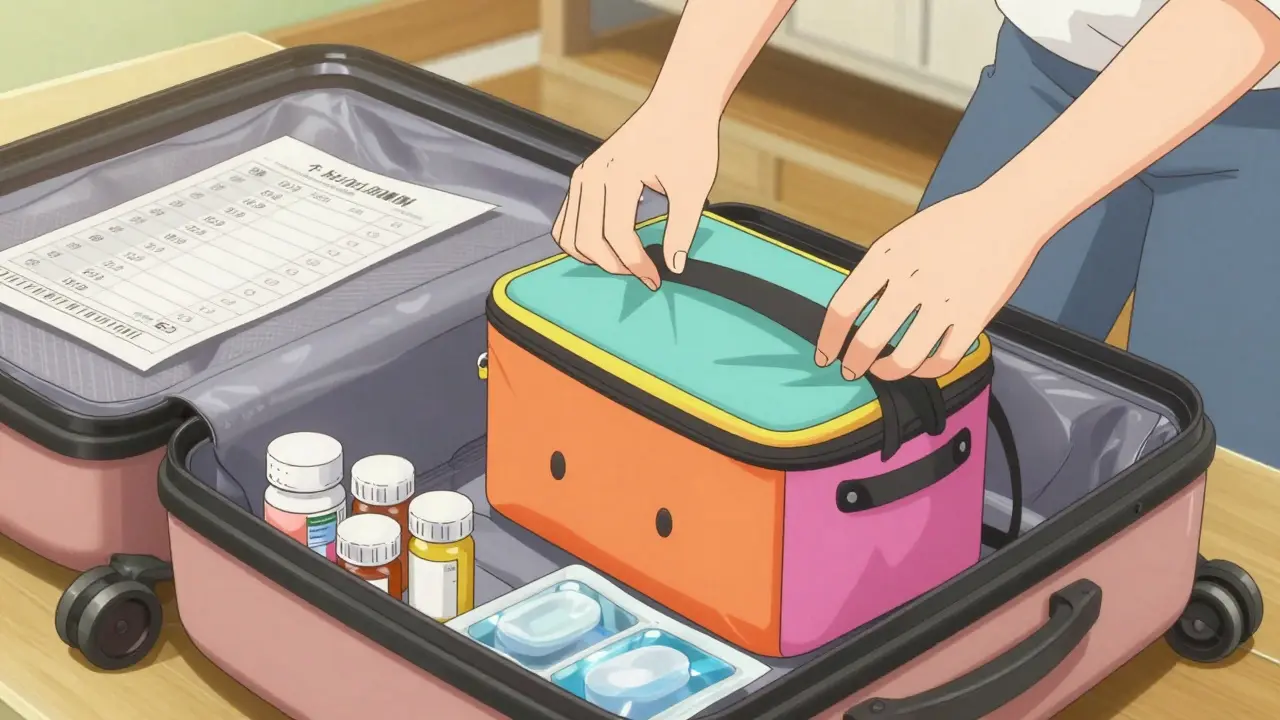
Storage is another critical layer. About 35% of time-sensitive medications need temperature control between 35-46°F (2-8°C). Insulin is the biggest culprit here, accounting for 58% of specialty medication travel cases. A portable cooler like the Travelport 3.0, which uses phase-change technology to maintain temperature for up to 48 hours without power, is a reliable investment. Never put these bags in overhead bins where temperatures can fluctuate wildly; keep them under the seat or in your personal bag.
Calculate Your Dosing Schedule
This is the part that causes the most anxiety. When do you take your first dose after landing? The answer depends on direction and distance.
The University of Michigan Health System developed a protocol that reduces timing errors by 76%. It works like this:
- Traveling Eastbound (e.g., NY to London): You lose time. Advance your schedule by 1 hour for each time zone crossed per day. If you cross 5 zones, shift your dose 1 hour earlier each day for 5 days until you match local time.
- Traveling Westbound (e.g., London to NY): You gain time. Delay your schedule by 1 hour for each time zone crossed per day. This is generally easier on the body because extending the interval between doses is safer than shortening it for most drugs.
For medications with very long half-lives, the CDC suggests immediate adjustment to local time. But for short half-life drugs, the gradual shift is safer. Always consult your pharmacist before finalizing this plan. They can calculate the exact window based on your specific drug’s metabolism rate.
Use Tools to Automate Reminders
Human memory fails under stress, jet lag, and unfamiliar surroundings. Don’t rely on it. Use technology designed for this exact problem.
Apps like Medisafe, downloaded over 1.2 million times as of August 2024, automatically adjust schedules based on your flight itinerary. You input your departure and arrival times, and the app recalculates your next dose based on the new time zone. It sends alerts even if your phone’s clock hasn’t synced yet.
If you prefer hardware, the MedTime Zone Watch allows you to set multiple time zones simultaneously. You can glance at your home time for reference while seeing the current local time. For those who want zero tech friction, a simple printed timeline created 72 hours before travel helps. List every dose time in both home and destination formats. Tape it to your medication bottle.
Prepare for Emergencies and Regulations
Even with perfect planning, things go wrong. Flights get delayed, luggage gets lost, or you feel unwell mid-flight. Preparation is your safety net.
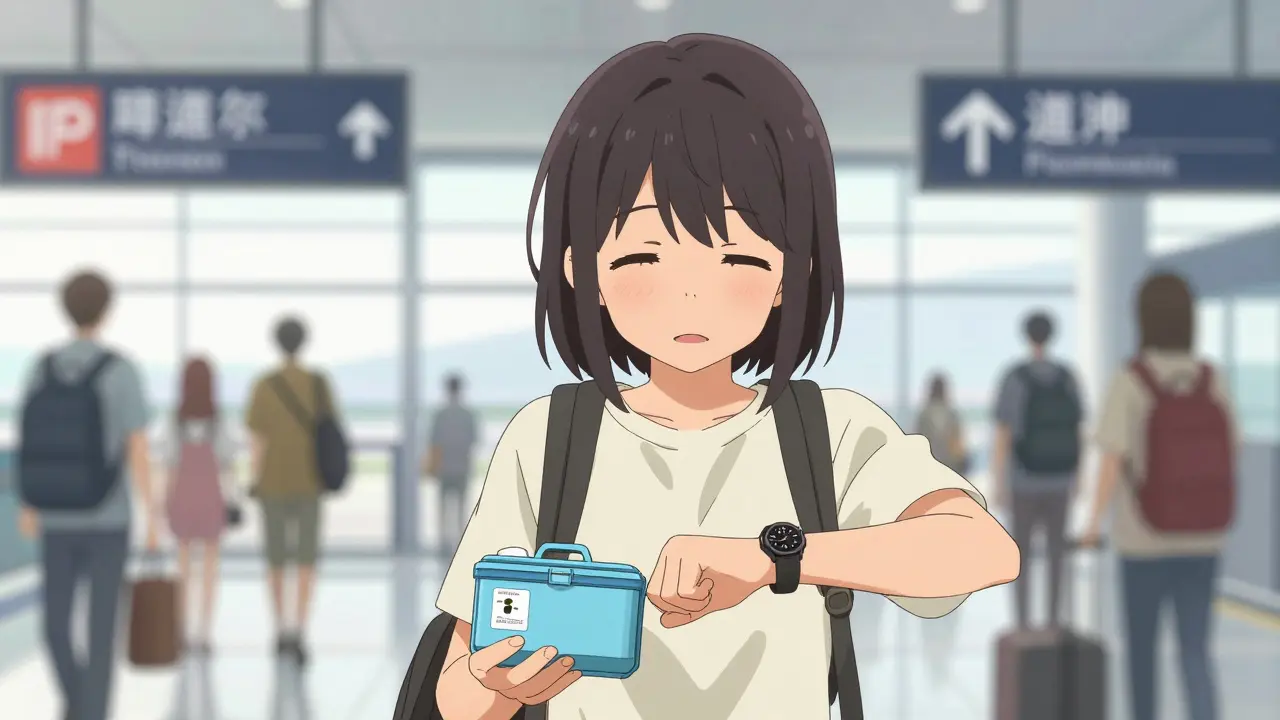
Always carry a complete medication list. The CDC recommends including drug names (brand and generic), dosages, frequency, prescribing doctor’s name, and pharmacy contact info. Emergency departments report that 83% of medication-related issues are resolved faster when this information is available. Keep a digital copy in your cloud storage and a physical copy in your wallet.
Regulations vary wildly by country. The CDC’s Yellow Book 2024 notes that 37 countries require special permits for medications considered standard in the US. Pseudoephedrine is prohibited in 12 countries, and zolpidem requires advance permission in 24 others. Check the embassy website of your destination country before packing. Carry your medications in original labeled bottles to prove legitimacy if questioned by customs.
If you experience side effects or missed doses during travel, seek medical attention immediately. Do not double up doses to "catch up" unless explicitly instructed by your doctor. WebMD warns that doubling doses can lead to toxicity, especially with narrow therapeutic index drugs.
Final Checklist Before Departure
To ensure you’re fully prepared, run through this quick checklist:
- Consult your pharmacist: Discuss your travel plans at least two weeks before departure. Studies show 89% of travelers who do this report successful management compared to only 47% who make last-minute adjustments.
- Pack extras: Bring at least 3-5 extra days’ worth of medication in case of delays. Split them between your carry-on and checked luggage if possible, but never leave any essential meds in checked bags.
- Test your cooler: If using a portable cooler, test it at home to ensure it maintains temperature for the expected duration.
- Set alarms: Program your phone or watch with both home and destination times for the first 48 hours.
- Carry documentation: Have your medication list, doctor’s note, and prescription labels easily accessible.
Flying with time-sensitive medications doesn’t have to be stressful. With proper planning, the right tools, and clear communication with your healthcare team, you can maintain your health routine across any time zone. Safety comes from preparation, not improvisation.
Can I bring liquid medication through airport security?
Yes, liquid medications are exempt from the standard 3.4-ounce limit imposed by the TSA. You must declare them separately to the security officer for screening. Ensure they are in their original containers with clear labels to avoid delays.
Should I adjust my medication schedule immediately upon arrival?
It depends on the medication. For drugs with long half-lives, immediate adjustment is often safe. For time-sensitive medications with short half-lives or narrow therapeutic windows, experts recommend gradually shifting your schedule by 1 hour per day toward the destination time to avoid adverse effects.
What should I do if I miss a dose while flying?
Do not double your next dose to make up for the missed one unless specifically instructed by your doctor. Contact your healthcare provider or a local clinic at your destination for guidance. If you cannot reach anyone, follow the general advice on your medication label, but prioritize safety over strict timing if the delay is minor.
Are gel ice packs allowed in carry-on luggage?
Yes, the TSA permits gel ice packs in carry-on bags if they are used for medically necessary items like insulin or biologics. They are allowed even if partially melted. Be prepared for additional screening, and inform the officer that the pack is for medical purposes.
How far in advance should I consult my pharmacist before traveling?
Ideally, at least two weeks before your trip. This gives you time to create a detailed medication timeline, obtain necessary travel letters or permits, and discuss potential interactions or scheduling adjustments based on your specific pharmacokinetics.
Is it safe to store medication in overhead bins?
No, especially for temperature-sensitive medications. Overhead bins can experience extreme temperature fluctuations depending on the aircraft's environment. Store your medications in your personal bag under the seat or in your pocket to keep them within the required temperature range.
What documents should I carry for international travel with medication?
Carry a list of your medications (generic and brand names), dosages, frequency, prescribing doctor’s contact info, and pharmacy details. Also, bring a letter from your doctor explaining your condition and the necessity of the medications. Keep prescriptions in their original labeled containers.
Can I take my medication 1-2 hours early or late?
For many medications, a 1-2 hour variation is safe. However, for time-sensitive drugs like anti-epileptics, immunosuppressants, or insulin, even small deviations can be risky. Always check with your pharmacist or doctor to determine the acceptable window for your specific medication.