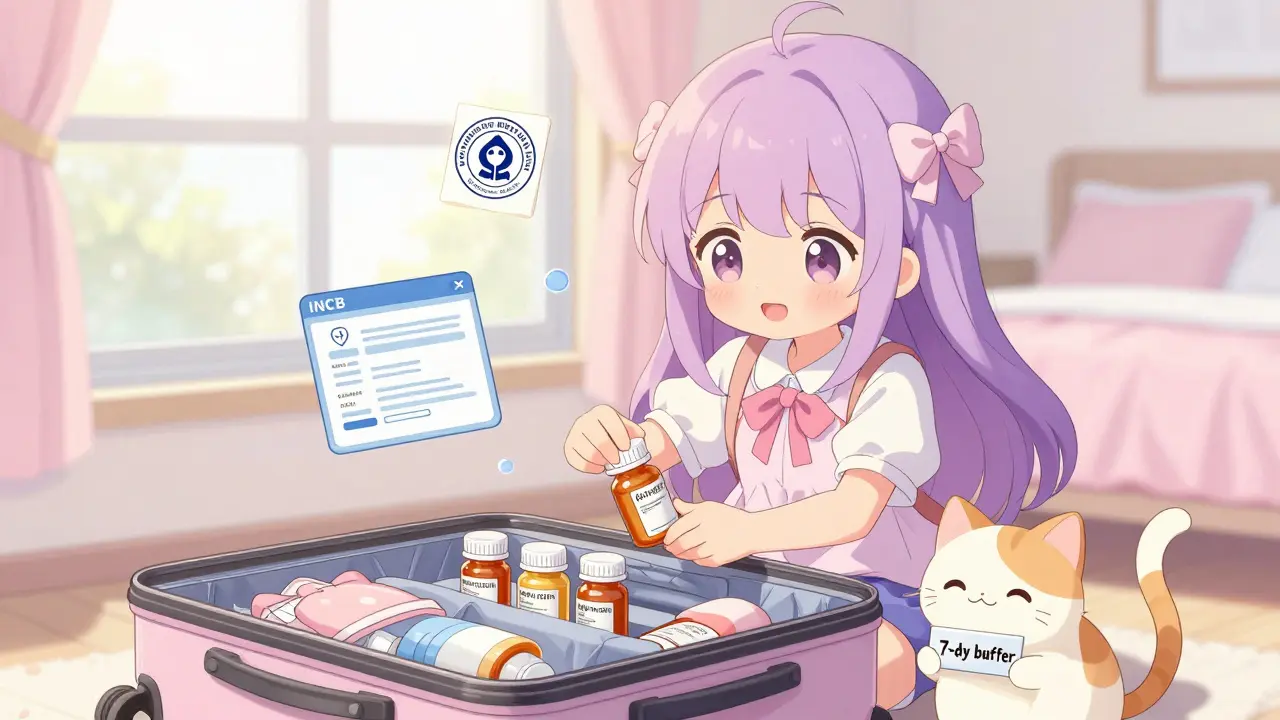
Running out of your medication halfway through your trip isn’t just inconvenient-it can be dangerous. For people managing chronic conditions like high blood pressure, diabetes, anxiety, or ADHD, missing a dose can lead to hospital visits, panic attacks, or worse. And if you’re carrying controlled substances like opioids, benzodiazepines, or stimulants, you could face detention, fines, or even jail in some countries-even if your meds are perfectly legal back home.
Why This Isn’t Just About Packing Extra Pills
It’s not enough to just grab your prescription bottle and throw it in your suitcase. Over 12% of international travelers run into medication problems abroad, according to the CDC’s Yellow Book. Some of these are simple: forgetting to refill, misjudging how long your supply will last. But the biggest risks come from legal traps. In Thailand, carrying just 28 tablets of alprazolam without a notarized doctor’s letter landed someone in a 4-hour detention. In Japan, common ADHD meds like Adderall are outright banned. In the UAE, codeine can get you five years in prison.
These aren’t rare cases. The U.S. Department of State documented over 70 such incidents in 2024 alone. And it’s not just about drugs you’d think are risky. Even over-the-counter decongestants like pseudoephedrine are illegal in Japan and restricted in many European countries. Your local pharmacy might sell it without a second thought-but overseas, it’s treated like a controlled substance.
Step 1: Know What’s Allowed Where
Start by checking the International Narcotics Control Board (INCB) Country Regulations database. It’s the most reliable public source for up-to-date rules on what medications are banned, restricted, or require permits in over 180 countries. Type in your medication’s generic name-not the brand name-because regulations are based on active ingredients. For example, if you take Vyvanse, search for “lisdexamfetamine,” not the brand.
Some countries have extreme lists. Japan bans over 1,400 medications, including common antibiotics, antihistamines, and sleep aids. Saudi Arabia requires every single prescription to be pre-approved by their Ministry of Health. Thailand demands notarized letters for any controlled substance. The INCB database updates monthly, and as of January 2026, it now includes direct embassy contact links for 68 countries, making it easier to verify requirements.
Step 2: Contact the Embassy-No Excuses
Don’t rely only on the INCB. Embassies often have their own rules, and sometimes they’re stricter. Call or email your destination’s embassy at least 60 days before you leave. Ask these three questions:
- Is my medication legal to bring into your country?
- Do I need a special permit or letter from my doctor?
- Is there a limit on how much I can carry?
Save the email or note down the name of the person you spoke to. If they say “yes, but you need a letter,” ask for the exact wording they require. Some embassies have templates. Others want specific phrases like “medically necessary for chronic condition” or “no substitution available.” Get it in writing.
Pro tip: If you’re flying through multiple countries, check transit rules too. You might be fine in your final destination, but if you’re connecting through Dubai or Singapore, their rules apply while you’re in their airport.
Step 3: Talk to Your Doctor-Early and Often
Your doctor isn’t just there to write prescriptions. They’re your key to crossing borders safely. Ask them for:
- A letter on official letterhead explaining your condition, the medication name (generic and brand), dosage, and why it’s medically necessary.
- Confirmation that your prescription is valid for international travel.
- Generic equivalents in case your brand isn’t available abroad.
Some doctors also provide an International Certificate for Medicinal Products (ICMP). About 68% of U.S. pharmacies can help you get one-it costs $25 to $40, but it’s worth it. The ICMP is recognized in over 50 countries and can save you hours at customs.
If you’re on ADHD meds, opioids, or benzodiazepines, your doctor may need to sign additional forms. Don’t wait until the last minute-some doctors take weeks to process these requests.
Step 4: Pack the Right Amount-Plus a Buffer
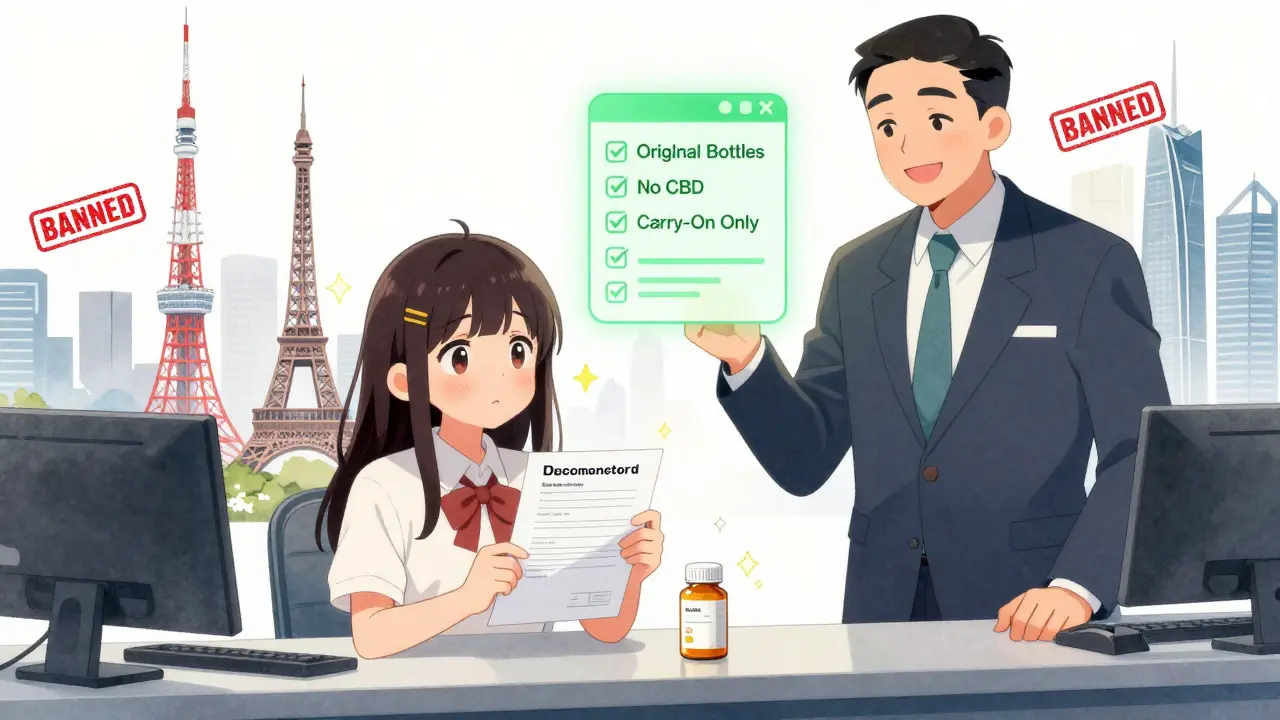
U.S. Customs and Border Protection says you can bring no more than a 90-day supply for personal use. That’s a good rule of thumb. But here’s the catch: what if your trip is 60 days long and you have a 30-day refill delay? You’ll be stuck.
Always pack at least 7 extra days’ worth. That’s the minimum buffer experts recommend. If you’re going somewhere with unreliable pharmacies or if your medication is hard to find (like certain antidepressants or hormone therapies), pack 14 to 30 extra days. Better safe than stranded.
And never, ever mail your meds. The U.S. Postal Service and private couriers like FedEx or DHL can’t legally ship prescription drugs internationally. Even if they say they can, customs will seize them-and you’ll lose your supply.
Step 5: Pack Smart-Don’t Risk Confiscation
Here’s how to pack your meds so you don’t get stopped:
- Keep everything in original prescription bottles with your name and the pharmacy label clearly visible.
- Carry all medications in your carry-on. Checked luggage can get lost, delayed, or stolen. You need your meds with you at all times.
- If you’re bringing liquids (insulin, liquid antibiotics, eye drops), declare them at TSA security. You’re allowed more than 3.4 ounces if it’s medically necessary, but you must tell them.
- If you use needles or syringes, bring a doctor’s note explaining why you need them. Delta Air Lines and other major carriers require this for insulin users.
- Keep a printed copy of your doctor’s letter and embassy approval in your carry-on, separate from your meds.
Some U.S. states (California, New York, Texas, Florida, Illinois) require controlled substances to stay in original bottles-even for domestic flights. So even if you’re flying from New York to Tokyo, you still need to follow those rules. Don’t transfer pills to pill organizers unless you have a backup in the original bottle.
What If You’re Traveling to Multiple Countries?
If you’re hopping from France to Thailand to Japan, you’re playing a high-stakes game of regulatory whack-a-mole. The European Union has harmonized rules within Schengen countries, so you can move freely between France, Germany, and Italy with your meds. But once you step outside the EU, you’re back to square one.
Plan for the strictest country on your route. If Japan bans your ADHD med, you can’t carry it even if you’re only there for a layover. Always check each country’s rules individually. The INCB database lets you compare multiple countries side by side-use it.
What About CBD, Cannabis, or Hemp Products?
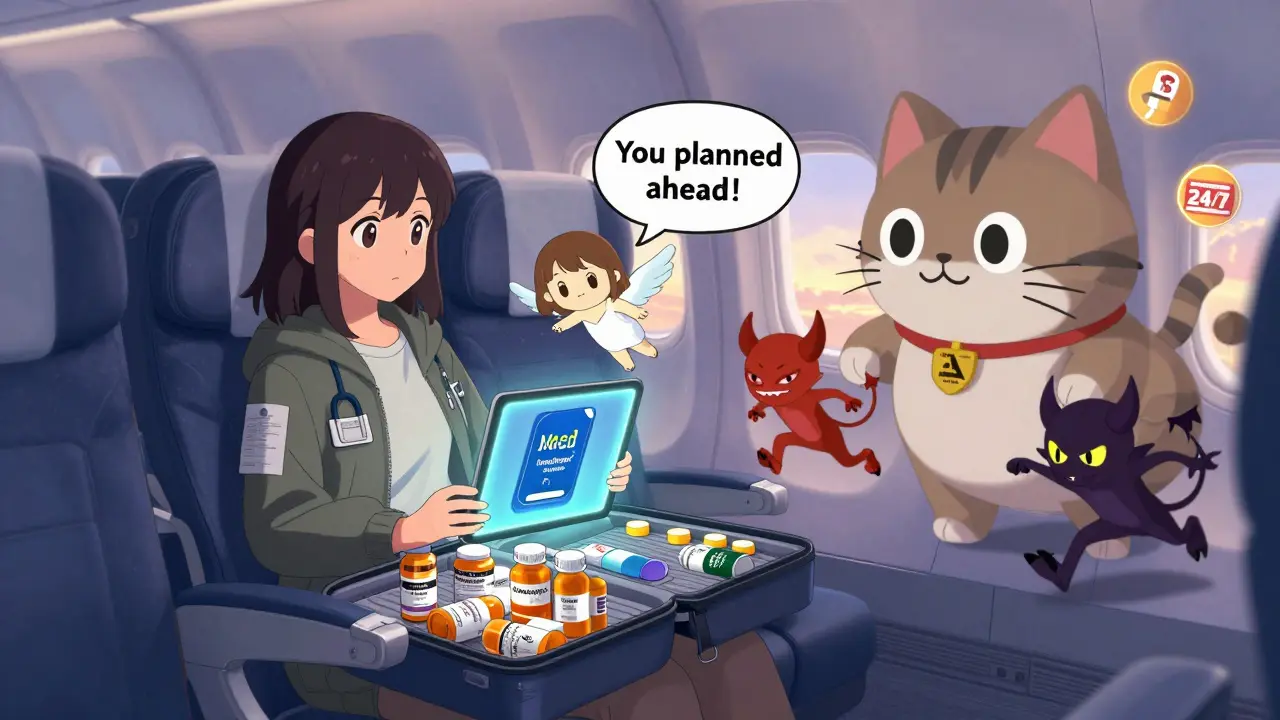
Even if it’s legal in your state or federally legal in the U.S., CBD and THC products are banned in 19 countries as of 2024. That includes South Korea, Malaysia, Singapore, and the UAE. Don’t assume “natural” means “allowed.” A CBD gummy that helps your anxiety could get you arrested in Bangkok. Leave it at home.
What If Something Goes Wrong?
Even with perfect planning, things can go sideways. Your flight gets delayed. Your bag gets lost. Your prescription runs out early.
Here’s what to do:
- Call your embassy. They can’t get you new meds, but they can help you find local doctors or pharmacies.
- Use the INCB’s 24/7 emergency line: +41 22 917 92 92. They can confirm if a medication is legal in a country and help you find alternatives.
- Keep a digital copy of your prescriptions and doctor’s letter on your phone and in the cloud.
- If you’re traveling with a chronic condition, consider signing up for a service like MedPassport ($49/year). It stores your meds, permits, and doctor info in one secure app that’s accessible offline.
Final Checklist: Before You Leave
Use this as your last-minute sanity check:
- ✅ All meds in original bottles with labels
- ✅ Doctor’s letter with generic names and dosage
- ✅ Embassy approval email or letter
- ✅ 7-30 extra days of medication
- ✅ Medications in carry-on, not checked bag
- ✅ Liquid meds declared at security
- ✅ Needles/syringes with doctor’s note
- ✅ Digital copies saved on phone and cloud
- ✅ INCB database checked for all countries on itinerary
- ✅ No CBD, THC, or hemp products in luggage
Getting your meds right doesn’t take magic. It takes planning. Start 8 to 12 weeks before you leave. Talk to your doctor. Check the embassy. Pack smart. You’ve managed your health this long-don’t let a trip overseas undo it.
Can I bring my prescription meds in a pill organizer?
Only if you also carry the original prescription bottles with you. TSA and customs require proof of legitimacy-your name, the pharmacy, and the doctor’s name must be visible. A pill organizer alone won’t cut it. Keep your full supply in original containers and use the organizer only for daily doses you’re actively using.
What if my medication isn’t available overseas?
Talk to your doctor before you leave. Ask for the generic name and dosage, and if there’s an equivalent medication used in your destination country. Some countries use different brand names or formulations. Your doctor can write a note explaining why you can’t switch. Never try to buy meds abroad without consulting a local doctor first-dosing and ingredients can vary dangerously.
Do I need a letter for over-the-counter meds like ibuprofen or allergy pills?
Usually not. But if you’re carrying large quantities (like 100+ tablets), or if you’re traveling to Japan, Saudi Arabia, or the UAE, even OTC meds can raise flags. Pseudoephedrine (in cold meds) is banned in Japan and restricted in Europe. When in doubt, carry a simple note from your doctor saying it’s for personal use. Better safe than questioned at customs.
Can I get my meds refilled while traveling?
Sometimes, but it’s risky. Many countries won’t refill a foreign prescription without seeing you in person. Even if they do, the pharmacy might not carry your exact brand or dosage. Always plan ahead and bring enough. Don’t count on being able to refill abroad unless you’ve confirmed it with the embassy and a local doctor beforehand.
What if I’m flying with insulin or other injectables?
You’re allowed to bring insulin and syringes in your carry-on, even if they exceed liquid limits. Always carry a doctor’s letter explaining your condition and need. Keep them in their original packaging. Some airlines, like Delta, require this documentation. Declare them at security. Most TSA agents are trained to handle medical devices, but being prepared avoids delays.
Kegan Powell
January 26, 2026 AT 18:12Candice Hartley
January 27, 2026 AT 13:13astrid cook
January 27, 2026 AT 15:00Anjula Jyala
January 28, 2026 AT 22:07Kirstin Santiago
January 29, 2026 AT 11:42Kathy McDaniel
January 30, 2026 AT 04:11April Williams
January 31, 2026 AT 11:50Harry Henderson
February 1, 2026 AT 11:48suhail ahmed
February 2, 2026 AT 18:15Andrew Clausen
February 3, 2026 AT 10:29John O'Brien
February 3, 2026 AT 10:47Paul Taylor
February 4, 2026 AT 10:12Desaundrea Morton-Pusey
February 5, 2026 AT 01:28Murphy Game
February 6, 2026 AT 11:06Conor Flannelly
February 7, 2026 AT 12:23