When you pick up a generic pill at the pharmacy, you expect it to work just like the brand-name version. But how do regulators know it’s truly the same? The answer lies in something most people never hear about: dissolution profiles. These aren’t just lab curves on a screen-they’re the silent gatekeepers of drug quality, safety, and effectiveness. If two drugs don’t dissolve the same way in the body, they won’t act the same way. And that’s why comparing dissolution profiles isn’t optional-it’s mandatory for every generic drug approved in the U.S., Europe, Canada, and beyond.
What Exactly Is a Dissolution Profile?
A dissolution profile is a graph that shows how quickly a drug releases from its tablet or capsule into a liquid that mimics the stomach or intestines. Think of it like watching sugar dissolve in water-but instead of sugar, it’s a pill, and instead of water, it’s a controlled fluid at body temperature (37°C). The test uses machines called dissolution apparatuses (usually USP Apparatus 1 or 2), spinning at 50-100 rpm, with samples taken every 5 to 30 minutes until at least 85% of the drug has dissolved.
For a generic drug to be approved, its dissolution curve must match the brand-name version’s curve almost perfectly. Not close. Almost. That’s because how fast a drug dissolves directly affects how fast it enters your bloodstream. If a generic dissolves too slowly, you might not get enough medicine. If it dissolves too fast, you could get too much at once. Either way, your treatment fails.
Why Compare Dissolution Profiles Instead of Doing Human Trials?
Traditionally, proving two drugs are equivalent meant running expensive, time-consuming bioequivalence studies-giving the drug to dozens of healthy volunteers, drawing blood every hour, and measuring drug levels in plasma. Those studies cost $500,000 to $2 million and take 6-12 months.
Dissolution profile comparison cuts that down. By showing the drug releases at the same rate under controlled lab conditions, regulators can skip the human trials entirely in many cases. This is called a biowaiver. In 2022-2023, 78% of generic drug applications to the FDA used this method. It’s not magic-it’s science backed by decades of data. A 2021 University of Maryland study found that using dissolution profiles instead of human trials saves up to 60% in development costs and speeds up approval by 12-18 months.
But here’s the catch: it only works if the dissolution method is discriminatory. That means the test has to be sensitive enough to catch even tiny differences. A poorly designed test might show two very different pills as identical. That’s why regulators require stress testing-like aging the tablets or changing compression pressure-to make sure the method can spot real problems.
The f2 Factor: The Industry Standard for Similarity
The most common tool for comparing dissolution profiles is the f2 similarity factor. Developed in 1996 by Moore and Flanner, it’s used in over 92% of FDA submissions. The math looks complicated, but the idea is simple: it measures how close two curves are across all time points.
The rule? f2 must be between 50 and 100. 100 means the profiles are identical. 50 is the minimum acceptable. If you get 49, your application gets rejected. No exceptions.
But f2 has flaws. It treats every time point equally-even if the drug dissolves 90% in the first 10 minutes. Two pills could have wildly different release patterns early on but still hit f2=52 because they both reach 85% by 45 minutes. That’s a problem. Dr. Diane Bunick from the University of Connecticut warned in a 2021 paper that f2 can’t detect differences in release mechanisms. One pill might dissolve in bursts; another might release steadily. f2 doesn’t care. It just sees the total.
That’s why experts now recommend combining f2 with other tools. The FDA suggests using the area under the curve (AUC) ratio. If the AUC of the generic is between 80% and 125% of the brand, and f2 is above 50, the chance of true bioequivalence jumps by 23%. It’s not just about shape-it’s about total exposure.
When f2 Isn’t Enough: Advanced Methods
Some drugs are tricky. Highly soluble ones (like amlodipine or metoprolol) dissolve so fast that small variations in the machine or temperature cause wild swings in results. One lab’s f2=51 might be another’s f2=48. That’s not a product problem-it’s a measurement problem.
That’s where advanced methods come in. The FDA now recommends bootstrap f2 for these cases. Instead of one f2 value, you run 1,000-10,000 simulations to get a confidence interval. If the lower limit of that interval is above 50, you’re good.
Even better? The Mahalanobis Distance Test (MDT). A 2021 study showed MDT correctly flagged dissimilar profiles 94% of the time, compared to 82% for bootstrap f2. It looks at the whole pattern-not just the average-and handles variability better. But here’s the catch: MDT needs specialized software and statisticians. Most small generic companies don’t have that. So they stick with f2, even when it’s imperfect.
Regulatory Rules: FDA vs. EMA vs. WHO
Not all agencies are the same. The FDA requires f2 ≥ 50 for immediate-release drugs. The EMA used to do the same-but in 2022, they updated their rules. Now they want 90% confidence intervals around the mean dissolution at every time point. That’s stricter. It forces companies to prove consistency across all samples, not just the average.
And for drugs with a narrow therapeutic index-like warfarin, levothyroxine, or phenytoin-the FDA’s 2023 draft guidance says f2 must be ≥ 65. Why? Because small differences in these drugs can cause serious side effects. One extra milligram of thyroid hormone can send a patient into atrial fibrillation. You can’t afford to be sloppy.
For BCS Class I drugs (highly soluble, highly permeable), you need to test in three pH levels: 1.2 (stomach), 4.5 (upper intestine), and 6.8 (lower intestine). The generic must pass f2 ≥ 60 in all three. If it fails one, you’re back to square one.

Real-World Failures and Successes
It’s not all smooth sailing. A 2022 survey of 127 labs found that 73% of failed dissolution comparisons were due to equipment issues-not the drug. A paddle that’s 0.8mm off-center. A thermometer that’s 0.5°C off. A vessel that wasn’t cleaned properly. These tiny errors can tank an f2 score.
One Pfizer scientist on the AAPS forum shared that their team once had to completely redesign a 50mg tablet because f2=49.8. The drug worked fine in patients. The test just couldn’t prove it. They spent six months and $300,000 fixing the dissolution method-then passed on the first try.
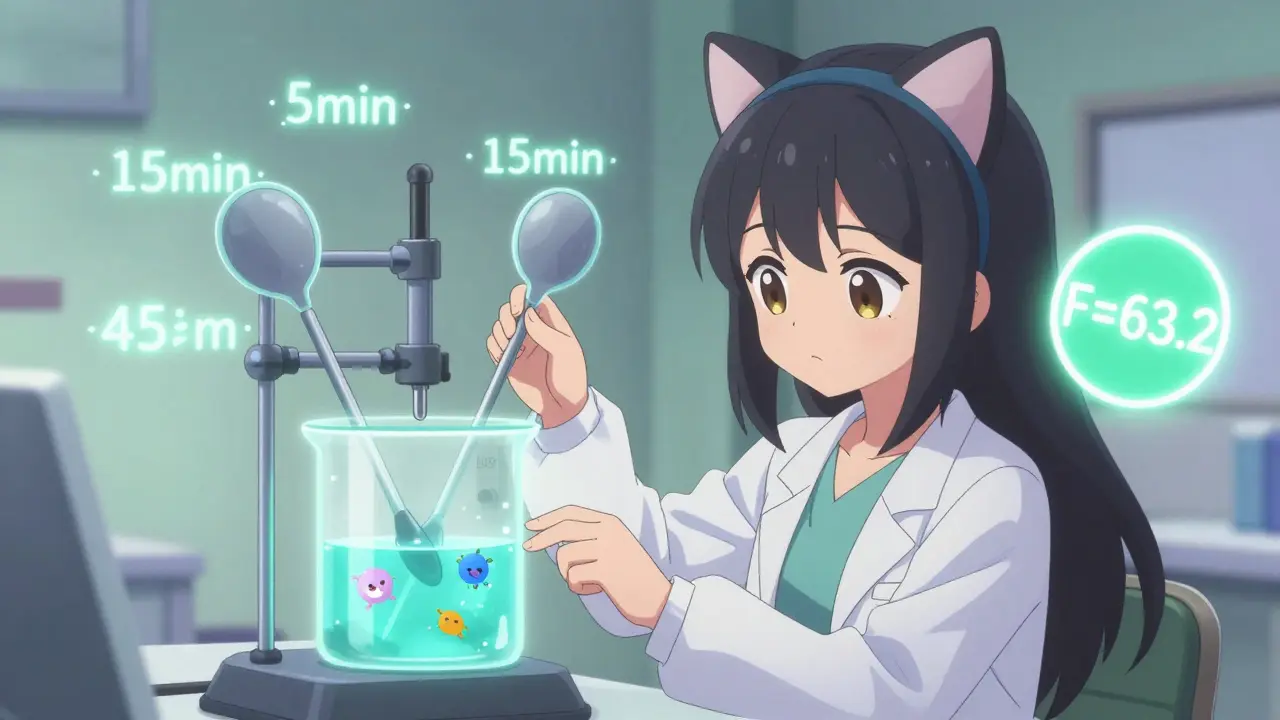
On the flip side, Teva Pharmaceuticals got approval for a 25mg amlodipine generic using f2=63.2. How? They calibrated their paddles to within 0.3mm of perfect alignment and used surfactant in the dissolution medium to mimic intestinal fluids. Result? $1.2 million saved. No human trials. One smooth approval.
What You Should Know as a Patient
You don’t need to understand f2 values or dissolution apparatuses. But you should know this: the system works. Every generic drug sold in the U.S. has been tested to prove it behaves like the brand. The FDA doesn’t approve a generic unless it’s shown to be therapeutically equivalent.
That said, if you’ve ever noticed a difference after switching from brand to generic-feeling more tired, less focused, or experiencing new side effects-talk to your doctor. It’s rare, but sometimes the formulation differences (like fillers or coatings) can affect how you feel. It’s not the active ingredient. It’s the delivery.
And if you’re prescribed a narrow therapeutic index drug, ask if the generic has been tested in multiple pH conditions. That’s where the real safety margin lies.
The Future: AI, Biorelevant Media, and Smarter Testing
Dissolution testing isn’t stuck in the 1990s. The FDA and EMA are pushing for biorelevant media-liquids that mimic what’s actually in your gut, not just plain buffer solutions. These include bile salts, enzymes, and fatty acids. They’re more complex, but they predict real-world performance better.
Thirty-seven percent of top pharma companies are now using AI to predict in vivo outcomes from dissolution data. Instead of waiting for clinical trials, machines learn from thousands of past profiles and say: “This curve will work.” It’s still early, but it’s coming fast.
By 2026, the goal is to have a unified global standard for dissolution testing. One method. One set of rules. One way to prove a generic is safe. That’s the future. And it’s built on the quiet, precise science of watching pills dissolve in a beaker.
What does an f2 value of 50 mean for a generic drug?
An f2 value of 50 is the minimum acceptable threshold for similarity between a generic and brand-name drug’s dissolution profile. It means the two curves are similar enough that regulators can assume the drugs will behave the same in the body. However, f2=50 doesn’t guarantee perfect equivalence-it’s a starting point. For drugs with a narrow therapeutic index, regulators now require f2 ≥ 65. Values below 50 mean the drug will not be approved without additional human studies.
Can a generic drug have a different dissolution profile and still be safe?
Technically, yes-but only if the difference doesn’t affect how the drug is absorbed. Regulatory agencies require proof that any variation won’t change the drug’s effect in the body. If a generic dissolves faster but still stays within the 80-125% AUC range and passes f2 ≥ 50, it’s considered bioequivalent. However, if the release pattern is erratic or inconsistent, even a high f2 score won’t save it. The system is designed to catch dangerous differences, not minor ones.
Why do some people say generics don’t work as well as brand drugs?
Most of the time, it’s not the active ingredient-it’s the fillers, coatings, or how the tablet breaks down in the stomach. Some people are sensitive to certain inactive ingredients. Others may notice a difference if the generic dissolves slightly slower or faster, especially with drugs that have a narrow therapeutic window, like thyroid medication or blood thinners. In rare cases, manufacturing inconsistencies can cause real issues. That’s why regulators require strict dissolution testing: to prevent these problems before they reach patients.
Is dissolution testing the same for all types of pills?
No. Immediate-release tablets use standard dissolution methods with f2 comparison. But extended-release, delayed-release, or chewable pills need different approaches. For example, extended-release products must show controlled release over 8-12 hours, and regulators require multiple time points and model-dependent analysis. Biorelevant media is also more commonly used for these types. The FDA’s 2022 guidance on modified-release products added new requirements to ensure these complex formulations behave predictably.
How often are dissolution profiles tested after a drug is approved?
Every time a manufacturer changes the production process-like switching suppliers, changing equipment, or altering tablet compression-they must re-test the dissolution profile. The FDA requires this under its SUPAC-IR guidelines. Even small changes, like a new mixer or different batch size, can affect how the drug dissolves. Companies must submit new data to prove similarity before the change is approved. This is why generic drug quality stays consistent over time.
Martin Viau
January 1, 2026 AT 11:29Let’s be real-f2=50 is a joke. I’ve seen labs where the paddle was off by a millimeter and they still passed it. The FDA’s ‘gold standard’ is just a rubber stamp for cheap generics made in places where quality control means ‘close enough.’ We’re letting kids take pills that might as well be lottery tickets. And don’t get me started on how 78% of approvals skip human trials. That’s not science-it’s corporate laziness dressed up as efficiency.
Marilyn Ferrera
January 3, 2026 AT 06:16It’s not about perfection-it’s about proportionality. The system isn’t flawless, but it’s rigorously calibrated. f2 isn’t magic; it’s a statistical tool built on decades of clinical correlation. When a drug passes f2 ≥ 50 + AUC 80–125%, the odds of clinical failure are lower than being struck by lightning while holding a cell phone. The real risk? Not using generics at all.
Robb Rice
January 4, 2026 AT 22:04I appreciate the depth of this post. It’s rare to see such a nuanced explanation of dissolution testing. While I understand the frustrations with f2, the regulatory framework has saved billions and prevented unnecessary human exposure to experimental drug formulations. That said, I do wonder-how many of the labs reporting f2 scores are properly calibrated? The margin of error in equipment is often underestimated.
Harriet Hollingsworth
January 6, 2026 AT 07:02So you’re telling me some company can make a pill that dissolves 2 seconds slower and the FDA just says ‘meh’? And then we give it to people with heart conditions? This is criminal negligence. My uncle died because they switched his generic and he had a stroke. They didn’t even test it right. This isn’t science-it’s a scam.
Deepika D
January 6, 2026 AT 20:04Hey everyone, I’m a pharmacist in Mumbai and I’ve seen this play out in real life. We import generics from the U.S., Europe, and China-and yes, the differences are real. But here’s the thing: most patients don’t notice because their bodies adapt. The real issue? Access. If we didn’t have generics, 90% of my patients couldn’t afford their meds. So yes, f2 isn’t perfect-but it’s the best tool we have to make life-saving drugs available to millions. Don’t throw the baby out with the bathwater. Use better methods when you can, but don’t scare people away from generics. They’re saving lives every day. 💪❤️
Bennett Ryynanen
January 8, 2026 AT 17:13Bro, the fact that you’re even questioning this shows you’ve never worked in a lab. I’ve run dissolution tests on 50+ batches. The system works. Yeah, f2 has flaws-but we use AUC, MDT, bootstrap, and biorelevant media on top of it. If your generic fails, it’s because your formulation sucks, not because the test is broken. Stop blaming the system and start fixing your process. And yes, I’ve seen f2=49.8 turn into f2=63 after we fixed the paddle alignment. It’s not magic-it’s discipline.
Chandreson Chandreas
January 9, 2026 AT 09:09Man, this whole thing is wild. I used to think generics were just cheap knockoffs. Now I see it’s like comparing two different recipes for the same cake-one uses organic flour, the other doesn’t, but both rise the same and taste fine. The test isn’t perfect, but it’s trying. And honestly? If a pill dissolves in 30 minutes instead of 28, does it really matter? 🤔💊
Darren Pearson
January 9, 2026 AT 12:18While the article presents a superficially coherent overview, it conspicuously omits the epistemological limitations inherent in the f2 metric as a proxy for in vivo bioequivalence. The reliance on a single, non-parametric similarity index-despite its known insensitivity to kinetic mechanisms-is a classic case of regulatory capture masquerading as scientific rigor. One must interrogate not merely the statistical threshold, but the ontological assumptions underpinning the entire paradigm. Until dissolution testing incorporates dynamic biorelevant microenvironments and machine learning-driven kinetic modeling, it remains a crude, 20th-century artifact.