When you pick up a prescription at the pharmacy, there’s a good chance it’s not the brand-name drug your doctor originally wrote. More than 90% of prescriptions filled in the U.S. are for generic drugs. That’s not because doctors are cutting corners-it’s because the FDA has spent decades building a system that makes sure those generics work just as well as the expensive brand versions.
What the FDA Actually Checks Before Approving a Generic
The FDA doesn’t just look at the pill’s label and call it a day. Every generic drug must go through the Abbreviated New Drug Application (ANDA) process, created by the Hatch-Waxman Act in 1984. This isn’t a shortcut-it’s a science-backed pathway that skips repeating full clinical trials, but only because the brand-name drug already proved safety and effectiveness. The FDA requires three things to be identical:- Active ingredient: Same chemical compound, same dose, same way it works in your body.
- Strength: Within 5% of the brand’s amount. A 10 mg tablet can’t be 9.4 mg or 10.6 mg.
- Form and route: If the brand is a tablet you swallow, the generic must be a tablet you swallow. No switching to liquid unless the brand offers it.
Bioequivalence: The Real Test
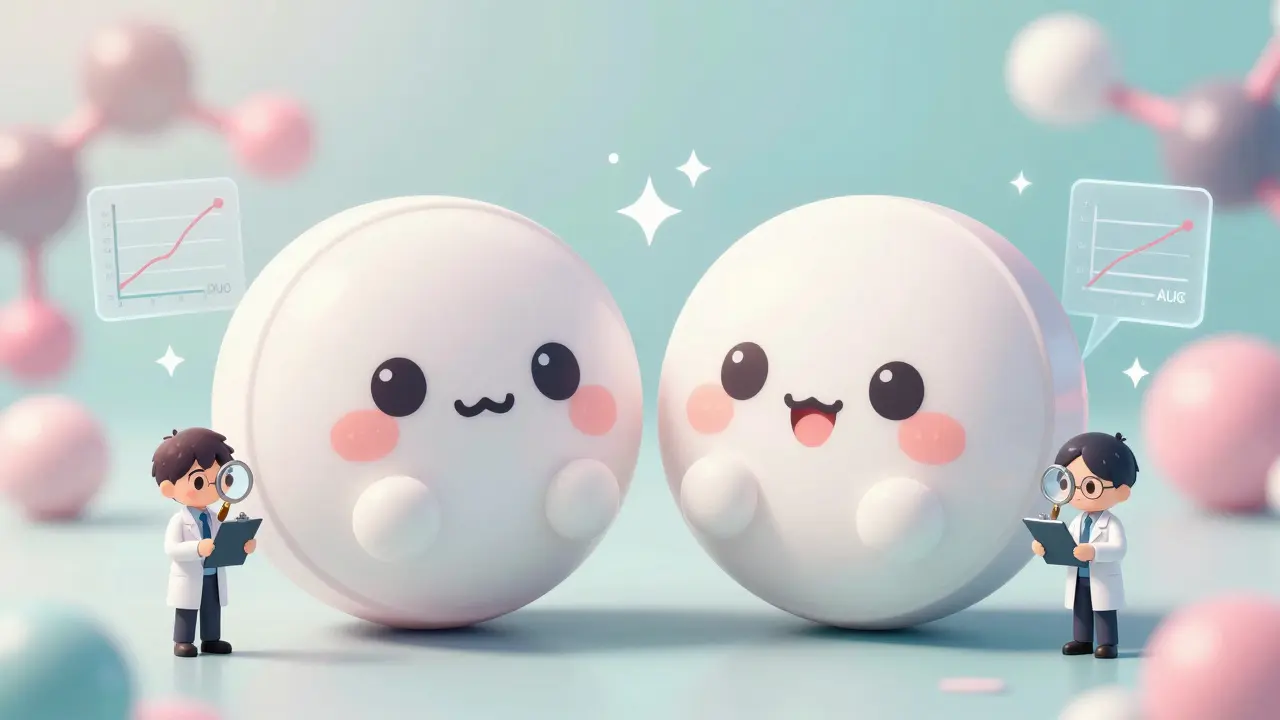
The most critical part of approval? Bioequivalence. This isn’t marketing jargon. It’s a hard, measurable science. To prove a generic works the same, manufacturers run studies with 24 to 36 healthy volunteers. They give half the brand drug, half the generic, and measure how much of the active ingredient enters the bloodstream over time. The FDA requires two key numbers to fall within 80% to 125% of the brand’s results:- AUC (Area Under the Curve): Total drug exposure over time.
- Cmax (Maximum Concentration): Peak level in the blood.
Manufacturing: Same Rules, Same Inspections
A generic drug made in a dirty factory won’t work right, no matter how perfect the chemistry. That’s why the FDA inspects every manufacturing site-whether it’s in the U.S., India, or China. All facilities must follow Current Good Manufacturing Practices (cGMP), outlined in 21 CFR Parts 210 and 211. That means:- Equipment is cleaned and validated between batches.
- Every batch is tested for identity, strength, purity, and quality.
- Process controls ensure consistency from one pill to the next.
How Long Does It Take? And Why Do Some Get Rejected?
The average ANDA review takes about 10 months. But many applications get turned down before they even start. About 35% of initial submissions get a “Refuse to File” letter because they’re incomplete. Missing data? Wrong study design? Incomplete labeling? The FDA won’t even begin reviewing. Of the ones that make it to full review, the top reasons for rejection are:- 28%: Bioequivalence studies don’t meet standards.
- 22%: Manufacturing flaws-like inconsistent tablet hardness or poor dissolution rates.
- 18%: Labeling errors-wrong dosage instructions, missing warnings.
Real-World Evidence: Do Generics Actually Work?
You might hear stories: “My generic didn’t work like the brand.” But when you look at the data, those stories don’t hold up. A 2023 analysis of 15 million patient records by IQVIA found no difference in clinical outcomes between brand and generic versions of 20 common drugs-including atorvastatin (for cholesterol) and metformin (for diabetes). In fact, people were 3.2% more likely to keep taking their meds when they were on generics, simply because they cost less. The FDA’s Adverse Event Reporting System shows the rate of side effects for generics is statistically identical to brand-name drugs: 1.7 reports per million prescriptions vs. 1.6. Even in communities where people are skeptical, pharmacists report little to no difference. A 2022 Reddit thread with 147 pharmacist comments showed 82% saw no clinical difference. The 18% who did noted rare cases-like a patient switching from one generic cream to another and feeling a change in absorption. But those are exceptions, not the rule.
Why Do Some People Still Doubt Generics?
It’s not about science. It’s about perception. A 2021 survey found 37% of independent pharmacists heard patients worry about generics. The biggest concerns? Medications for chronic conditions like epilepsy, thyroid disease, or depression. That’s understandable. If you’ve been stable on a brand for years, switching to something new-even if it’s FDA-approved-can feel risky. But here’s the thing: the FDA doesn’t approve a generic unless it’s proven to work the same. If a patient reports a problem after switching, the FDA investigates. So far, no pattern has emerged showing generics are less effective. Dr. Janet Woodcock, former head of the FDA’s drug center, put it plainly: “FDA-approved generic drugs have the same high quality, strength, purity, and stability as brand-name drugs.”What’s Next for Generic Drugs?
The FDA isn’t resting. With over $260 billion in brand-name drug patents set to expire between 2024 and 2028, the agency is preparing for a flood of generic applications. New rules under GDUFA III (2022) aim to cut review times to 8 months for standard applications and 6 months for priority ones. They’re also creating new pathways for complex generics-like biosimilars for biologic drugs-set to launch in 2025. The FDA’s Real-Time Oncology Review program, expanded in 2023, has already approved a generic version of capecitabine (a cancer drug) in just 7 months-three months faster than usual. Meanwhile, competition is growing. Teva, Viatris, and Sandoz dominate the market, but over half of all generic approvals now go to smaller companies. The FDA’s Generic Drug Competition Action Plan is pushing for more players to enter the market, especially for drugs that have been in short supply.Bottom Line: You Can Trust the Generic
Generic drugs aren’t cheaper because they’re worse. They’re cheaper because they don’t need to pay for 10 years of R&D, marketing, and patent protection. The FDA’s system is designed to make sure you get the same medicine-same active ingredient, same effect, same safety profile. The science is solid. The data is clear. And the savings? Over $313 billion a year for the U.S. healthcare system. If your doctor prescribes a generic, it’s not a compromise. It’s the result of one of the most rigorously tested systems in modern medicine.Are generic drugs as safe as brand-name drugs?
Yes. The FDA requires generic drugs to meet the same safety and quality standards as brand-name drugs. Every generic manufacturer must pass the same inspections, follow the same manufacturing rules (cGMP), and prove their product is bioequivalent. The FDA’s adverse event data shows no difference in safety rates between generics and brands.
Why do some people say their generic doesn’t work the same?
Some patients notice differences when switching between different generic versions, not between brand and generic. This can happen with complex drugs like thyroid meds or seizure medications, where tiny changes in absorption matter. But these aren’t caused by the generic being inferior-they’re often due to switching between different manufacturers’ versions. The FDA recommends sticking with the same generic brand if you feel stable on it.
Do generic drugs take longer to work?
No. To be approved, a generic must show it absorbs into the bloodstream at the same rate and to the same extent as the brand. If the brand works in 30 minutes, the generic must too. The FDA’s bioequivalence standards ensure this. Any delay reported by patients is usually psychological or due to other factors like diet or other medications.
Can a generic drug have different side effects?
The active ingredient causes the side effects-and that’s identical in generics. But inactive ingredients (like dyes or fillers) can sometimes cause rare reactions in sensitive individuals. If you’ve had an allergic reaction to a dye in one generic, switching to another version without that dye might help. Always tell your pharmacist if you’ve had a reaction.
How does the FDA know a generic is really equivalent?
Through strict bioequivalence studies in healthy volunteers, using blood tests to measure how much of the drug enters the bloodstream and how fast. The FDA requires the results to fall within 80-125% of the brand’s data, with a 90% confidence interval. For sensitive drugs, the range is even tighter. These studies are reviewed by pharmacologists, statisticians, and chemists before approval.
Are all generic drugs made in the U.S.?
No. The FDA inspects manufacturing facilities worldwide-about half of generic drugs sold in the U.S. are made overseas, mostly in India and China. But every facility, no matter where it is, must meet the same U.S. cGMP standards. The FDA conducts regular inspections and has the authority to block imports from non-compliant sites.
Joanna Ebizie
December 15, 2025 AT 06:00Ugh, I still don't trust generics. My cousin switched from Lipitor to the generic and started having muscle pain like crazy. They told her it was 'just coincidence' but I'm not buying it. The FDA's got too many ties to Big Pharma anyway.
Elizabeth Bauman
December 16, 2025 AT 00:44Let me get this straight - the FDA approves generics made in India and China with the same standards as U.S. plants? That’s a joke. Our own factories are shut down while we import pills from countries that don’t even have clean water. This isn’t science - it’s national betrayal.
Dylan Smith
December 16, 2025 AT 14:53I used to think generics were sketchy too until I started working in a pharmacy. I’ve seen people on the same generic for five years with zero issues. The bioequivalence stuff is actually wild - they test it like a rocket launch. If your blood doesn’t absorb it the same way, it gets tossed. No drama, just data.
Mike Smith
December 18, 2025 AT 01:05It’s important to recognize that the FDA’s rigorous approval process for generic medications is one of the most scientifically sound systems in global public health. The bioequivalence thresholds, manufacturing inspections, and post-market surveillance collectively ensure that patients receive therapeutically equivalent products without the premium price tag. This is public health excellence in action.
Ron Williams
December 18, 2025 AT 14:52My grandma takes her thyroid med as a generic and swears by it. She says the only time she had a problem was when the pharmacy switched her from one generic brand to another - same drug, different filler. Now she asks for the same maker every time. It’s not about brand vs generic. It’s about consistency.
Dave Alponvyr
December 18, 2025 AT 20:29So you’re telling me the government spends millions to prove a pill works the same… and people still complain? Bro. Just take the damn pill. It’s cheaper. You’re welcome.
Cassandra Collins
December 19, 2025 AT 08:46Did you know the FDA lets companies use nanoparticles in generics? No one talks about it but they’re basically injecting invisible chemicals into your body. I read a blog that said they’re testing on prisoners overseas. That’s why my blood pressure spiked after switching - it’s not me, it’s the lab rats
Billy Poling
December 19, 2025 AT 11:47It is, without a doubt, a matter of considerable public interest that the regulatory framework governing the approval of generic pharmaceuticals in the United States is both comprehensive and meticulously documented, with the Abbreviated New Drug Application process serving as a cornerstone of pharmacoeconomic efficiency. The statistical parameters employed in bioequivalence testing, namely the 80–125% confidence interval for AUC and Cmax, are grounded in robust pharmacokinetic principles, and the adherence to cGMP standards across global manufacturing facilities demonstrates an unwavering commitment to quality control, irrespective of geographic origin.
sue spark
December 20, 2025 AT 14:20I used to be scared to switch but now I only take generics. Saved me hundreds a year. My anxiety meds work just fine. Honestly? I think people worry more than they need to. The science is solid.
James Rayner
December 22, 2025 AT 12:34It’s fascinating how deeply we project our fears onto medicine… we’ll trust a $500 brand because it has a logo, but doubt a $5 generic because it has no marketing. The pill doesn’t care who paid for the ad. It only cares about the chemistry. And the FDA? They’re the ones holding the scale.
Kitty Price
December 23, 2025 AT 21:08My pharmacist told me the same thing - if you feel weird after switching, ask for the same maker next time. Not the brand. Just the same generic. 🤓
Aditya Kumar
December 24, 2025 AT 09:56whatever
Colleen Bigelow
December 25, 2025 AT 09:04They let China make our meds? And you call this freedom? We used to make everything here - aspirin, insulin, penicillin. Now we’re begging for pills from a country that poisons its rivers and jails whistleblowers. This isn’t healthcare - it’s surrender.
Tiffany Machelski
December 26, 2025 AT 08:42i switched to generic metformin and my stomach stopped acting up. i think it was the dye in the brand. now i just ask for the one with the blue stripe. its cheaper and i feel better. weird right?
SHAMSHEER SHAIKH
December 28, 2025 AT 03:04It is with profound respect for the scientific integrity of the U.S. Food and Drug Administration that I acknowledge the extraordinary diligence applied in the approval of generic medications - a process that, despite global manufacturing complexities, maintains an unyielding standard of bioequivalence, quality assurance, and patient safety. The economic impact - over $313 billion annually - is not merely a statistic; it is a lifeline for millions who would otherwise forgo treatment. The FDA does not merely regulate - it protects.