Every year, thousands of people end up in the hospital not because their illness got worse, but because two medications they were taking clashed in ways no one saw coming. One might be for high blood pressure, another for depression, and a third for arthritis. Taken alone, each is safe. Taken together? They can cause dangerous drops in blood pressure, kidney damage, or even life-threatening heart rhythms. This isn’t rare. It’s drug-drug interactions - and they’re more common than most people realize.
What Exactly Is a Drug-Drug Interaction?
A drug-drug interaction (DDI) happens when one medication changes how another medication works in your body. That change can make the drug stronger, weaker, or cause side effects you didn’t expect. It’s not about the drugs being "bad." It’s about how they interact inside you - chemically, physically, and biologically.
There are two main types: pharmacokinetic and pharmacodynamic. Think of pharmacokinetic as "what the body does to the drug" - how it’s absorbed, moved around, broken down, or flushed out. Pharmacodynamic is "what the drug does to the body" - how it affects your cells, receptors, or organs directly.
Pharmacokinetic Interactions: The Body’s Delivery System Gets Disrupted
Your body treats every drug like a package. It has to get it in, move it where it needs to go, break it down, and get rid of it. When two drugs interfere with any of those steps, trouble starts.
Absorption: Some drugs change the pH of your stomach or slow down gut movement. For example, antacids can reduce how well your body absorbs antibiotics like ciprofloxacin. If you take them together, the antibiotic might not work as well.
Distribution: Many drugs stick to proteins in your blood to travel around. If two drugs compete for the same protein spots, one can get pushed out into the bloodstream, raising its level dangerously. Warfarin, a blood thinner, is a classic example. When it’s displaced by drugs like ibuprofen, it floats freely - increasing bleeding risk.
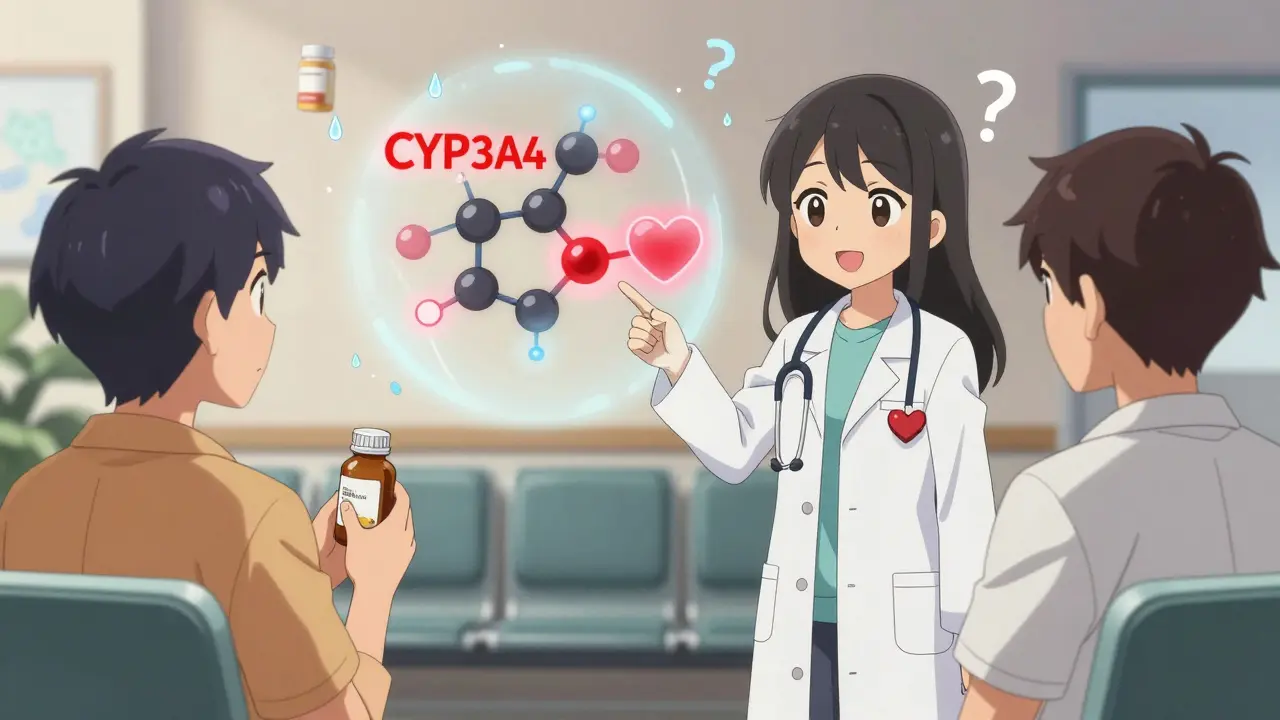
Metabolism: This is where most serious interactions happen. About 70-80% of all drug interactions involve the cytochrome P450 enzyme system, especially CYP3A4. This enzyme is like a factory that breaks down drugs. If one drug blocks it (an inhibitor), other drugs pile up. If another drug turns it on (an inducer), the first drug gets cleared too fast.
Take simvastatin, a cholesterol drug. If you also take ketoconazole - an antifungal - it shuts down CYP3A4. Simvastatin levels can spike 10 to 20 times higher. That’s not just a side effect. That’s rhabdomyolysis - muscle breakdown that can lead to kidney failure.
On the flip side, St. John’s Wort, a popular herbal supplement, turns on CYP3A4. It can slash the levels of cyclosporine (used after organ transplants) by half. That means your body might reject the new organ.
Excretion: Your kidneys and liver flush drugs out. Some drugs block those pathways. Verapamil, used for heart rhythm issues, blocks a transporter called P-glycoprotein. When taken with digoxin (a heart medication), digoxin builds up. Levels can rise 50-100%. That’s a recipe for dangerous heart rhythms.
Pharmacodynamic Interactions: When Drugs Talk Directly to Each Other
These don’t change drug levels. They change how the drugs affect your body - even when concentrations stay the same.
Synergistic effects: Two drugs amplify each other. Take fluoroquinolone antibiotics (like ciprofloxacin) and macrolides (like azithromycin). Both can prolong the QT interval - a timing measure in your heart’s rhythm. Together, they increase the risk of torsades de pointes, a deadly arrhythmia, by 5.7 times compared to either drug alone.
Antagonistic effects: One drug cancels out the other. For example, beta-blockers and albuterol (an asthma inhaler) fight each other. Beta-blockers tighten airways. Albuterol opens them. If you’re on both, your asthma control can worsen - even if you’re taking the right doses.
One of the most dangerous combos? ACE inhibitors (like lisinopril) with potassium-sparing diuretics (like amiloride). Both raise potassium. Together, they can push levels up by 1.0-1.5 mmol/L. That’s enough to cause cardiac arrest.
Who’s at Highest Risk?
It’s not just older people - though they’re the most vulnerable. About 3-5% of hospital admissions in adults over 65 are linked to drug interactions. Why? They often take five or more medications. The Beers Criteria, updated in 2019, lists 30 high-risk combos for seniors, including NSAIDs with blood thinners - a combo that triples or quadruples bleeding risk.
People with kidney or liver disease are also at higher risk. Their bodies can’t clear drugs as well, so even small interactions become big problems.
And don’t forget genetics. About 10% of people are poor metabolizers of CYP2D6 - a key enzyme. If you’re one of them and take codeine, your body can’t turn it into morphine. But if you’re an ultrarapid metabolizer, and you take codeine with a CYP3A4 inhibitor? You get too much morphine too fast - risking overdose.
How Do Doctors and Pharmacists Catch These?
Pharmacists are on the front lines. A 2021 study found that when pharmacists reviewed medication lists for 12,543 patients, they cut serious interactions by 37%. They spot what automated systems miss.
Electronic health records (EHRs) have DDI alerts. But here’s the problem: 80-90% of those alerts are false. Clinicians get so used to ignoring them, they start overriding even real warnings. That’s called alert fatigue - and it’s deadly.
Specialized tools help. The Liverpool HIV-Drug Interactions Checker updates daily and covers over 350 antiretroviral combos. For people on complex regimens, this isn’t optional - it’s lifesaving.
What Can You Do?
Don’t assume your doctor knows every pill you take. Tell them about every prescription, over-the-counter drug, supplement, herb, and even recreational substance. That includes CBD, melatonin, St. John’s Wort, and turmeric.
Ask: "Could this interact with anything else I’m taking?" If you’re on warfarin, ask about vitamin K-rich foods like kale and spinach. If you’re on statins, ask about grapefruit juice - it can double the drug’s effect.
Use a pill organizer. Keep a written list. Update it every time you start or stop something. Bring it to every appointment.
The Future: Personalized Medicine and AI
Science is catching up. The Clinical Pharmacogenetics Implementation Consortium (CPIC) now has 22 guidelines that link genetics to drug safety. If you’re a CYP2D6 poor metabolizer, your doctor might avoid codeine entirely. If you’re an ultrarapid metabolizer, they might avoid it too - especially if you’re on other drugs.
AI is stepping in. A 2021 study trained a machine learning model on 89 million patient records. It predicted DDIs with 94.8% accuracy - far better than old rule-based systems. Soon, your EHR might not just warn you - it might suggest safer alternatives before you even get the prescription.
But the most powerful tool is still you. Knowing your meds, asking questions, and speaking up saves lives.
Real-World Impact: The Cost of Overlooked Interactions
It’s not just about health. It’s about money. Preventable drug interactions cost the U.S. healthcare system $1.3 billion a year - mostly from hospital stays caused by bleeding from anticoagulants or muscle damage from statins.
That’s not just a statistic. That’s someone’s parent, sibling, or friend. Someone who took a pill they thought was safe - and ended up in the ER.
The tools are getting better. The science is advancing. But until every doctor, pharmacist, and patient is fully aware, the risk stays high.
Can over-the-counter drugs cause dangerous interactions?
Yes. Common OTC meds like ibuprofen, naproxen, and even antacids can interact with prescription drugs. Ibuprofen can increase bleeding risk when taken with warfarin or aspirin. Antacids can block absorption of antibiotics like ciprofloxacin or thyroid meds like levothyroxine. Always check with a pharmacist before mixing OTC and prescription drugs.
Do herbal supplements cause drug interactions?
Absolutely. St. John’s Wort is one of the most dangerous. It can reduce blood levels of birth control pills, antidepressants, and transplant drugs by up to 60%. Garlic, ginkgo, and ginger can increase bleeding risk with blood thinners. Even vitamin E and fish oil can interfere with anticoagulants. Just because something is "natural" doesn’t mean it’s safe with your meds.
How do I know if I’m at risk for a drug interaction?
You’re at higher risk if you take three or more medications regularly, are over 65, have kidney or liver disease, or are on drugs with narrow therapeutic windows like warfarin, digoxin, or lithium. If you’ve had a recent hospital stay or emergency visit for an unexplained symptom, ask your doctor to review your meds for interactions.
Are drug interactions always obvious?
No. Many are silent until something serious happens. A slow rise in potassium, a slight drop in blood pressure, or a subtle change in mood might go unnoticed for weeks. That’s why regular medication reviews with your pharmacist are critical - even if you feel fine.
Can I just stop a drug if I think it’s causing an interaction?
Never stop a prescribed medication without talking to your doctor. Abruptly stopping blood pressure meds, antidepressants, or seizure drugs can cause rebound effects, seizures, or dangerous spikes in blood pressure. Always consult your provider first - they can guide a safe switch or taper.
What to Do Next
Start today. Make a list of every medication, supplement, and herb you take - including dosages and how often. Bring it to your next doctor or pharmacist visit. Ask: "Is there anything here that shouldn’t be taken together?"
If you’re on blood thinners, statins, heart meds, or antidepressants - don’t wait. These are the top offenders in real-world interactions. A 5-minute conversation now could prevent a hospital trip later.
Knowledge isn’t power here - it’s protection.
Marian Gilan
January 26, 2026 AT 08:59Conor Murphy
January 26, 2026 AT 11:40Conor Flannelly
January 27, 2026 AT 13:55Patrick Merrell
January 29, 2026 AT 13:32Mohammed Rizvi
January 30, 2026 AT 18:11Dan Nichols
January 30, 2026 AT 20:10Renia Pyles
January 31, 2026 AT 20:51Rakesh Kakkad
February 1, 2026 AT 19:53Nicholas Miter
February 1, 2026 AT 21:25Suresh Kumar Govindan
February 2, 2026 AT 11:38TONY ADAMS
February 3, 2026 AT 11:22George Rahn
February 4, 2026 AT 17:51Ashley Karanja
February 5, 2026 AT 23:25Karen Droege
February 7, 2026 AT 12:50Aishah Bango
February 8, 2026 AT 05:04