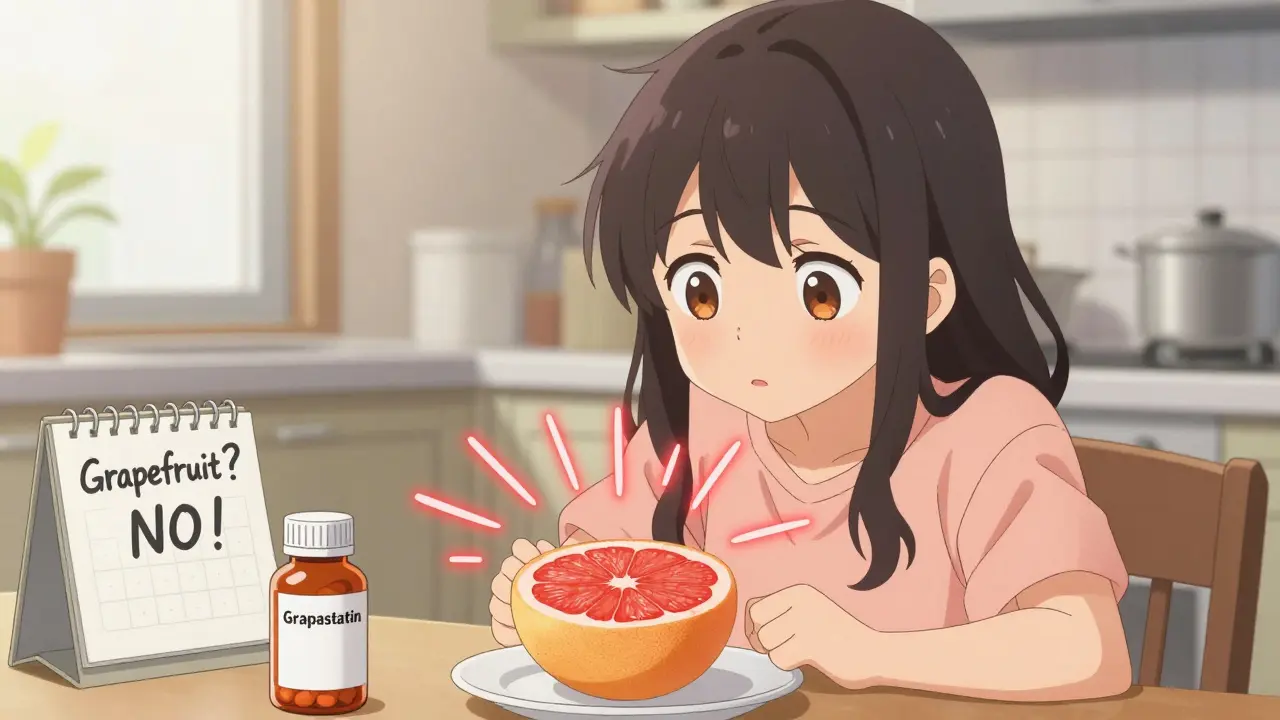
Statin-Grapefruit Interaction Checker
This tool helps you determine if your statin medication interacts dangerously with grapefruit. Select your statin to see if grapefruit consumption is safe.
If you're taking a statin to lower your cholesterol, drinking grapefruit juice might seem like a healthy choice. But for some statins, it’s not just a bad idea-it’s dangerous. This isn’t a myth or a warning from an old wives’ tale. It’s a well-documented, life-threatening interaction backed by decades of clinical research. The problem isn’t that grapefruit is bad for you. It’s that it can turn your statin into something far more powerful-and far more risky-than your doctor intended.
Why Grapefruit Changes How Your Statin Works
Grapefruit doesn’t just mix with statins. It hijacks your body’s ability to process them. The culprit? Furanocoumarins, natural chemicals found in grapefruit, Seville oranges, and pomelos. These compounds shut down an enzyme in your gut called CYP3A4, which normally breaks down certain statins before they enter your bloodstream. When that enzyme is blocked, your body absorbs way more of the drug than it should.Think of it like this: your liver and gut are supposed to be the gatekeepers, controlling how much statin gets into your system. Grapefruit locks the gate. Suddenly, you’re getting 5 to 16 times more of the drug than your prescription says. That’s not a little extra-it’s the equivalent of taking a much higher dose, sometimes without even realizing it.
This isn’t a one-time thing. The enzyme doesn’t bounce back after a few hours. Once it’s blocked by furanocoumarins, it takes about three days to fully recover. So even if you drink grapefruit juice in the morning and take your statin at night, you’re still at risk. The damage is done.
Which Statins Are at Risk?
Not all statins react the same way. The interaction is real-but only with specific ones. If you’re taking one of these, grapefruit is a hard no:- Simvastatin (Zocor): The worst offender. Studies show grapefruit juice can spike simvastatin levels by up to 16 times. That’s why the FDA says it’s contraindicated-meaning you shouldn’t do it under any circumstances.
- Lovastatin (Mevacor): Similar to simvastatin. Even small amounts of grapefruit can push levels into dangerous territory.
- Atorvastatin (Lipitor): The risk is lower than simvastatin or lovastatin, but still real. The American College of Cardiology says you can have a small amount (like 8 ounces of juice) once a week-but nothing more.
Here’s the good news: several statins don’t interact with grapefruit at all:
- Pravastatin (Pravachol)
- Rosuvastatin (Crestor)
- Fluvastatin (Lescol)
- Pitavastatin (Livalo)
These statins are broken down by different enzymes, so grapefruit doesn’t interfere. If you’re on a high-risk statin and love grapefruit, switching to one of these is often the safest move.
The Real Danger: Muscle Damage and Kidney Failure
Most people think statin side effects mean a little muscle soreness. That’s common-but with grapefruit, it can turn into something far worse: rhabdomyolysis.Rhabdomyolysis happens when muscle tissue breaks down rapidly, spilling a protein called myoglobin into your blood. Your kidneys try to filter it out, but they can’t keep up. The result? Acute kidney failure. It’s rare-less than 1 in 10,000 statin users get it-but with grapefruit, the risk shoots up.
There’s a documented case of a 40-year-old woman who developed rhabdomyolysis after eating grapefruit every day for 10 days while taking simvastatin. She didn’t have other risk factors. No alcohol, no other meds. Just grapefruit and her statin. She ended up in the hospital.
Symptoms to watch for:
- Severe muscle pain or weakness-not just soreness after a workout
- Dark, tea-colored urine (a sign of myoglobin in your system)
- Fever, nausea, or confusion (signs your kidneys are struggling)
If you feel any of these, stop eating grapefruit and call your doctor. Don’t wait. This isn’t something you can treat at home.

How Much Grapefruit Is Too Much?
You might think, “I only have a slice once in a while.” But here’s the thing: there’s no safe threshold for high-risk statins. Even a single glass of grapefruit juice can trigger the enzyme shutdown. The 1998 study that first proved this interaction used 200 mL (about 7 ounces) of double-strength grapefruit juice-three times a day. That’s less than you’d think.And it’s not just juice. The whole fruit, even grapefruit segments, contain the same furanocoumarins. So if you’re eating half a grapefruit with breakfast, you’re still at risk.
For atorvastatin users, one small grapefruit or 8 ounces of juice per week is considered low-risk. But if you’re on simvastatin or lovastatin, even that’s too much. No exceptions.
What About Other Citrus Fruits?
Don’t panic and ditch all citrus. Only grapefruit, Seville oranges (the kind used in bitter marmalade), and pomelos cause this problem. Regular oranges, tangerines, lemons, and limes? Safe. You can still have your OJ with breakfast. Just avoid anything that looks or tastes like grapefruit.Some people assume “citrus” means the same thing. It doesn’t. The interaction is specific to furanocoumarins, which are only in those three fruits. So if your doctor says “avoid citrus,” ask for clarification. You might be unnecessarily cutting out healthy foods.
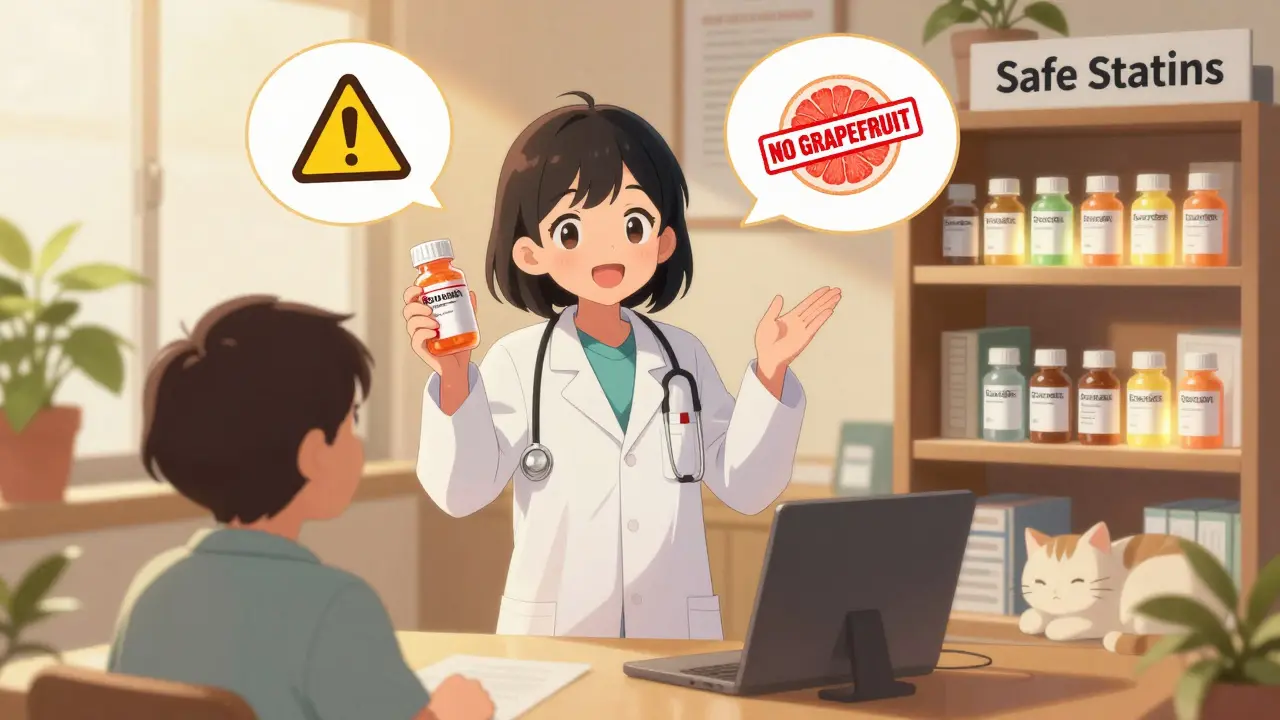
What Should You Do If You’re on a High-Risk Statin?
Step 1: Check your prescription. Look at the name of your statin. If it’s simvastatin or lovastatin, stop eating grapefruit entirely. No gray area.Step 2: Talk to your doctor. Don’t stop your statin. That’s riskier than grapefruit. Heart attacks and strokes are far more common than rhabdomyolysis. But do ask: “Is there a safer statin I could switch to?” Pravastatin or rosuvastatin are excellent alternatives with the same cholesterol-lowering power-and no grapefruit risk.
Step 3: Tell your pharmacist. Pharmacists are trained to catch these interactions. If you’ve been taking simvastatin and grapefruit for years, your pharmacist might be the first to notice the problem. Let them help you.
Step 4: Read your label. Since 2014, the FDA has required grapefruit warnings on simvastatin, lovastatin, and atorvastatin bottles. If your bottle doesn’t say anything about grapefruit, that doesn’t mean it’s safe. Some older prescriptions or generics might still be out there. Always double-check.
Why Don’t More Doctors Talk About This?
It’s shocking, but true: only 42% of primary care doctors routinely ask patients if they eat grapefruit before prescribing high-risk statins. And only 28% of patients say they were warned about it.Why? Because it’s easy to overlook. Grapefruit isn’t a drug. It’s fruit. Doctors assume patients know. But most people don’t. A 2022 study found that 12-15% of statin users regularly eat grapefruit. That’s millions of people at risk.
It’s not about blame. It’s about awareness. If you’re on a statin, it’s your job to know the risks. Don’t wait for your doctor to bring it up. Ask.
What’s Next? Furanocoumarin-Free Grapefruit?
Scientists at the University of Florida are working on a solution: breeding grapefruit without furanocoumarins. Early results show it’s possible to keep the sweet taste, the vitamin C, and the antioxidants-without the dangerous compounds. If this works, we could have a safe grapefruit within the next decade.But until then? Stick to the facts. If you’re on simvastatin or lovastatin: skip grapefruit. If you’re on atorvastatin: limit it to a tiny amount once a week. If you’re on pravastatin, rosuvastatin, fluvastatin, or pitavastatin: enjoy your fruit without worry.
This isn’t about fear. It’s about control. You’re taking a statin to protect your heart. Don’t let grapefruit undo that.
Can I drink grapefruit juice if I take my statin at night and juice in the morning?
No. The enzyme inhibition caused by grapefruit lasts for about 72 hours. Even if you separate them by hours or days, the enzyme stays blocked. The interaction isn’t about timing-it’s about whether the enzyme is active when the statin is absorbed. If you’ve had grapefruit in the past few days, your body is still affected.
Is grapefruit interaction the same for all statins?
No. Only statins broken down by the CYP3A4 enzyme are affected. Simvastatin, lovastatin, and atorvastatin are. Pravastatin, rosuvastatin, fluvastatin, and pitavastatin are not. Always check your specific medication. Don’t assume all statins behave the same way.
What if I accidentally ate grapefruit while on simvastatin?
One small amount is unlikely to cause harm, but don’t make it a habit. Watch for muscle pain, weakness, or dark urine. If you notice any of these, contact your doctor right away. Going forward, avoid grapefruit entirely. The risk isn’t worth it.
Can I switch to a different statin to avoid this?
Yes. Switching from simvastatin or lovastatin to pravastatin or rosuvastatin is a common and safe solution. These statins work just as well to lower cholesterol without the grapefruit risk. Talk to your doctor about whether a switch makes sense for you.
Does grapefruit affect other medications besides statins?
Yes. Grapefruit can interfere with blood pressure meds, anti-anxiety drugs, some immunosuppressants, and certain heart rhythm medications. If you take more than one medication, ask your pharmacist to check for grapefruit interactions. It’s not just a statin problem.
waneta rozwan
January 17, 2026 AT 22:57Oh my GOD. I’ve been drinking grapefruit juice every morning with my simvastatin for THREE YEARS. I just cried reading this. My doctor never mentioned it. I thought it was ‘healthy.’ Now I’m terrified. I’m calling my pharmacy right now.
Why does no one tell you this?! I feel like I almost killed myself with fruit.
Nicholas Gabriel
January 19, 2026 AT 14:05Thank you for posting this. Seriously. This is the kind of info that saves lives. I’m a nurse, and I’ve seen rhabdomyolysis cases-some of them preventable. Grapefruit isn’t ‘just a fruit’ when you’re on statins. It’s a silent drug multiplier. Please, if you’re on simvastatin or lovastatin-stop. Now. Switch to rosuvastatin. It’s just as effective, and your kidneys will thank you.
And yes, the 72-hour window is real. It’s not about timing. It’s about enzyme death. Furanocoumarins don’t care when you take your pill. They’re just waiting to ruin your day.
Cheryl Griffith
January 20, 2026 AT 22:58I switched from simvastatin to pravastatin last year after my pharmacist flagged the grapefruit thing. I was so mad at first-I loved my morning juice. But now I don’t even think about it. I just enjoy my orange juice instead. It’s sweet, it’s refreshing, and I don’t have to live in fear of muscle breakdown.
Also, I told my mom, my sister, and my best friend. Everyone needs to know this. It’s not common knowledge, but it should be.
swarnima singh
January 20, 2026 AT 23:18Isabella Reid
January 21, 2026 AT 15:58As someone who’s lived in India and the US, I’ve seen how differently people treat food and meds. Here, grapefruit is a ‘superfood.’ In some parts of India, it’s just… fruit. But the science doesn’t care where you’re from. This interaction is universal.
My aunt in Delhi takes atorvastatin and drinks juice daily-no issues. My cousin in Chicago takes simvastatin and swears by grapefruit. I’m gonna send him this thread. He needs to know.
Jody Fahrenkrug
January 21, 2026 AT 23:13Okay but can we just appreciate how wild it is that we’re told to eat more fruit and then suddenly… this one fruit is a landmine? I get it, science. But it’s still a little absurd.
Anyway, I’m on rosuvastatin now. Grapefruit is officially banned from my kitchen. I replaced it with mango. Life’s good.
Kasey Summerer
January 23, 2026 AT 07:41So let me get this straight… I can’t have my morning grapefruit because my liver is too lazy to do its job? 😒
Meanwhile, my body’s got a whole army of enzymes working overtime to process my coffee, my Tylenol, my CBD gummies, and my questionable tacos… but one little fruit shuts down the whole operation?
Thanks, evolution. 🙃
Corey Chrisinger
January 24, 2026 AT 04:15It’s fascinating how biology doesn’t care about our intentions. We eat grapefruit because we think we’re being healthy. We take statins because we want to live longer. But the body doesn’t care about ‘good intentions.’ It just reacts to chemistry.
Maybe the real lesson here isn’t about grapefruit. It’s about how little we understand the systems inside us-and how dangerous it is to assume we do.
Our bodies aren’t machines we can tweak. They’re ecosystems. And sometimes, the ‘healthy’ thing is the poison.
🌱
Travis Craw
January 24, 2026 AT 13:25Christina Bilotti
January 26, 2026 AT 00:09Oh, so now we’re blaming grapefruit? How quaint. The real issue is that people are on statins at all. You’re treating symptoms, not causes. Why not fix your diet? Or exercise? Or sleep? Or stop eating processed carbs?
Meanwhile, you’re willing to risk rhabdomyolysis over a glass of juice? Pathetic. You’d rather take a pill than change your life.
And yes, I know I’m right. You’re welcome.
waneta rozwan
January 26, 2026 AT 21:09Wait-so if I stopped grapefruit today, how long until I’m safe? I’m still terrified. I had juice yesterday. Is it too late? 😭