
When you pick up a prescription, you might not notice the thick black border on the drug’s packaging or insert. But that border isn’t there for decoration. It’s the FDA black box warning-the strongest safety alert the U.S. Food and Drug Administration can issue. This isn’t a gentle reminder. It’s a red flag signaling that the drug can cause serious harm, even death, under certain conditions.
What Exactly Is a Black Box Warning?
A black box warning is a formal, legally required notice that appears at the very top of a drug’s prescribing information. It’s surrounded by a thick black border to make it impossible to miss. The FDA doesn’t use this label lightly. Only drugs with risks so severe they could outweigh the benefits get this warning.These warnings aren’t about minor side effects like headaches or nausea. They’re reserved for life-threatening reactions: liver failure, suicidal thoughts, heart attacks, severe allergic reactions, or fetal harm during pregnancy. For example, the antidepressant fluoxetine carries a black box warning for increased suicidal behavior in children and teens. The diabetes drug rosiglitazone (Avandia) was flagged for heart attack risk. And the painkiller diclofenac warns of fatal cardiovascular events.
As of 2025, more than 400 prescription medications in the U.S. carry this warning. That’s not a small number. It means nearly one in every five commonly prescribed drugs has a known risk that could kill you if not managed carefully.
How Does the FDA Decide to Add a Black Box Warning?
Many people assume these warnings are added before a drug hits the market. That’s not true. Most come after years of use.The FDA approves drugs based on clinical trials involving thousands of patients. But those trials can’t catch every rare or long-term side effect. That’s why the agency relies on post-market surveillance. Every year, the FDA receives about 1.3 million reports of adverse reactions through the MedWatch system-from doctors, pharmacists, patients, and drug companies.
When patterns emerge-like a spike in liver damage among users of a certain medication-the FDA investigates. If the evidence shows the risk is serious, frequent, and preventable with proper use, they mandate a black box warning. Sometimes, it takes years. The antibiotic levofloxacin didn’t get its warning about tendon rupture until 10 years after approval. The blood thinner warfarin got its warning about bleeding risks only after hundreds of deaths were reported.
It’s not about fear. It’s about control. The FDA adds these warnings to help doctors make smarter choices and to ensure patients know what they’re signing up for.
What Do These Warnings Actually Say?
Black box warnings don’t just say “danger.” They give specifics. Here’s what you’ll typically find:- What the risk is-e.g., “May cause severe liver injury leading to transplant or death.”
- Who’s at highest risk-e.g., “Patients over 65 with kidney disease.”
- What to avoid-e.g., “Do not use with other NSAIDs.”
- What monitoring is needed-e.g., “Liver function tests every 4 weeks.”
- When to stop-e.g., “Discontinue immediately if signs of rash or fever appear.”
Some warnings are so specific they read like a clinical protocol. Take the drug clozapine, used for treatment-resistant schizophrenia. Its black box warning requires monthly blood tests to check for agranulocytosis-a drop in white blood cells that can be fatal. Without those tests, the drug can’t be prescribed. That’s not just a warning. It’s a safety system built into the prescription process.
Does a Black Box Warning Mean You Can’t Take the Drug?
No. And this is where most people get confused.A black box warning doesn’t mean “never use.” It means “use with extreme caution.” For many patients, the benefits still outweigh the risks. Take methotrexate, used for rheumatoid arthritis and certain cancers. It carries a black box warning for bone marrow suppression and liver toxicity. But for someone with severe arthritis who can’t walk, the relief it provides can mean regaining independence. The warning doesn’t stop doctors from prescribing it-it just forces them to monitor closely.
Pharmacists and doctors are trained to use the STEPS framework when deciding: Safety, Tolerability, Effectiveness, Price, Simplicity. If a drug with a black box warning is the most effective option and safer alternatives don’t work, it’s still a valid choice. The warning isn’t a stop sign. It’s a speed bump with a checklist.
Patients should never stop taking a medication just because it has a black box warning. But they should ask: “What are the exact risks for me? What tests do I need? What symptoms mean I should call my doctor right away?”
How Do These Warnings Affect Prescribing and Sales?
Black box warnings change behavior-fast.After Avandia’s heart risk warning in 2007, prescriptions dropped by 70%. But here’s the twist: 3.8 million people still took it. Why? Because for some, it was the only drug that controlled their blood sugar. The warning didn’t eliminate use-it just made it more intentional.
Studies show that when a black box warning is paired with media coverage, prescriptions drop even more. But if the media ignores it-like with pioglitazone, a similar drug-prescriptions stay steady. That tells us: awareness matters. A warning on a label means nothing if no one reads it.
Drug companies also feel the impact. Sales of medications with black box warnings typically drop 25-40% in the first year. But for life-saving drugs-like those for cancer or epilepsy-the drop is smaller. Patients and doctors accept the risk because there’s no better option.
What Should You Do If Your Medication Has a Black Box Warning?
If you’re taking a drug with this warning, here’s what to do:- Read the warning-Don’t skip it. It’s written for patients, not just doctors.
- Ask your doctor-“What’s the specific risk for me? How often do I need tests? What symptoms mean I need to stop?”
- Know your monitoring schedule-If you need blood tests or liver scans, don’t miss them.
- Report side effects-Use MedWatch (FDA’s system) to report anything unusual. Even if you’re not sure it’s related, report it. The FDA needs this data.
- Check for REMS-Some drugs with black box warnings have extra rules called Risk Evaluation and Mitigation Strategies. These might mean you can only get the drug from certified pharmacies or need to sign paperwork. Don’t ignore these.
And remember: if you feel worse after starting the drug, don’t wait. Call your doctor. Don’t assume it’s “normal.” A black box warning exists because some side effects aren’t normal-they’re emergencies.
Are There Alternatives Without Black Box Warnings?
Sometimes. But not always.For conditions like depression, epilepsy, or autoimmune diseases, there are often multiple drugs. But for others-like certain cancers or rare genetic disorders-there might be only one option. That’s why the FDA doesn’t remove drugs just because they have warnings. They weigh: “Can this save a life? Can we manage the risk?”
If you’re concerned, ask your doctor: “Is there another drug that works as well without this warning?” But be ready for the answer: “Not for you.” That’s not a failure. It’s medicine.
Independent resources like Consumer Reports’ Best Buy Drugs and the Drug Effectiveness Review Project can help you compare options. But don’t rely on them alone. Talk to your provider.
The Future of Black Box Warnings
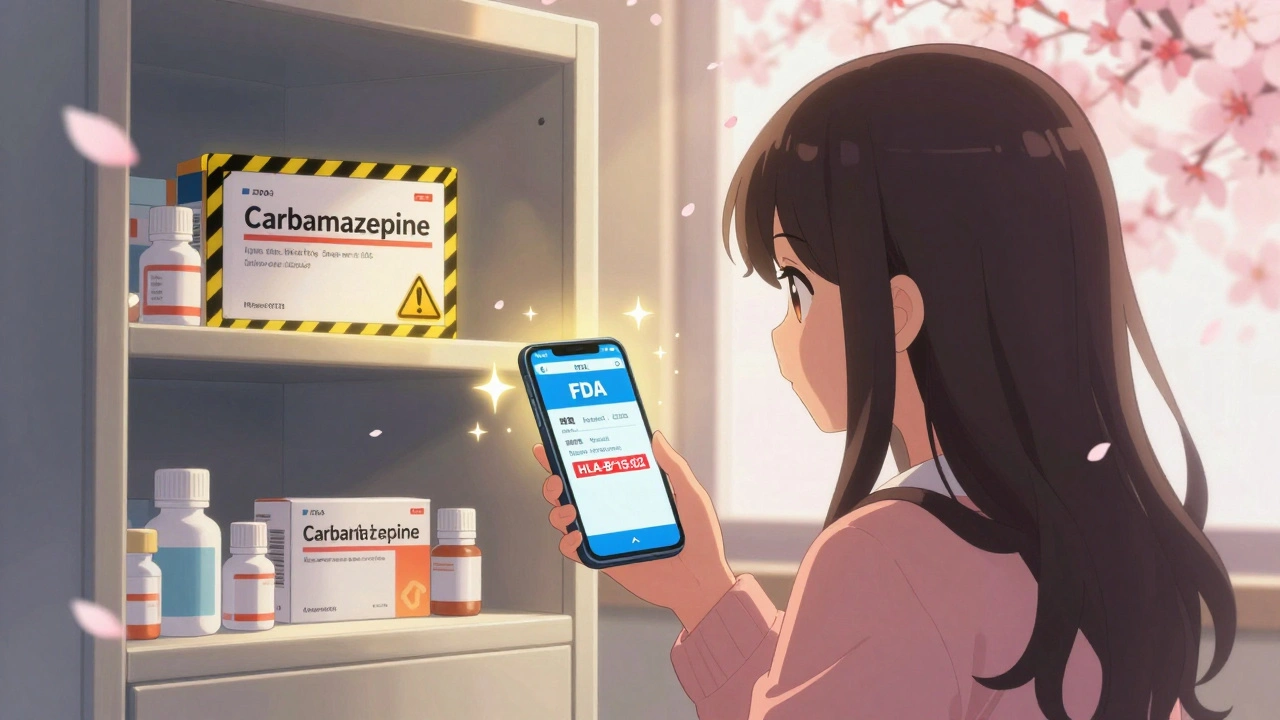
The FDA is moving toward smarter warnings. Instead of saying “this drug can harm anyone,” they’re starting to say “this drug can harm people with this gene.”Thanks to advances in pharmacogenomics, the FDA now includes genetic risk data in some new warnings. For example, the drug carbamazepine (used for seizures) now warns that patients with the HLA-B*15:02 gene are at high risk for a deadly skin reaction-and that this gene is common in people of Asian descent. That’s precision medicine in action.
Soon, you might see digital warnings that pop up when your doctor writes a prescription, tailored to your age, medical history, and genetic profile. The goal? To make the black box warning not just a label, but a real-time safety tool.
For now, though, the system remains simple: if a drug can kill you, you need to know. And you need to act.
Does a black box warning mean a drug is unsafe?
No. A black box warning means the drug has serious, potentially life-threatening risks-but those risks can often be managed. Many patients safely take these medications because the benefits outweigh the dangers. The warning exists to ensure you and your doctor make an informed decision, not to ban the drug.
Can I stop taking a drug with a black box warning on my own?
Never stop a prescription medication without talking to your doctor. Some drugs, like antidepressants or seizure medications, can cause dangerous withdrawal symptoms if stopped suddenly. Even if you’re scared of the warning, work with your provider to safely adjust or switch your treatment.
Are over-the-counter drugs ever given black box warnings?
Rarely, but yes. The FDA can require black box warnings for certain OTC drugs if the risk is severe enough. For example, high-dose acetaminophen (Tylenol) carries a warning about liver failure, especially when combined with alcohol or taken in excess. Always read the full label, even for medicines you buy without a prescription.
How do I find out if my medication has a black box warning?
Check the drug’s prescribing information, which your pharmacist can print for you. You can also search the FDA’s Drugs@FDA database online or use trusted apps like Medscape or Micromedex. If you’re unsure, ask your doctor or pharmacist directly-they’re required to know.
Do other countries have black box warnings?
Other countries have similar systems, but they’re not called “black box warnings.” The European Medicines Agency uses “contraindications” and “serious adverse reactions” in bold print. Canada and Australia have comparable alerts. The format varies, but the goal is the same: highlight the most dangerous risks.
Can a black box warning be removed?
Yes, but it’s rare. The FDA will remove a black box warning only if new evidence shows the risk is much lower than originally thought-often after years of monitoring. For example, the warning on the antidepressant paroxetine was updated after studies showed the suicide risk in adults was lower than in teens. The warning didn’t disappear, but it became more targeted.
Final Thought: Knowledge Is Your Safety Net
A black box warning isn’t meant to scare you. It’s meant to empower you. When you understand the risks, you can ask better questions, follow monitoring rules, and recognize warning signs early. That’s how you stay safe-not by avoiding medication, but by using it wisely.Millions of people take drugs with black box warnings every day. They live full lives. They manage their conditions. They don’t ignore the warning-they respect it. And that’s the difference between fear and control.
Myles White
December 5, 2025 AT 14:51Man, I’ve been on methotrexate for RA for six years now. The black box warning scared the hell out of me at first-bone marrow suppression, liver toxicity, the whole nine yards. But here’s the thing: I couldn’t tie my shoes before this drug. Now I hike on weekends. My doctor runs bloodwork every six weeks, I avoid alcohol like it’s radioactive, and I’ve learned to recognize the early signs of fatigue or bruising that mean I need to call in. It’s not magic, but it’s life-changing. The warning isn’t there to scare you off-it’s there so you don’t get blindsided. Knowledge is power, and honestly, I’d rather know the risks than wake up one day with a failing liver because I ignored the fine print.
Same with my cousin on clozapine. Monthly blood draws? Yeah, it’s a pain. But he went from not speaking for months to coaching little league. That’s not just treatment-that’s redemption. The FDA didn’t put that warning there to kill hope. They put it there so hope doesn’t get killed by ignorance.
Brooke Evers
December 6, 2025 AT 20:32I’m a nurse, and I’ve seen too many patients panic when they see that black border. One lady came in crying because her antidepressant had it-she thought it meant she’d die if she took it. I sat with her for 45 minutes, walked her through exactly what the warning said, and showed her how many people take these meds safely every day. She left calmer. That’s the thing nobody tells you: these warnings aren’t about fear. They’re about responsibility. Your doctor isn’t trying to poison you-they’re trying to save you, and they need you to be an active participant. If you’re on a drug with this warning, ask for a printed copy of the warning. Read it. Highlight what applies to you. Talk to your pharmacist. This isn’t a death sentence-it’s a safety manual written in bold letters because your life literally depends on it.
Chris Park
December 7, 2025 AT 10:38Let’s be real-this whole black box system is a corporate smokescreen. The FDA doesn’t care about you. They care about lawsuits. Every drug that gets a black box warning was approved because the pharma companies paid off regulators during trials. The warning only comes after thousands of people die because the FDA refused to act until the damage was done. Why do you think levofloxacin took TEN YEARS? Because the company buried the data. And now they profit off the fear they created. You think the warning protects you? It protects their bottom line. You’re being manipulated into thinking you’re safe because you’re ‘following the rules.’ But the rules were written by the same people who designed the poison. Wake up. Your meds are a gamble, and the house always wins.
Saketh Sai Rachapudi
December 9, 2025 AT 09:58joanne humphreys
December 9, 2025 AT 11:33I read this whole thing because I’m on lamotrigine with a black box warning for SJS. I was terrified. But after talking to my neurologist, I realized the risk is extremely rare-like, less than 1 in 10,000. And the monitoring protocol-slow titration, avoiding certain antibiotics, watching for rash-is actually really clear. I don’t feel like I’m being warned away from the drug. I feel like I’m being equipped to use it safely. It’s not about fear. It’s about precision. The fact that we can now tailor these warnings to genetic markers like HLA-B*15:02? That’s the future. This isn’t bureaucracy. It’s evolution in patient safety.
Nigel ntini
December 11, 2025 AT 07:25Look, I get why people freak out. I had a friend on warfarin who had a bleed after forgetting his INR check. He almost died. But here’s the thing-he didn’t die because of the drug. He died because he stopped listening. The black box warning didn’t fail him. He failed the warning. That’s the difference. These aren’t scare tactics. They’re checkpoints. Think of them like seatbelt alarms-you don’t turn them off because they’re annoying. You listen because your life depends on it. And if you’re worried about alternatives? Ask your doctor for a second opinion. Not because the drug is evil, but because your health is worth the extra effort. You’re not a patient. You’re a partner in your own survival.
Priya Ranjan
December 11, 2025 AT 10:45People who take drugs with black box warnings are irresponsible. If you are not strong enough to avoid side effects, you should not be taking medicine at all. In my village in India, we use turmeric, neem, and yoga. No pills. No warnings. No death. Why do you need science when nature gives you everything? You are addicted to chemicals because you have no discipline. Your body is weak because you sit all day and eat processed food. The warning is not enough-you need to change your life. Not take another pill.
Gwyneth Agnes
December 12, 2025 AT 18:36Ashish Vazirani
December 13, 2025 AT 01:20Okay, so let me get this straight-the FDA lets Big Pharma poison people for years, then slaps a black box on it like it’s some kind of moral victory? And now we’re supposed to be grateful? I’m on clozapine too. My white blood cell count dropped once. I was in the ER for three days. The hospital said ‘thank you for reporting this’-but the drug company? They just kept selling it. And now they’re selling ‘precision medicine’ like it’s a miracle? Please. This isn’t safety. This is damage control with a PowerPoint. And don’t even get me started on REMS programs-why do I need a special card just to get my own medicine? This isn’t healthcare. This is corporate hostage negotiation.
Mansi Bansal
December 13, 2025 AT 07:29It is my solemn duty to elucidate the profound systemic deficiencies inherent in the current pharmacovigilance paradigm. The FDA’s black box warning mechanism, while ostensibly a laudable attempt at risk mitigation, remains fundamentally reactive rather than prophylactic. The reliance upon post-marketing surveillance-predicated upon the voluntary and often delayed reporting of adverse events-is not only archaic but statistically indefensible. One must question the ethical imperative of permitting a pharmaceutical agent to be administered to millions before its lethality is quantified through morbidity and mortality metrics. The case of rosiglitazone is not an anomaly; it is a systemic indictment. We are not managing risk-we are merely cataloging corpses. Until we mandate pre-market genomic screening and real-time EHR integration of adverse event data, we are not practicing medicine. We are practicing negligence dressed in regulatory finery.
Kay Jolie
December 13, 2025 AT 09:24Okay, but can we just pause for a sec and appreciate how *meta* this is? A black box warning about black box warnings? It’s like the FDA is performing a meta-commentary on institutional authority. ‘Here’s a warning about the warning that warns you about the danger.’ It’s Postmodern Pharma. And honestly? I love it. The fact that we’ve reached a point where the most dangerous drugs come with their own interpretive layer? That’s not a flaw-that’s evolution. We’re moving from ‘take this pill’ to ‘here’s your personalized risk matrix, your monitoring schedule, your genetic red flags, and your mandatory consent form.’ It’s not scary. It’s sophisticated. It’s the difference between a cave painting and a 4K VR simulation of your own mortality. And I’m here for it.
pallavi khushwani
December 13, 2025 AT 22:02It’s funny how we treat medicine like it’s supposed to be perfect. Like if a drug can kill you, it shouldn’t exist. But life isn’t perfect. Pain isn’t perfect. Illness isn’t perfect. Sometimes the only thing that gives you back your life also carries the risk of taking it. I think the black box isn’t there to scare us-it’s there to remind us that we’re human. We’re not machines. We’re not algorithms. We’re bodies that heal, break, and adapt. And sometimes, the bravest thing you can do is take a pill that might kill you… because not taking it will make you disappear. The warning doesn’t say ‘don’t live.’ It says ‘live aware.’ And that’s the most human thing I’ve read all year.
Billy Schimmel
December 15, 2025 AT 19:42So let me get this straight-you’re telling me the same FDA that approved OxyContin with a straight face is now the guardian of my safety? Cool. I’ll believe it when I see them pull a drug off the market before it kills 10,000 people. Until then, I’m just gonna take my meds, check my labs, and assume the system is broken but I’m lucky enough to have a doctor who actually reads the label. The warning’s not the problem. The silence after the warning is.
Shayne Smith
December 17, 2025 AT 10:28I used to ignore these warnings. Then my mom had a bad reaction to diclofenac and ended up in the hospital. Now I print out the black box for every new script and tape it to the pill bottle. I don’t need to read the whole FDA document. I just need to know: what’s the one thing that could kill me? And what do I do if I see it? Simple. I don’t trust the system. But I trust myself enough to read the damn box.
Katie O'Connell
December 18, 2025 AT 11:56While the FDA’s black box warning protocol exhibits a commendable adherence to risk communication frameworks as delineated in the 2020 WHO Guidelines on Pharmacovigilance, the underlying epistemological assumption-that laypersons can meaningfully interpret clinical risk data presented in a static, text-based format-is empirically unsound. Cognitive load theory suggests that patients with low health literacy, which constitutes over 60% of the U.S. population, are unable to accurately assess probabilistic risk. Consequently, the black box functions not as a protective mechanism, but as a performative regulatory artifact, designed to satisfy legal liability requirements rather than to enhance patient outcomes. A more efficacious model would involve dynamic, AI-driven, context-aware alerts integrated directly into the e-prescribing workflow, personalized to the patient’s comorbidities, polypharmacy profile, and socioeconomic determinants of health. Until then, we are merely decorating the coffin with a warning label.
Myles White
December 19, 2025 AT 13:10Just read Chris Park’s comment and had to respond. You’re right that the system is broken-but that doesn’t mean the warning is useless. The fact that we can even have this conversation? That’s because someone reported the liver failure. Someone filed the MedWatch form. Someone pushed back. The system’s flawed, but it’s not dead. If you stop taking your meds because you think the FDA is corrupt, you’re playing right into their hands. The real rebellion? Taking the warning seriously. Getting your labs done. Reporting side effects. Asking for alternatives. That’s how you fight back-not by quitting, but by demanding better.