Why Your Prescription Label Might Be Dangerous
If you or someone you love doesn’t speak English well, the small print on your prescription bottle could be putting your life at risk. It’s not just about看不懂 - it’s about misunderstanding. A single mistranslated word can turn a life-saving medicine into something deadly.
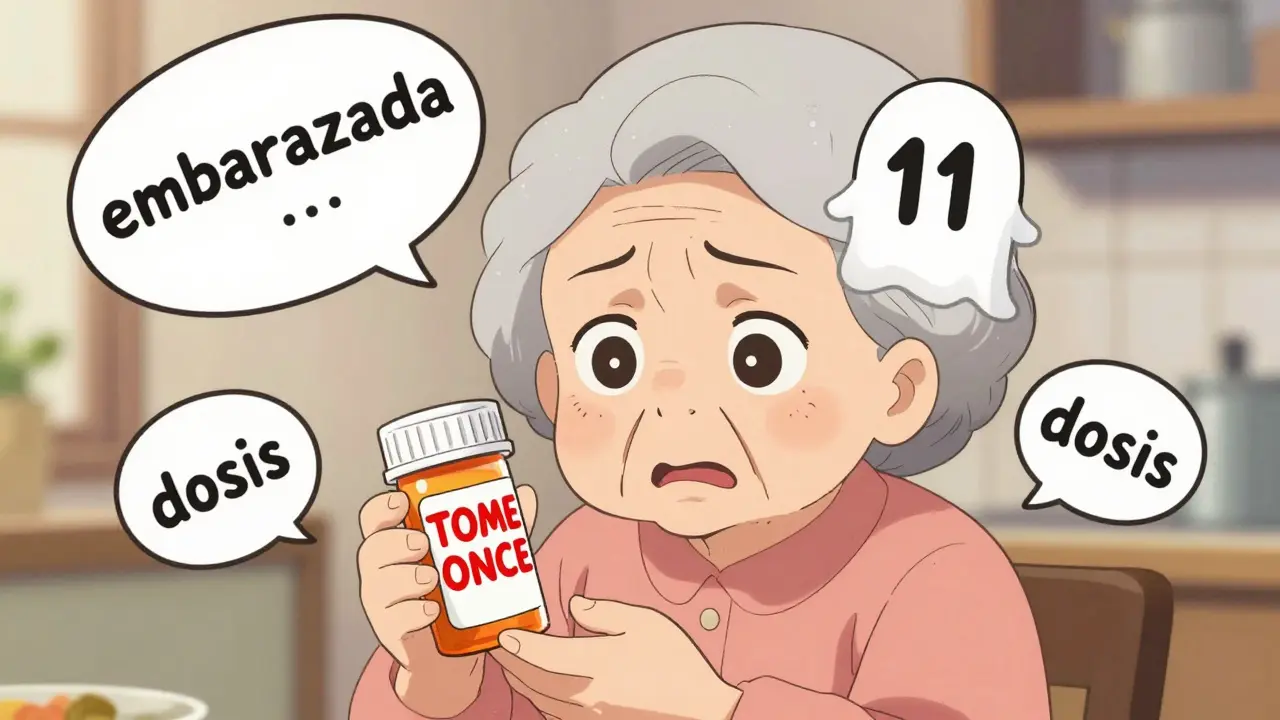
Take the word “once.” In English, it means “one time.” But in Spanish, “once” means “eleven.” If your label says “tome once al día,” you might think you’re supposed to take one pill a day - but you’re actually being told to take eleven. That’s not a typo. That’s what happens when pharmacies use cheap, automated translation tools instead of real human experts.
A 2010 study in the Bronx found that 86% of pharmacies there used computer translations for Spanish labels. Half of those labels had errors. Some told patients to take pills twice a week instead of twice a day. Others confused “take with food” with “take with alcohol.” One woman nearly overdosed because her heart medication label said “una vez” (once) but the system printed “once” (eleven). She didn’t notice until her neighbor, who spoke both languages, read the bottle.
How Computer Translation Gets It Wrong
Most pharmacies don’t have bilingual staff. Instead, they rely on software that pulls translations from third-party databases. These systems don’t understand context. They don’t know if “alcohol” means rubbing alcohol or drinking alcohol. They don’t know if “dosis” refers to a tablet or a teaspoon.
Here’s what goes wrong:
- False cognates: “Embarazada” means pregnant, not embarrassed - but some systems translate “embarrassed” as “embarazada,” leading to confusion.
- Word order: English says “take two pills twice daily.” Spanish says “tome dos pastillas dos veces al día.” But automated systems sometimes flip the order: “dos veces dos pastillas,” which sounds like “two times two pills” - meaning four at once.
- Dialect differences: In Mexico, “pastilla” means pill. In Spain, it can mean candy. In Puerto Rico, “medicina” is common. In Argentina, “fármaco” is used. One system can’t handle all of them.
- Missing units: “Take 5 mg” becomes “tome 5” - no mention of milligrams. Patients don’t know if it’s 5 grams, 5 drops, or 5 pills.
These aren’t rare mistakes. A 2023 MedShadow report found that the same English instruction could appear in three different ways in Spanish across different pharmacies - all generated by the same software. That’s not consistency. That’s chaos.
Who’s Affected - And How Bad It Really Is
More than 25 million Americans have limited English proficiency. That’s 1 in 8 people. About 16 million of them speak Spanish. Millions more speak Chinese, Vietnamese, Arabic, or Russian.
But translation help isn’t equally available. In major chains like CVS and Walgreens, Spanish labels are available at 87% of locations. For Chinese? Only 23%. For Vietnamese? Even less. If you speak Tagalog, Hmong, or Somali, you’re lucky if your pharmacy has *any* translated label at all.
The results are deadly serious. A 2023 survey by the National Health Law Program found that 63% of non-English speakers were confused by their prescription labels. Nearly 3 in 10 admitted they’d taken the wrong dose because of a mistranslation. One man in Florida took his blood thinner three times a day instead of once - because “una vez” was printed as “tres veces.” He ended up in the ER with internal bleeding.
These aren’t just stories. They’re data. In California, where laws require professional translation since 2016, medication errors among Spanish speakers dropped by 32%. ER visits for drug mistakes fell by 27%. That’s not luck. That’s proof that good translation saves lives.
What’s Being Done - And What’s Not
Only two states - California and New York - require pharmacies to use certified translators for prescription labels. In the rest of the country, it’s optional. Most pharmacies choose the cheapest option: automated systems that cost pennies per label.
Professional human translation? It costs 5 to 15 times more. But it’s 98% accurate. Automated systems? They’re only 65-75% accurate - and can drop to 50% for complex instructions.
Some big chains are trying to improve. Walgreens launched MedTranslate AI in late 2023. It uses artificial intelligence to flag bad translations and sends them to a pharmacist for review. CVS has LanguageBridge, which does the same. Both cut errors by over 60% in pilot tests.
But these systems are still new. Only a fraction of stores have them. And they’re not foolproof. AI still struggles with dialects, slang, and medical jargon. It needs human eyes on every label.
Meanwhile, the federal government is stepping in. In March 2024, the Department of Health and Human Services launched a $25 million grant program to help pharmacies buy better translation tools. The FDA also released new guidelines in January 2024, pushing for plain-language labels that are easier to translate accurately.
What You Can Do Right Now
You don’t have to wait for laws or tech fixes. Here’s how to protect yourself or a loved one:
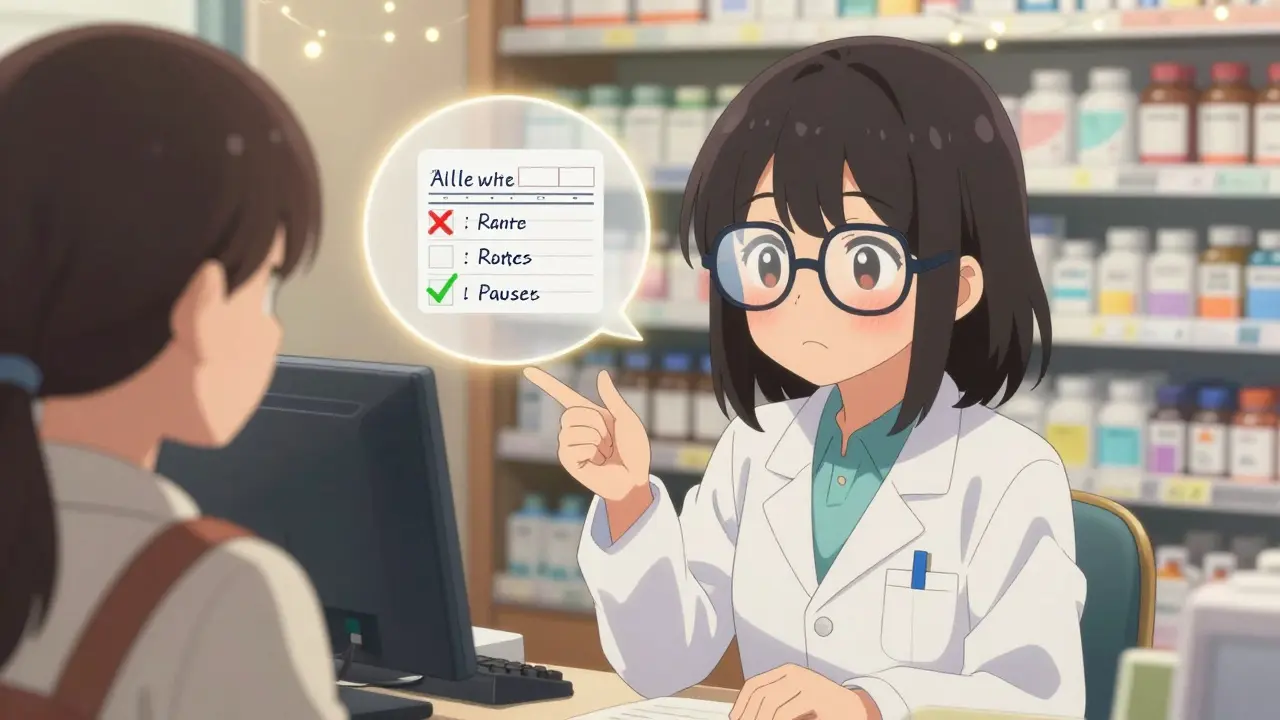
- Ask for a human translator. Don’t settle for the printed label. Ask the pharmacist: “Can you read this to me in my language?” Most pharmacies have phone interpreter services - even if they don’t have printed labels.
- Bring a bilingual friend. If you’re picking up a new prescription, take someone who speaks both languages. Ask them to compare the label to what the doctor said.
- Check for consistency. If you get the same drug from two different pharmacies and the labels say different things, don’t ignore it. Call the pharmacy and ask for clarification.
- Use free translation tools wisely. Apps like Google Translate can help, but don’t trust them for dosage. Instead, use them to understand general instructions - then verify with a pharmacist.
- Know your rights. Under Title VI of the Civil Rights Act, healthcare providers must offer language assistance. If a pharmacy refuses, file a complaint with the U.S. Department of Health and Human Services.
In Miami, a woman with diabetes asked her Walgreens pharmacist to call a certified translator. The pharmacist did - and caught a critical error: the label said “take one tablet every 12 hours,” but the system had printed “take one tablet every 12 days.” Without that check, she would’ve missed doses for weeks.
What Needs to Change
Real change means making professional translation mandatory - not optional - everywhere. It means training pharmacists to recognize translation risks. It means funding better software that learns from human corrections, not just pulls from outdated databases.
It also means listening to patients. When someone says, “I don’t understand this,” don’t assume they’re confused. Assume the label is broken.
The technology exists. The proof is in California. The cost of fixing this is far less than the cost of hospital stays, ER visits, and preventable deaths. Every dollar spent on accurate translation saves $3.80 in avoided medical harm, according to McKinsey’s analysis.
This isn’t about convenience. It’s about survival. A prescription label isn’t just a piece of paper. It’s a lifeline. And if that lifeline is mistranslated, it could snap at any moment.
How to Report a Dangerous Prescription Label
If you find a translation error on your prescription:
- Keep the bottle and the label.
- Write down exactly what the label said and what the doctor told you.
- Call the pharmacy and ask them to correct it immediately.
- If they refuse or ignore you, file a complaint with the FDA’s MedWatch program at www.fda.gov/medwatch or call 1-800-FDA-1088.
- You can also report it to the U.S. Department of Health and Human Services Office for Civil Rights at 1-800-368-1019.
Don’t wait until someone gets hurt. Report it now. Your report could help stop the next mistake.
Bob Hynes
February 2, 2026 AT 07:07Ellie Norris
February 4, 2026 AT 03:26larry keenan
February 6, 2026 AT 02:00Nick Flake
February 7, 2026 AT 02:34Akhona Myeki
February 8, 2026 AT 04:43Chinmoy Kumar
February 9, 2026 AT 19:13Brett MacDonald
February 11, 2026 AT 15:42Marc Durocher
February 11, 2026 AT 22:13Sandeep Kumar
February 13, 2026 AT 15:22Becky M.
February 13, 2026 AT 16:28jay patel
February 15, 2026 AT 14:34