
When you’re on medication for osteoporosis, waiting a year or two to see if it’s working can feel like guessing in the dark. You take your pills, you eat your calcium, you do your exercises-but how do you know it’s actually helping your bones? That’s where bone turnover markers come in. These aren’t fancy scans or painful biopsies. They’re simple blood tests that tell you, within weeks, whether your treatment is doing its job.
What Are Bone Turnover Markers?
Your bones are never still. Even as an adult, they’re constantly being broken down and rebuilt. This process is called bone remodeling. When bone is broken down, fragments of collagen and other proteins spill into your bloodstream. When new bone is made, your body produces specific proteins as building blocks. These fragments and proteins are bone turnover markers (BTMs). There are two main types:- Resorption markers: Show how fast old bone is being removed. The most reliable one is β-CTX-I (beta-C-terminal telopeptide of type I collagen).
- Formation markers: Show how fast new bone is being made. The gold standard here is PINP (procollagen type I N-terminal propeptide).
Why Wait a Year When You Can Know in 6 Weeks?
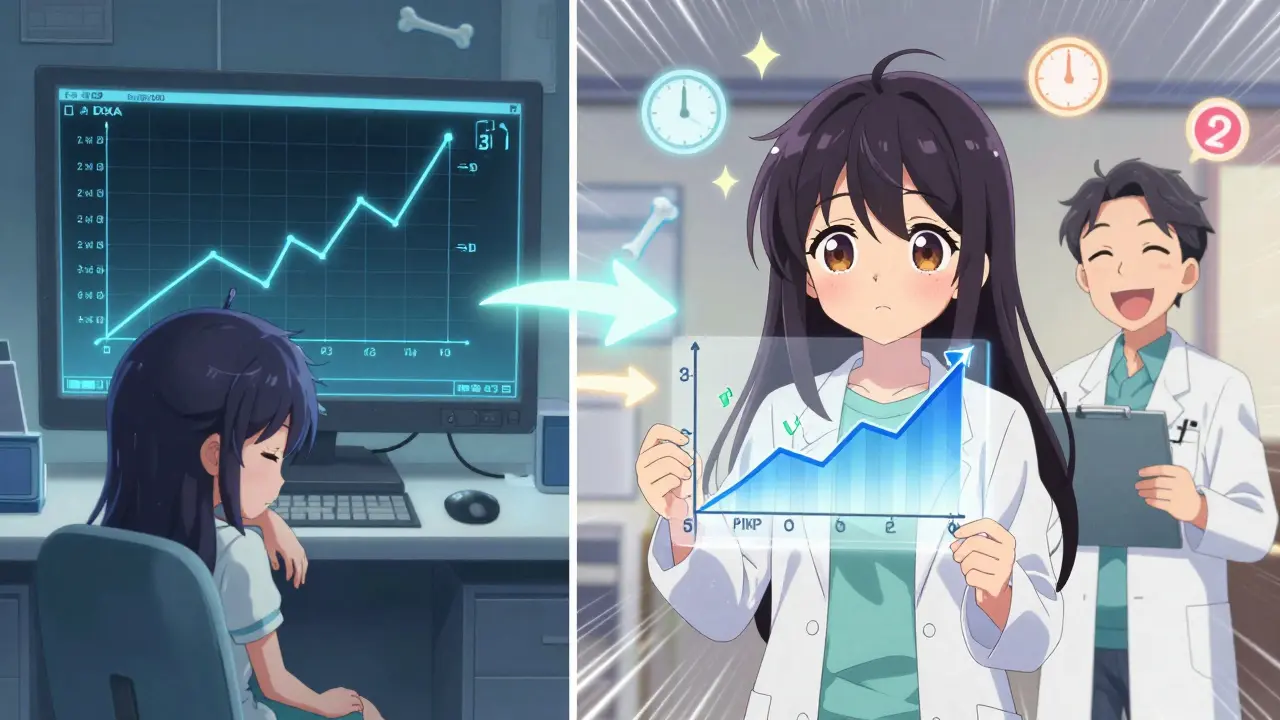
Traditional bone density scans (DXA) are great-they tell you how strong your bones are. But they’re slow. It takes 12 to 24 months to see a clear change in bone density after starting treatment. By then, if the drug isn’t working, you’ve already wasted a year-and your fracture risk hasn’t dropped. BTMs change much faster. Within 3 to 6 weeks of starting a drug like a bisphosphonate or denosumab, your β-CTX-I levels will drop. If you’re on teriparatide (an anabolic drug), your PINP levels will spike. These changes are measurable long before your bones get denser. A major study called TRIO found that patients who saw a 30% or greater drop in β-CTX-I after 3 months had a 1.6% lower risk of fracture over the next year compared to those who didn’t respond. That’s not a small difference-it’s life-changing.How Do Doctors Use These Tests?
It’s not about testing every patient all the time. BTMs are most useful in three situations:- Before you start treatment: Get a baseline PINP and β-CTX-I test. This gives you a starting point.
- At 3 months: Test again. For anti-resorptive drugs (like alendronate or denosumab), your β-CTX-I should drop by at least 30%. Your PINP should drop by at least 35%. If it hasn’t, you might not be taking your medication-or your body isn’t responding.
- At 12-24 months: Get your DXA scan. The BTM results help explain what’s happening. If your BTMs improved but your bone density didn’t, it might just mean you need more time. If neither changed? Your treatment plan needs a rethink.
What Can Throw Off the Results?
These tests are powerful-but they’re not foolproof. If the sample isn’t handled right, you’ll get a false reading.- Timing matters: β-CTX-I levels rise after eating and peak in the early morning. The test must be done fasting, between 8 and 10 a.m.
- Food and drink: Even a cup of coffee or a snack can raise β-CTX-I by 20-30%.
- Other health issues: Kidney disease can cause PINP and β-CTX-I to build up in your blood, even if your bones are healthy. In these cases, doctors may use bone alkaline phosphatase (BALP) or TRACP5b instead.
- Lab differences: Not all labs use the same methods. That’s why it’s best to use the same lab for all your tests.
How Do BTMs Compare to DXA Scans?
Many people think bone density scans are the only thing that matters. They’re not wrong-but they’re incomplete.| Feature | Bone Turnover Markers (PINP, β-CTX-I) | DXA Scan (Bone Density) |
|---|---|---|
| What it measures | Speed of bone breakdown and rebuilding | Amount of mineral in your bones |
| Time to see change | 3-6 weeks | 12-24 months |
| Best for | Early response, adherence, treatment adjustment | Diagnosis, long-term monitoring, fracture risk prediction |
| Preparation needed | Fasting, morning collection | None |
| Cost | $25-$35 per test | $100-$200 per scan |

Who Should Get Tested?
Not everyone needs BTMs. But they’re especially helpful if:- You’re starting a new osteoporosis drug and want to know if it’s working
- You’re not sure you’ve been taking your medication regularly
- Your bone density hasn’t improved after a year on treatment
- You have kidney disease and need alternative markers
- You’re on an anabolic drug like teriparatide
What’s Next for Bone Turnover Markers?
The use of BTMs is growing. Medicare in the U.S. has covered PINP and β-CTX-I testing since 2020. In Europe, up to 60% of clinics use them routinely. In the U.S., adoption is still around 30%, but that’s rising. Research is expanding too. New studies are looking at whether BTMs can predict fracture risk better than bone density alone. Others are testing if using BTMs to adjust treatment early can reduce fractures even further. One big challenge? Reference ranges. Most normal values are based on Caucasian populations. People of Asian descent tend to have naturally lower β-CTX-I levels. African populations often have higher PINP. Labs are working to fix this, but it’s not universal yet.Bottom Line: BTMs Are Your Early Warning System
Osteoporosis treatment isn’t a set-it-and-forget-it situation. Medications work differently for different people. Some respond fast. Others need a different drug. Some forget to take theirs. BTMs help you find out which group you’re in-without waiting years. If you’re on osteoporosis therapy, ask your doctor: “Can we check my PINP and β-CTX-I at 3 months?” It’s a simple blood test. No radiation. No pain. And it could save you from a fracture-or from wasting time on a drug that isn’t working for you.The science is solid. The guidelines are clear. The tools are available. The only thing missing is asking the question.
Kenji Gaerlan
January 22, 2026 AT 03:28so i got my btms tested last year and my doc just said 'looks fine' and moved on. no idea what pinp or b-ctx-i even mean. i think they just copy-paste the lab report and call it a day.
Akriti Jain
January 23, 2026 AT 00:08💀 lol so now they’re selling blood tests as ‘early warning systems’? next they’ll charge us for ‘bone vibes’ 🧘♀️🩸
also… did you know big pharma owns 87% of labs? just saying. 💡
Mike P
January 23, 2026 AT 05:20Let me break this down for the people still using DXA like it’s 2010. 🇺🇸 We’ve had solid guidelines since 2023 and you’re still waiting a year to see if your meds work? That’s not patience, that’s negligence.
My cousin’s on denosumab, got her β-CTX-I tested at 8 weeks-dropped 42%. Doc switched her to a higher dose immediately. She’s not worried about fractures anymore. Meanwhile, my neighbor’s still on the same meds for 18 months and just broke her hip. No BTMs. No accountability. Just ‘well, you’re elderly.’
And yeah, fasting matters. I’ve seen people drink coffee before the test and then blame the lab. No. It’s not the lab. It’s you. Stop being lazy.
Also, if your doc doesn’t know PINP from a hole in the wall, find a new one. This isn’t rocket science. It’s bone biology. We’ve had the data. The guidelines are clear. Stop pretending you’re ‘waiting for results’ when you’re just waiting to get hit with a bill for a broken hip.
And don’t even get me started on the ‘reference ranges are biased’ thing. Yeah, they are. But that’s why you get tested at the same lab every time. Standardization isn’t optional. It’s basic science.
And yes, it’s $30. That’s less than a weekly Starbucks run. If you can afford coffee, you can afford a test that might keep you from ending up in a wheelchair.
Stop waiting. Start testing. Your bones don’t care how ‘busy’ you are.
Margaret Khaemba
January 24, 2026 AT 21:07This is actually so helpful! I’m from Kenya and we don’t have access to these tests here, but I’m sharing this with my sister who’s on osteoporosis meds in Texas. She had no idea her doctor should be checking this at 3 months.
Also, the coffee thing? I had no idea. I always drink my morning espresso before anything. 😅 Now I know why her last test was weird.
Thanks for writing this like a real person-not a textbook. I feel like I can actually talk to my doctor now without sounding like I’m making stuff up.
Keith Helm
January 26, 2026 AT 01:50Proper fasting protocol is non-negotiable. Failure to adhere invalidates results.
Daphne Mallari - Tolentino
January 26, 2026 AT 06:12How quaint. A blood test to ‘track bone turnover’-as if the human body can be reduced to a spreadsheet. One wonders whether the medical-industrial complex has run out of profitable interventions and is now monetizing biochemical noise.
Meanwhile, real medicine-nutrition, weight-bearing exercise, sunlight-remains ignored because it cannot be patented. But of course, $30 tests are far more lucrative than advising someone to eat kale.
Neil Ellis
January 26, 2026 AT 14:43This is the kind of info that should be plastered on every pharmacy shelf next to the calcium supplements. 🙌
I used to think osteoporosis was just ‘old lady bones’-turns out it’s a silent thief that only wakes up when you’re on the floor after a slip.
My aunt got her BTMs checked after her second fall. Turned out she was skipping her meds. Doc caught it early. Now she’s walking like a superhero again.
Don’t wait for a fracture to be your wake-up call. Ask for the test. It’s not fancy. It’s not scary. It’s just smart.
Alec Amiri
January 27, 2026 AT 13:14so you’re telling me we’re paying for a blood test to see if people are taking their pills? 🤡
why not just put a tracker in the pill bottle? or maybe… ask them?
Rob Sims
January 28, 2026 AT 21:02LOL at people who think ‘30% drop in β-CTX-I’ means anything. I’ve seen labs report different values just because the tech was having a bad day.
Also, ‘anabolic drugs spike PINP’? Yeah, right. That’s why 70% of people on teriparatide end up with osteosarcoma. Oh wait, that’s just a rumor. 🤫
Don’t trust the hype. Trust your doctor. And if your doctor doesn’t know what BTMs are? You’ve got bigger problems than bone density.
Lauren Wall
January 29, 2026 AT 17:02My doc didn’t mention this. I had to google it myself. Guess I’m the only one who cares.