When you hear "generic drug," you probably think of a cheaper version of your prescription pill-same active ingredient, same effect, same price cut. But when someone mentions "biosimilar," it might sound like just another kind of generic. It’s not. And that difference matters a lot-for your health, your wallet, and how your doctor prescribes your medicine.
What exactly is a biosimilar?
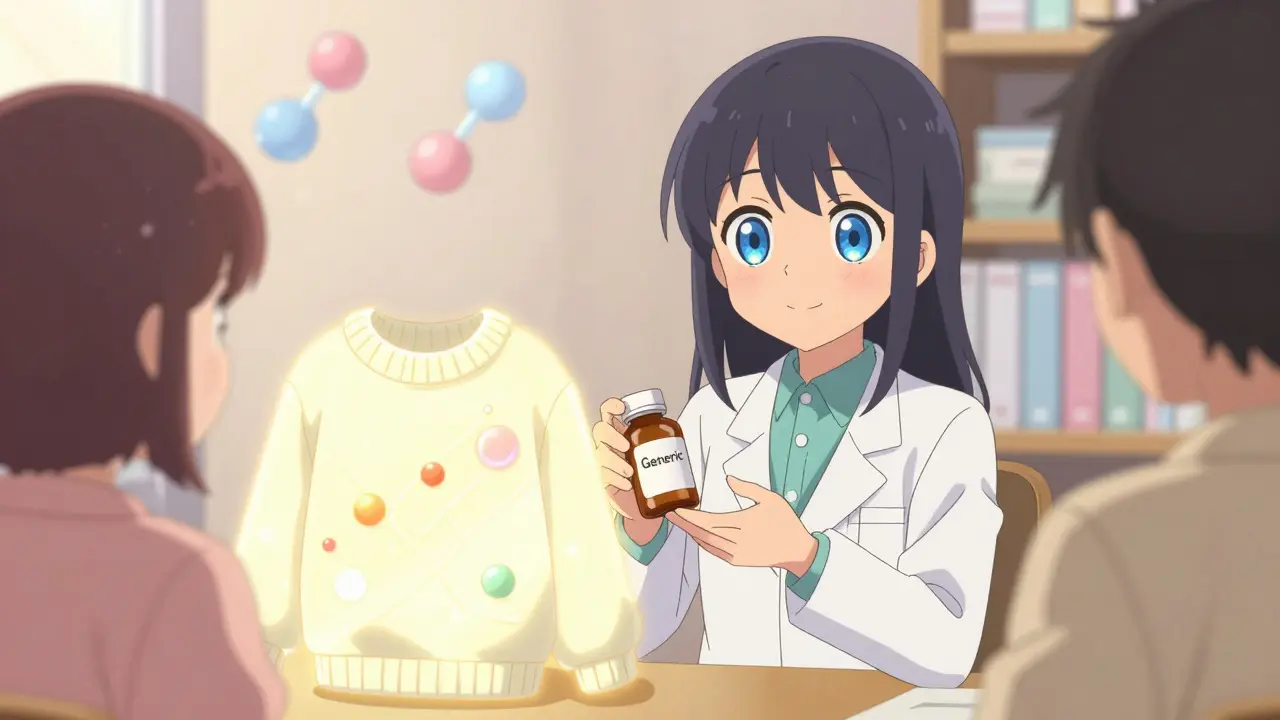
Biosimilars are copies of biologic drugs, which are made from living cells-like yeast, bacteria, or animal cells. These aren’t simple chemicals. They’re large, complex proteins, sometimes thousands of times bigger than a regular pill. Think of them like a handmade sweater: even if two knitters follow the same pattern, no two sweaters are perfectly identical. That’s why biosimilars are called "highly similar," not "identical."
Examples include drugs like Humira (adalimumab), Enbrel (etanercept), and Herceptin (trastuzumab). These treat serious conditions-rheumatoid arthritis, Crohn’s disease, cancer. The biosimilar versions, like Amjevita (for Humira), must go through intense testing to prove they work the same way in the body. The FDA requires studies on structure, function, safety, and even immune reactions. It’s not enough to just match the chemical formula. You have to prove the whole biological system behaves the same.
What exactly is a generic drug?
Generics are copies of traditional, small-molecule drugs. These are made from chemical compounds you can easily write on a whiteboard-like aspirin, ibuprofen, or metformin. Their molecular structure is simple and stable. Once the patent expires, any manufacturer can replicate the exact chemical formula. The FDA doesn’t need to retest how the drug works in humans. They just need to prove it absorbs into the bloodstream the same way as the brand-name version. That’s called bioequivalence.
Generics are typically 40% to 50% cheaper than brand-name drugs. They’re interchangeable at the pharmacy level in all 50 states. Your pharmacist can swap your brand-name drug for the generic without asking your doctor. That’s because the difference is so tiny-like swapping one brand of bottled water for another.
The molecular difference: size matters
Here’s where things get technical, but it’s important. A generic drug like ibuprofen weighs about 206 daltons. That’s tiny. A biologic like infliximab (Remicade) weighs around 148,000 daltons. That’s 700 times heavier. And that size isn’t just a number-it’s why biosimilars can’t be exact copies.
Biologics are made using living cells. Those cells change slightly with every batch-temperature, nutrients, pH levels all affect the final product. That’s normal. The FDA allows small, natural variations as long as they don’t change safety or effectiveness. But that’s impossible with a small-molecule drug. You can mix chemicals in a lab and get the same molecule every time. That’s why generics are exact matches. Biosimilars are very close-but never the same.
Regulatory paths: why biosimilars take longer and cost more
Generics have been around since the 1984 Hatch-Waxman Act. The process is streamlined: prove bioequivalence, submit paperwork, get approved. It costs about $2-5 million to bring a generic to market.
Biosimilars? They follow the 2009 BPCIA law. The path is longer, harder, and way more expensive. Manufacturers must:
- Do hundreds of lab tests to compare structure and function
- Run animal studies
- Conduct clinical trials to prove no meaningful difference in safety or effectiveness
- Prove their manufacturing process is stable-even though they can’t copy the original company’s process
This can cost $100-200 million per biosimilar. That’s why they’re not as cheap as generics. They save 15% to 20%-sometimes up to 33%-compared to the brand-name biologic. Not as much as generics, but still significant for expensive drugs that cost $20,000 a year.
Can your pharmacist switch you without asking?
This is one of the biggest practical differences.
With generics? Yes. Your pharmacist can swap them automatically. Laws in every state allow it.
With biosimilars? Only if they’re labeled "interchangeable." And as of late 2023, only 7 out of 42 approved biosimilars have that status. The rest? Your doctor must specifically write "dispense as written" or you’ll get the brand-name drug.
Why? Because of immune reactions. Biologics can trigger your body’s immune system. If you’re stable on one drug and your pharmacist switches you to a biosimilar without your doctor’s input, there’s a small-but real-risk of your immune system reacting differently. That’s why the FDA and medical groups like the American Society of Health-System Pharmacists say: don’t assume biosimilars are like generics.
Who uses them and where?
Generics make up 90% of all prescriptions filled in the U.S. That’s about 6.8 billion prescriptions a year. But they only account for 20% of total drug spending because they’re so cheap.
Biosimilars? They’re growing fast but still represent less than 3% of the biologics market. Most are used in oncology (cancer), immunology (autoimmune diseases), and endocrinology (like insulin). Hospitals and specialty pharmacies are leading adoption because they handle high-cost drugs and have the resources to manage the complexity.
Why isn’t adoption higher? Several reasons:
- Doctors aren’t always confident switching patients who are stable on a biologic
- Insurance plans sometimes don’t cover biosimilars as preferred options
- Manufacturers of brand-name biologics use patent thickets-filing dozens of patents to delay competition
- The "buy and bill" reimbursement system means providers buy the drug and bill insurance, so they might prefer the more expensive brand if the profit margin is better
What’s changing in 2026?
The Inflation Reduction Act of 2022 is starting to make a difference. It’s capping insulin costs at $35 a month for Medicare patients-and that includes biosimilar insulins. More importantly, it’s removing the Part D coverage gap, which makes biosimilars more attractive to insurers.
Amjevita, the first interchangeable biosimilar for Humira, hit the market in January 2024 with a 35% price cut. That’s a game-changer. More biosimilars for Stelara, Eylea, and other top-selling biologics are coming through 2026. Analysts predict biosimilars could hit 25-30% of the U.S. biologics market by 2028.
But don’t expect them to replace generics. They’re not meant to. They’re meant to bring down the cost of the most expensive drugs in medicine-drugs that used to cost $100,000 a year and now, with biosimilars, might cost $70,000.
Bottom line: not the same, but both valuable
Biosimilars aren’t generics. Generics are simple, exact copies. Biosimilars are complex, highly similar versions of living medicines. One isn’t better than the other-they serve different needs.
If you’re taking a pill you’ve been on for years, the generic version is probably safe to switch to without thinking twice. But if you’re on a biologic for rheumatoid arthritis or cancer, switching to a biosimilar should be a conversation with your doctor-not a pharmacy decision.
The goal for both is the same: make life-saving treatments more affordable. Generics have done that for decades. Biosimilars are just beginning to do it for the most expensive drugs on the market. And that’s worth understanding-before your next prescription.