Antibiotics don’t cure colds. They don’t touch viruses. But when you have a bacterial infection - strep throat, a urinary tract infection, pneumonia, or a skin abscess - they can be the difference between getting better and getting sicker. These drugs have saved millions of lives since penicillin hit the market in the 1940s. Yet most people don’t know how they actually work. Not just that they kill bacteria, but how they do it. And why some work for one infection and not another.
How Antibiotics Actually Kill Bacteria
Antibiotics aren’t magic bullets. They’re precision tools. Each class targets a specific part of a bacterial cell - something human cells don’t have. That’s why they can kill bacteria without wrecking your body. There are four main ways they do this.
The first and most common method is attacking the bacterial cell wall. Bacteria have a rigid outer shell made of peptidoglycan. It’s like a chain-link fence made of sugar and protein. Without it, the cell bursts from internal pressure. That’s what happens when you take penicillin or amoxicillin. These drugs, called beta-lactams, mimic a key building block in the wall. They latch onto the enzymes that stitch the wall together and shut them down. The bacteria keep growing, but their walls stay weak. They swell, then pop. It’s a clean, fast kill.
Other antibiotics, like vancomycin, do something similar but bind to a different spot on the wall. That’s why vancomycin is used when penicillin fails - it’s a backup plan for resistant bugs.
Beta-Lactams: Penicillins, Cephalosporins, and More
Beta-lactams are the most widely used antibiotics in the world. Penicillin was the first. Today, we have dozens of versions grouped into generations.
First-generation cephalosporins like cefalexin are great for skin infections and simple strep throat. They mostly hit Gram-positive bacteria - the kind with thick walls. Second-generation ones like cefuroxime add a bit of coverage against Gram-negative bacteria, which have thinner walls and are trickier to penetrate. Third-generation drugs like ceftriaxone go even further. They can cross into the brain, making them essential for meningitis. And fourth-generation cefepime? It’s broad-spectrum, hitting both Gram-positive and Gram-negative bugs, including tough ones like Pseudomonas.
But here’s the catch: bacteria fight back. Many now produce enzymes called beta-lactamases that chop up the beta-lactam ring in these drugs. That’s why doctors often pair amoxicillin with clavulanic acid - the latter blocks the enzyme, letting the antibiotic do its job.
Protein Synthesis Blockers: Macrolides, Tetracyclines, and Others
Another big group of antibiotics doesn’t touch the cell wall. Instead, they go after the bacteria’s protein-making machines - ribosomes. Human ribosomes are different, so these drugs leave us mostly alone.
Macrolides like azithromycin bind to the 50S part of the ribosome. They stop the assembly line. Bacteria can’t make the proteins they need to grow or survive. That’s why azithromycin is used for pneumonia, bronchitis, and even some STIs. It’s taken as a single big dose because it sticks around in tissues for days.
Tetracyclines like doxycycline work differently. They latch onto the 30S ribosome and block tRNA from delivering amino acids. They’re used for acne, Lyme disease, and even some tick-borne illnesses. But they come with downsides: they make your skin sensitive to sunlight, and they can permanently stain kids’ teeth if given under age 8.
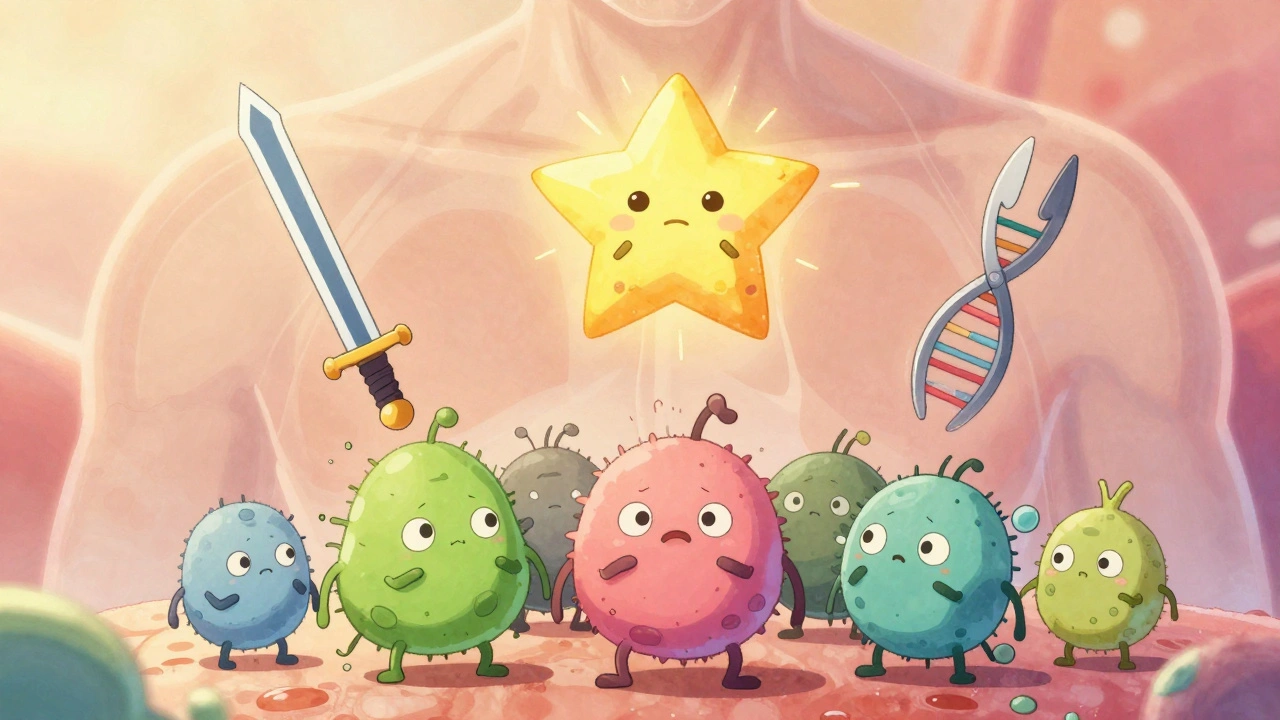
Aminoglycosides like gentamicin are powerful but risky. They bind to the 30S ribosome and cause the bacteria to misread genetic instructions. The result? Broken, useless proteins. But they’re hard on the kidneys and ears. That’s why they’re usually given in hospitals for serious infections like sepsis - and only for short periods.
Linezolid is a newer player. It’s the first fully synthetic antibiotic that blocks protein synthesis at the very start - before the ribosome even assembles. It’s reserved for drug-resistant infections like MRSA. It’s expensive, but it works when nothing else does.
DNA and RNA Disruptors: Fluoroquinolones and Others
Then there are the antibiotics that go after bacterial DNA. Fluoroquinolones - ciprofloxacin, levofloxacin - are the main ones here. They block two enzymes: DNA gyrase and topoisomerase IV. These enzymes untangle DNA so it can be copied. Without them, the bacteria can’t replicate. The result? Cell death.
Fluoroquinolones are great because they get into almost every tissue - bones, lungs, urine, even inside cells. That’s why they’re used for complicated UTIs, kidney infections, and even anthrax. But they come with serious warnings. The FDA added black box labels for tendon ruptures, nerve damage, and even mental health side effects. They’re no longer first-line for simple infections like sinusitis or bronchitis.
Metronidazole is another DNA disruptor, but it works differently. It’s activated only inside anaerobic bacteria - the kind that live without oxygen. Once activated, it shreds their DNA. That’s why it’s the go-to for C. diff infections, dental abscesses, and bacterial vaginosis. But it reacts badly with alcohol - causing nausea, vomiting, and a pounding headache. If you take it, don’t drink.
Why Some Antibiotics Fail
Not every infection responds to every antibiotic. That’s not just because of resistance - though that’s a huge problem. It’s also because of the type of bacteria, where the infection is, and how the drug moves through the body.
For example, aminoglycosides can’t reach anaerobic bacteria because they need oxygen to get inside the cell. So if you have a deep abscess filled with oxygen-hating bugs, gentamicin won’t help. Metronidazole will.
Then there’s the issue of resistance. In 2023, over 50% of E. coli infections in 72 countries were resistant to fluoroquinolones. That’s not a future threat - it’s happening now. Hospitals are seeing more cases where only last-resort drugs like colistin or cefiderocol work. Cefiderocol is clever: it tricks bacteria into pulling it inside using their own iron-transport system. It’s like a Trojan horse.
But here’s the deeper problem: we’re running out of new ones. Only 16 new antibiotics in development target the WHO’s top priority superbugs. Most big drug companies have walked away because antibiotics don’t make money. A cancer drug can bring in billions. An antibiotic? Maybe $17 million a year. That’s why some countries are trying new models - like paying a flat fee for access, no matter how much is used. Think Netflix for antibiotics.
What You Should Know Before Taking Them
Antibiotics aren’t harmless. They kill good bacteria too. Your gut, your skin, your mouth - they all have helpful microbes. Broad-spectrum antibiotics can wipe them out for months. Studies show this disruption increases the risk of C. diff infection by 17 times. That’s a dangerous, hard-to-treat diarrhea that can be deadly.
And yes - 30% of outpatient antibiotic prescriptions are unnecessary. Doctors often prescribe them out of caution, or because patients demand them. But if you have a viral sore throat, antibiotics won’t help. They’ll just make you more likely to get resistant infections later.
Procalcitonin tests can help. It’s a blood marker that rises only in bacterial infections. Using it cuts unnecessary antibiotic use by 23% in respiratory cases. But it’s not available everywhere.
Always finish your course - even if you feel better. Stopping early lets the toughest bacteria survive and multiply. That’s how resistance grows.
What’s Next?
The future isn’t just more antibiotics. It’s smarter use. Better diagnostics. Phage therapy - using viruses that only kill specific bacteria - is in late-stage trials. In New Zealand and Europe, labs are mapping local resistance patterns in real time so doctors can choose the right drug from day one.
For now, the best tool we have is knowing which antibiotic does what - and when to use it. Not because it’s trendy. Not because it’s the newest. But because it’s the right one for your infection, your body, and the bugs you’re fighting.
Can antibiotics treat viral infections like the flu or cold?
No. Antibiotics only work against bacteria. Colds, flu, most sore throats, and bronchitis are caused by viruses. Taking antibiotics for these doesn’t help you feel better faster and increases your risk of antibiotic resistance. It also harms your good bacteria.
Why do some antibiotics cause stomach upset?
Antibiotics kill bacteria - including the helpful ones in your gut. This imbalance can lead to diarrhea, bloating, or nausea. Probiotics may help reduce this, but they don’t prevent all side effects. Eating fiber-rich foods and staying hydrated can also support your gut during treatment.
What happens if I stop taking my antibiotics early?
Stopping early doesn’t mean you’re cured - it means the toughest bacteria are still alive. These survivors multiply and pass on resistance genes. That’s how superbugs form. Even if you feel fine, finish the full course unless your doctor says otherwise.
Are natural remedies like honey or garlic effective against bacterial infections?
Some natural substances, like honey, have mild antibacterial properties and can help with wound healing. Garlic has compounds that show activity in labs. But none replace antibiotics for serious infections like pneumonia, UTIs, or sepsis. Relying on them instead of proven treatment can be dangerous.
Why are antibiotics sometimes given in combination?
Doctors sometimes combine antibiotics to cover more types of bacteria at once, especially in serious or unknown infections. For example, amoxicillin-clavulanate combines a beta-lactam with an enzyme blocker. Sulfamethoxazole-trimethoprim targets two steps in the same bacterial pathway, making resistance harder to develop.
How do I know if I need an antibiotic?
Only a doctor can tell. Signs like high fever lasting more than 3 days, pus, worsening symptoms after initial improvement, or lab results (like elevated procalcitonin) suggest bacterial infection. But many infections - even with thick mucus or green phlegm - are still viral. Don’t pressure your doctor for antibiotics. Ask what tests are needed to confirm the cause.
Antibiotics are powerful - but only when used correctly. The goal isn’t to avoid them. It’s to use them wisely. So you stay healthy now - and so the next generation still has tools to fight infection.
Tejas Bubane
December 7, 2025 AT 23:53Antibiotics are just fancy chemical bandaids for lazy medicine. We treat symptoms instead of root causes, then wonder why superbugs evolve. It’s not the bacteria that’s the problem-it’s the entire healthcare industrial complex that profits off perpetual infection cycles.
precious amzy
December 8, 2025 AT 04:33One cannot help but observe that the anthropocentric framing of antibiotics as 'tools' betrays a deeply entrenched Cartesian dualism-human as sovereign, bacteria as mere mechanistic threat. The very lexicon of 'kill,' 'target,' and 'resistance' reflects a colonial epistemology imposed upon microbial ecosystems. Perhaps we ought to consider symbiosis over eradication.
Angela R. Cartes
December 8, 2025 AT 15:43lol at people who think metronidazole is 'dangerous'... you take it and don't drink, it's not that hard. Also, why is everyone acting like cefiderocol is some sci-fi miracle? It's just another beta-lactam with a fancy iron shuttle. We're not winning this war.
Philippa Barraclough
December 10, 2025 AT 06:45It is worth noting that the structural specificity of beta-lactam antibiotics, while elegant from a biochemical standpoint, also renders them exquisitely vulnerable to enzymatic degradation via beta-lactamases-a phenomenon that has been evolutionarily optimized over billions of years in microbial communities. The human tendency to deploy these agents with reckless frequency is not merely shortsighted; it is an ecological miscalculation of staggering proportions, one that fundamentally misunderstands the tempo and logic of natural selection.
Olivia Portier
December 10, 2025 AT 14:17omg yes!! i got a UTI last year and my dr gave me cipro and i was like 'wait but i heard it messes with your tendons??' and she was like 'yeah but it works' and i was like 'but what if i just drink cranberry juice??' and she was like 'you’re gonna end up in the hospital' so i took it and i’m alive so 🤷♀️
also probiotics are life. i eat yogurt like it’s my job.
Tiffany Sowby
December 12, 2025 AT 13:27Why are we even talking about this like it’s a mystery? America’s healthcare system is broken. We overprescribe because insurance won’t pay for tests. We don’t have access to procalcitonin because it’s 'too expensive.' Meanwhile, people in other countries are getting real diagnostics and not being treated like cattle. This isn’t science-it’s capitalism with a stethoscope.
Ronald Ezamaru
December 14, 2025 AT 02:50As someone who grew up in a rural village where antibiotics were rare, I’ve seen what happens when infections go untreated-amputations, death, children lost. I’m not romanticizing overuse, but I’m also not naive. Antibiotics saved my sister’s life from a simple cut infection. The problem isn’t the drugs-it’s the lack of access, education, and infrastructure. We need global equity, not just smarter prescriptions.
Iris Carmen
December 15, 2025 AT 05:16just finished my amoxi course even though i felt fine after 2 days. also ate 3 yogurts. my gut is happy. 🌈