
What is ankylosing spondylitis?
Ankylosing spondylitis (AS) isn't just back pain. It's a chronic inflammatory disease that targets the spine and sacroiliac joints, slowly fusing vertebrae together and stiffening the spine over time. Unlike ordinary backaches from lifting or sitting too long, AS pain wakes you up in the early morning, lasts more than 30 minutes, and gets worse with rest. Movement helps. That’s a key clue. It’s not wear and tear-it’s your immune system attacking your own joints.
First described in the 1800s, AS affects about 0.1% to 1.4% of people worldwide. It’s more common in men and often starts between ages 17 and 45. A genetic marker called HLA-B27 shows up in about 90% of people with AS, but having the gene doesn’t mean you’ll get the disease-only about 5-6% of HLA-B27 carriers actually develop it.
How does inflammation turn into fusion?
The process happens in three stages. First, inflammation hits the sacroiliac joints and spine, causing swelling, pain, and stiffness. Then, the body tries to repair the damage by breaking down bone. Finally, it overcompensates by building new bone in the wrong places-creating bony bridges between vertebrae. This is called syndesmophyte formation, and it’s what leads to the characteristic bamboo spine seen on X-rays.
At the center of this process is a protein called tumor necrosis factor-alpha (TNF-α). It’s like a fire alarm in your body that won’t shut off. In people with AS, immune cells pump out too much TNF-α, which pulls in more inflammatory cells, keeps the swelling going, and triggers the bone changes. MRI scans show this inflammation clearly in the early stages, even before X-rays show damage.
What are TNF inhibitors?
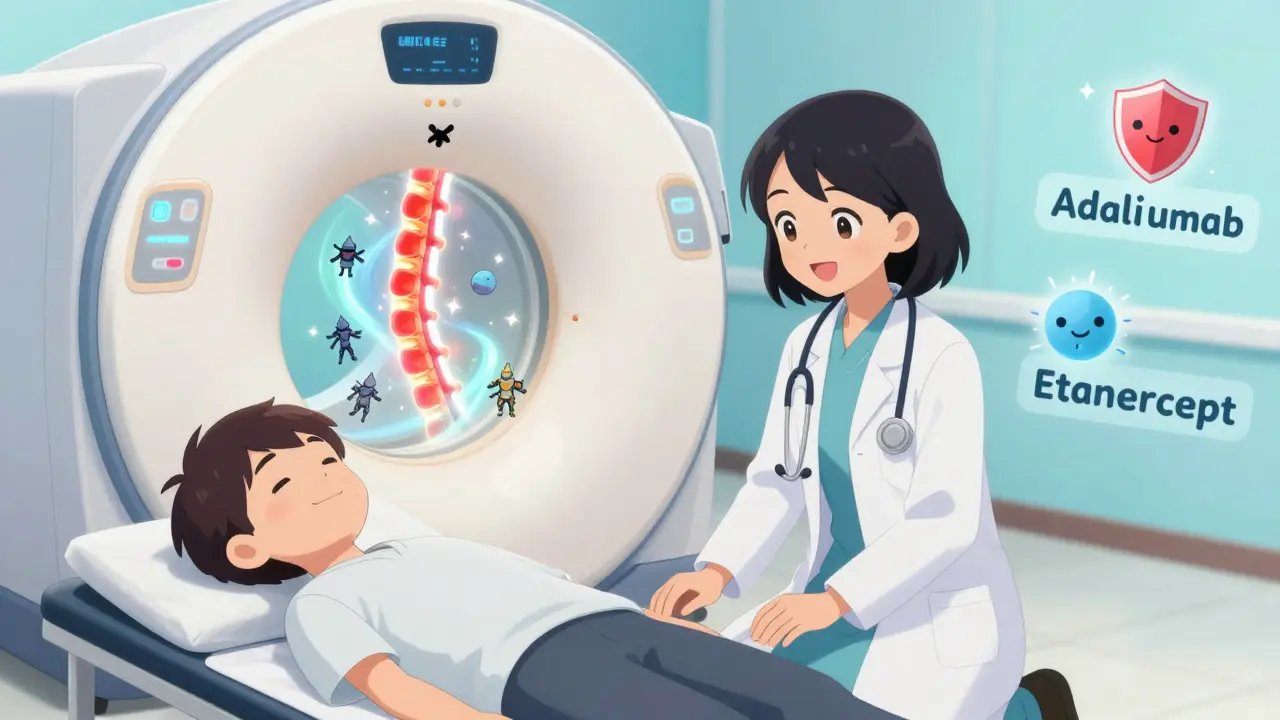
TNF inhibitors are biologic drugs designed to block TNF-α. They don’t cure AS, but they stop the inflammation before it causes permanent damage. Five are approved for AS treatment: infliximab, etanercept, adalimumab, certolizumab pegol, and golimumab.
They work differently. Infliximab and adalimumab are monoclonal antibodies made in labs to latch onto TNF-α like a key in a lock. Etanercept is a fusion protein that acts like a decoy, soaking up excess TNF-α before it reaches your joints. Certolizumab and golimumab are also antibodies but with slight structural differences that affect how long they last in your body.
Administration varies too. Infliximab is given through an IV every 4 to 8 weeks at a clinic. The others are self-injected under the skin-weekly, every other week, or monthly. Most patients learn to give themselves shots after one or two training sessions. About 92% get comfortable with it within a month.
How well do they work?
The numbers speak for themselves. In clinical trials, 58% to 65% of patients on TNF inhibitors saw at least a 20% improvement in symptoms (ASAS20 response) within 12 to 24 weeks. That’s nearly double the placebo group. For a 40% improvement (ASAS40), 40-45% of patients responded-compared to just 12-18% on placebo.
Real-world results are just as strong. A 2022 survey of over 1,200 AS patients found that 78% reported substantial improvement after starting TNF inhibitors. Morning stiffness dropped from over an hour to under 30 minutes for 62% of them. Many notice relief within two to three doses, though full benefits take up to 12 weeks.
MRI scans show inflammation in the spine and sacroiliac joints drops by nearly 60% after six months of treatment. This isn’t just symptom relief-it’s actual disease modification. Studies show TNF inhibitors can slow or even stop new bone formation if started early, especially within the first two years of symptoms.
Who benefits the most?
Not everyone responds the same way. The best candidates have:
- BASDAI score of 4 or higher (a validated measure of disease activity)
- Spinal pain score of 4 or higher on a 10-point scale
- Failure to improve after 4 weeks of maximum-dose NSAIDs
- Elevated CRP or ESR (inflammatory markers in blood)
Research shows patients with high CRP and SAA levels have an 81% chance of responding well. Younger patients (under 35), those with shorter disease duration (under 7 years), and those with higher baseline pain scores also respond better. Age and how long you’ve had AS matter more than you think.
One study found responders were, on average, 33 years old with 6.6 years of disease. Non-responders were 40 with 11.8 years. Starting treatment early gives you the best shot at keeping your spine flexible.
Side effects and risks
TNF inhibitors are powerful, and that means they come with risks. The biggest concern is infection. These drugs suppress part of your immune system, so you’re more vulnerable to bacteria and viruses. Tuberculosis (TB) can reactivate-so everyone gets tested before starting. Hepatitis B and C screening is also required.
According to FDA data, serious infections make up nearly 29% of reported adverse events. Skin reactions, headaches, and upper respiratory infections are common but usually mild. Injection site redness or itching happens in about 19% of users.
Some people develop psoriasis or worsening of existing psoriasis-especially with etanercept. One Reddit user switched from etanercept to adalimumab after developing psoriasis after 18 months. That’s not rare. About 15% of patients report skin issues.
Black box warnings from the FDA include risk of serious infections, lymphoma, heart failure, and nervous system disorders. But long-term data from the British Society for Rheumatology shows no increased cancer risk compared to the general AS population. The risk is low, but real.
How long do they last?
Many people stay on TNF inhibitors for years. A 2019 study tracking 429 AS patients found the average treatment duration was over 10 years. Etanercept had the longest persistence-13.5 years on average-followed by adalimumab at 10.2 years. Infliximab lasted 10 years. Golimumab was shortest at 7.7 years.
Why do people stop? About 35% say the drug stopped working. Another 30% stopped because they reached remission. About 15% had to quit due to side effects. This isn’t failure-it’s normal. AS is unpredictable. What works today might not work in five years.

Biosimilars and new options
Since Humira’s patent expired in Europe, cheaper biosimilars like Amjevita have entered the market. By late 2022, they captured 32% of the adalimumab market in the U.S., cutting costs by 15-20%. This is huge for patients with high out-of-pocket expenses.
But TNF inhibitors aren’t the only option anymore. Interleukin-17 inhibitors like secukinumab and ixekizumab are now approved for AS. In head-to-head trials, they matched TNF inhibitors in effectiveness. Secukinumab achieved a 56% ASAS40 response rate versus 53% for adalimumab.
Still, TNF inhibitors remain the most studied, with over 20 years of safety data. The American College of Rheumatology predicts they’ll still make up 60-65% of biologic prescriptions for AS through 2030. That’s because they work reliably, and we know how to manage them.
What’s next?
Research is moving toward personalized treatment. Scientists are studying HLA-B27 subtypes and gene expression patterns to predict who will respond best to which drug. Future drugs may target only the harmful form of TNF (TNFR1) while leaving the protective version (TNFR2) alone. Phase II trials for these selective inhibitors are expected to start in 2024.
For now, the message is clear: if you have active AS and NSAIDs aren’t enough, TNF inhibitors can change your life. They don’t just mask pain-they stop the disease in its tracks. Early use means less fusion, more mobility, and a better chance at staying active for decades.
What should you do if you think you have AS?
Don’t wait for X-rays. If you’ve had chronic back pain for more than three months, especially with morning stiffness that improves with movement, see a rheumatologist. Get a blood test for CRP and HLA-B27. Request an MRI of your sacroiliac joints. Early diagnosis is the best way to protect your spine.
And if you’re already on NSAIDs with no improvement after four weeks? Ask about TNF inhibitors. Don’t assume they’re too strong or too expensive. Many insurance plans cover them. Biosimilars are available. Support groups and specialty pharmacies offer free injection training and 24/7 nursing help.
Your spine doesn’t heal itself. But with the right treatment, it doesn’t have to fuse either.
Lance Nickie
January 13, 2026 AT 22:12Milla Masliy
January 14, 2026 AT 21:12Also, shoutout to the biosimilars-my copay dropped from $400 to $45. Life-changing.
Damario Brown
January 14, 2026 AT 23:55sam abas
January 15, 2026 AT 18:56also, why is everyone ignoring the gut-joint axis? microbiome studies show as patients respond to biologics, their gut flora shifts. we're not even close to understanding this.
Clay .Haeber
January 17, 2026 AT 12:46next they'll sell us a $50,000 'spine flexibility subscription' with monthly renewal and a 30-day free trial. at least my spine is still a spine. free and unmediated by Big Pharma.
Priyanka Kumari
January 18, 2026 AT 12:17Avneet Singh
January 18, 2026 AT 20:20mike swinchoski
January 20, 2026 AT 17:05Adam Vella
January 22, 2026 AT 00:52John Pope
January 22, 2026 AT 06:34But here’s the real truth: the HLA-B27 gene isn’t a defect. It’s an evolutionary adaptation to ancient pathogens. Maybe your immune system isn’t broken. Maybe it’s remembering something your modern life erased. Have you ever walked barefoot on soil? Eaten fermented food? Sung at sunrise? No? Then you’re not treating AS-you’re running from your own biology.
I’ve seen patients go into remission after 3 months of forest bathing and cold plunges. No drug. Just presence. The body remembers. The mind forgot. That’s the real fusion.